By Rana Sohail Ahmad (Opening Story of Chap 5: Happiness of Senses)
“Can you please be so kind as to inform me when Sakura Hanami will take place at your café?” I asked the waitress at Sakura Coffee, a café situated in Nagai Park in the city of Osaka, with genuine curiosity.
Five Senses and Sakura Hanami
By Rana Sohail Ahmad (Opening Story of Chap 5: Happiness of Senses)
“Can you please be so kind as to inform me when Sakura Hanami will take place at your café?” I asked the waitress at Sakura Coffee, a café situated in Nagai Park in the city of Osaka, with genuine curiosity.
Sakura is the Japanese word for cherry tree, and Hanami means watching. So Sakura Hanami literally means watching cherry blossoms. There are ninety-six varieties of Sakura trees in Japan. The day a Sakura tree blooms its first flower on otherwise barren branches, it becomes a festival in the town. Experts of Sakura Hanami begin visiting the tree well before the blossom. They examine the barren tree every day and exchange their ideas while estimating the date of Sakura Hanami. On the day of Sakura, the entire town celebrates. People come with their families to witness the first cherry blossom, appreciate the beauty of the first flower, and continue visiting the tree to observe the full bloom and cherish the beauty of nature.
I was part of a group of entrepreneurs and executives attending corporate management training arranged by a Japanese government training institution. Saturday was an off day from training. My colleague Hassan told me about Sakura Coffee in the town, and the café immediately attracted me because of the concept of Sakura Hanami.
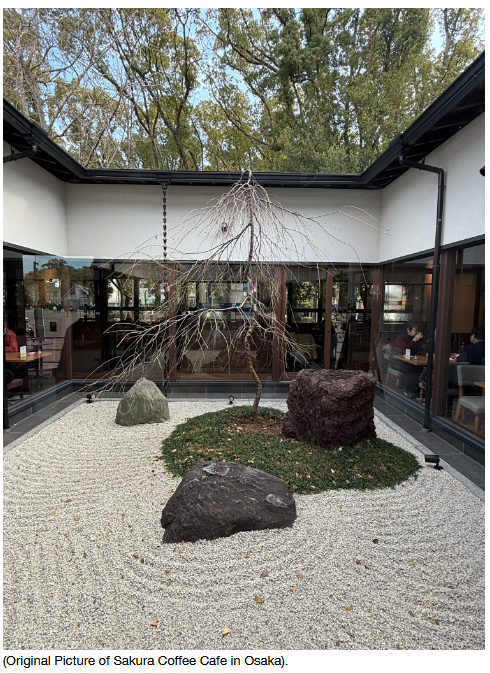
There was a long queue to enter Sakura Coffee. I wrote my name on the waiting list and began observing the café. The café was built around a cherry tree standing in a square. From the entrance, I could see the famous and sacred cherry tree clearly. It was the end of February. Spring had not yet started, and the tree stood completely bare, without a single leaf, only brown stems and branches. To be honest, I felt disappointed on seeing the tree. It looked quite ugly, and I wondered why the café was so crowded before the cherry blossom season.
The café was constructed around the tree and enclosed with glass. Seating was arranged close to the glass so visitors could observe the tree from a very close distance. Other tables were placed in the middle and at the far end of the café for the same viewing purpose. After waiting for about an hour, the café manager announced my name. I asked if I could get a table near the glass window. She replied that I would have to wait for another two hours for such a table. I agreed to take a table in the middle of the café.
“Oh wow, how do you know about Sakura Hanami?” The waitress asked the question with delight in return to my query, her face glowing with a wide smile.
“I try to learn more and more about Japanese philosophies of life and work through books, discussions, and traveling in your country. I have learned about Ikigai, Ichigo Ichie, and Wabi Sabi. Interestingly, I came to Osaka for corporate management training on tools like Kaizen, Gemba, Kanban, Hoshin Kanri, and many others. I even noticed Kintsugi on the cup of coffee you just brought with my Americano coffee. Kintsugi is a Japanese art of repairing broken pottery. It celebrates imperfections and embraces flaws as part of an object’s history, which applies beautifully to human life as well.”
The waitress was delighted by my detailed response and pleasantly surprised by my understanding of Japanese culture. “I am really glad to hear about your interest in our culture,” she said. “Yesterday, the veterans of Sakura Hanami gathered and estimated that Sakura Hanami may begin on 9th March.”
“Oh, I am leaving Osaka next week, so I may not witness the sacred event of Sakura Hanami,” I said with a sense of quiet grief.
“If you are interested, I can arrange a meeting with one of the veterans of our town who is an expert on Sakura Hanami. He can tell you more about this ritual and its philosophy. He is sitting next to the glass window near the Sakura tree, but I will need to ask his permission first.”
I finished my coffee while she approached the man. She returned with a wide smile that clearly showed his positive response. Takahiro Yuki appeared to be in his seventies, though he was still actively working as a manager in a manufacturing unit. In Japan, people rarely retire early. He was considered one of the experts on Sakura Hanami.
“Sakura has great significance in our culture,” he began with a gentle smile. “It appears in Japanese poetry, paintings, and even in modern popular culture. Sakura trees symbolize peace, friendship, and diplomacy. In our town, we expect Sakura Hanami to begin on 9th March this year. Sakura Hanami is associated with several concepts of Japanese culture.”
“Could you please give me some examples of these ideologies?” I asked with curiosity.
“Sakura Hanami is a symbol of hope,” he explained. “It teaches that life will always give you another chance to become beautiful, even if you appear ugly like this barren cherry tree at the moment. This tree looks unattractive now, but it will blossom soon and become a magnificent sight. Sakura Hanami reminds us that no matter how much we lose, life eventually gives us another opportunity to bloom.”
“After some time, the same tree will again become a normal green tree once the flowers fall. Sakura Hanami reflects the Samurai concept, in which warriors believed that life should not be long but purposeful and beautiful. Cherry flowers have a short lifespan, but they fulfill their purpose before ending their life.”
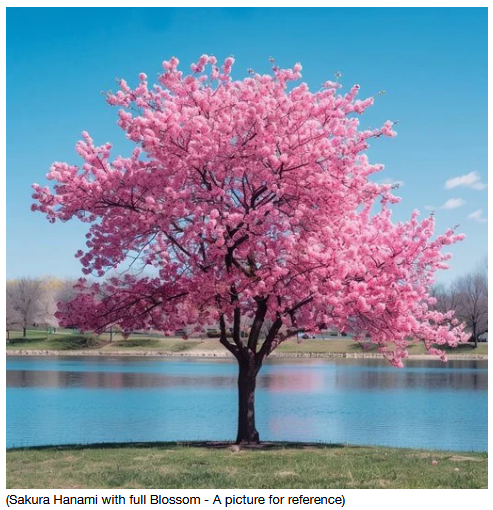
“Sakura Hanami also conveys the idea of impermanence. Nothing in life is permanent. Today, Sakura looks ugly, and in March it will be incredibly beautiful. Both stages are temporary. Life keeps changing its state, and Sakura Hanami teaches us to accept this truth and make peace with it.”
I listened with complete attention as he continued. “Sakura Hanami also provides the idea of Wabi Sabi. We come daily to appreciate even this tree without flowers or leaves. Wabi Sabi teaches us to understand beauty in imperfection. It helps us accept flaws and transience in life, relationships, and objects.”
“Sakura Hanami is also associated with Oubaitori, which means that each tree has its own time to blossom. Cherry, plum, peach, and apricot trees bloom at their own time. When cherry blossoms bloom, it does not mean that plum trees should feel distressed. Sakura Hanami encourages individuals to follow their own path without comparing themselves to others.”
“Wow, Sakura Hanami is such a deep concept,” I said with amazement. “I never knew this.”
“One of my most favorite concepts related to Sakura Hanami,” Takahiro said with a warm smile, “is that it provides happiness to the sense of my sight.”
“I do not fully understand this concept of happiness of the senses,” I replied. “Happiness is usually associated with the body, mind, or intellect, isn’t it? “
“I will explain it to you in detail,” he said as he leaned slightly toward me. “Let us talk about our five major senses: sight, hearing, taste, touch, and smell. All five of these major senses, along with other secondary senses, are used by our body and mind like servants working twenty four hours a day. Our body uses these senses as tools for survival instincts, while our mind uses them for reward seeking. They never truly get any rest from their tireless work.”
“Survival is the most basic instinct of the human body. For example, when you enter a room, you may immediately notice an unusual smell that the people already present in the room do not notice. This happens because when you enter a new space, your body uses the reptilian brain to scan the environment for danger. Different smells send alert signals to your intellect to stay cautious. Once you understand the source of the smell, your sense of smell stops sending warning signals and you become accustomed to it.”
“If someone touches you unexpectedly, you react instantly by jumping or shouting. You may giggle when someone else touches you, but you feel nothing when you touch yourself. This happens because your body constantly uses the sense of touch to protect you from danger. You immediately spit out bitter or spoiled food. Even a small sound can disturb your sleep, as your body continues scanning for danger even while sleeping.”
“You remember the Tom and Jerry cartoons,” he said with a smile. “Why did Jerry always win? Tom was always struggling for food, but Jerry was always focused on survival .” We laughed heartily at his analogy.
“Your mind always uses your senses to create reward pathways. A cue or trigger creates craving or desire, which converts into a reward when the response to that craving is executed. The mind uses all five senses to create these triggers. If you start liking a Porsche car, your sense of sight will keep noticing the same Porsche cars on the streets. In this way, the mind uses senses to create its own reward loop.”
“The important point is that senses work for the body and mind around the clock. But what about their Work-Life balance?. Here comes the responsibility of the intellect. It is the duty of the prefrontal cortex, the thinking part of the brain, to manage rest for the senses and give them Happiness through some novelty, newness and freshness.”
“Happiness of the sense of taste is to try new food for the taste buds. Happiness of smell is to experience new fragrances of flowers. Give happiness to your sense of hearing by listening to a new song or the sound of water flowing from a stream in a dense jungle. You can try a new gadget or a luxury experience that allows your senses to enhance their experience together. Happiness of sight is to see something new or refreshing, such as a beautiful landscape while traveling, watching a movie, or enjoying the beautiful view of cherry blossoms during Sakura Hanami.”
“Senses begin to dull and fade with fewer Active neural circuits, if you do not give them happiness in the form of newness and freshness. Novelty creates new neural pathways. This process is known as neuroplasticity and releases the happiness hormone dopamine. Try focusing on one sense someday. Close your eyes in a garden in the morning and count how many types of birds you can hear. Take a bite of your favorite food and focus only on its taste, this will generate new neural circuits and bring happiness for your Senses.”
“Traditionally, the human tongue was believed to recognize four basic tastes: sweet, like honey or fruits; salty, like salt or soy sauce; sour, like citrus fruits; and bitter, like coffee or dark chocolate. Our Japanese ancestors knew about the fifth taste centuries ago, known as Umami. The modern world later discovered it and called it Savoury. This taste is found in foods such as mushrooms, cheese, and meats. We recognized this fifth taste centuries ago because we focused deeply on the happiness of the sense of taste.”
“Let us do an experiment to create happiness for the sense of taste now,” he said, offering me a piece of dark chocolate. “Take a small bite, focus only on the taste, and observe the many flavors with every chew until you swallow.”
I followed his instructions carefully. With every chew, my sense of taste rejoiced in the novelty. It felt as if my senses were silently thanking me for offering them a moment of awareness, balance, and happiness beneath the silent, waiting Sakura tree.

About Author
Rana Sohail Ahmad
Rana Sohail Ahmad, a multifaceted author, entrepreneur, and philanthropist. With a background in Engineering and Business Administration, he’s the founder and CEO of Four thriving Global companies. Beyond his professional success, Rana is deeply interested in psychology, history, Technology and social sciences. He’s also an avid cyclist, yoga instructor, and health trainer.
However, his most significant endeavor is the Quest of Happiness Foundation (QHF), which he founded to spread happiness and well-being. QHF conducts workshops on happiness, physical health, and career planning, especially for teenagers and university graduates, while also taking part in social initiatives like cleaning and plantation campaigns. Rana Sohail Ahmad’s upcoming book offers a unique blend of personal growth, and social responsibility, all centered around the theme of happiness with scientific and management practices.
I was part of a group of entrepreneurs and executives