By Wajih Ahmad Sheikh
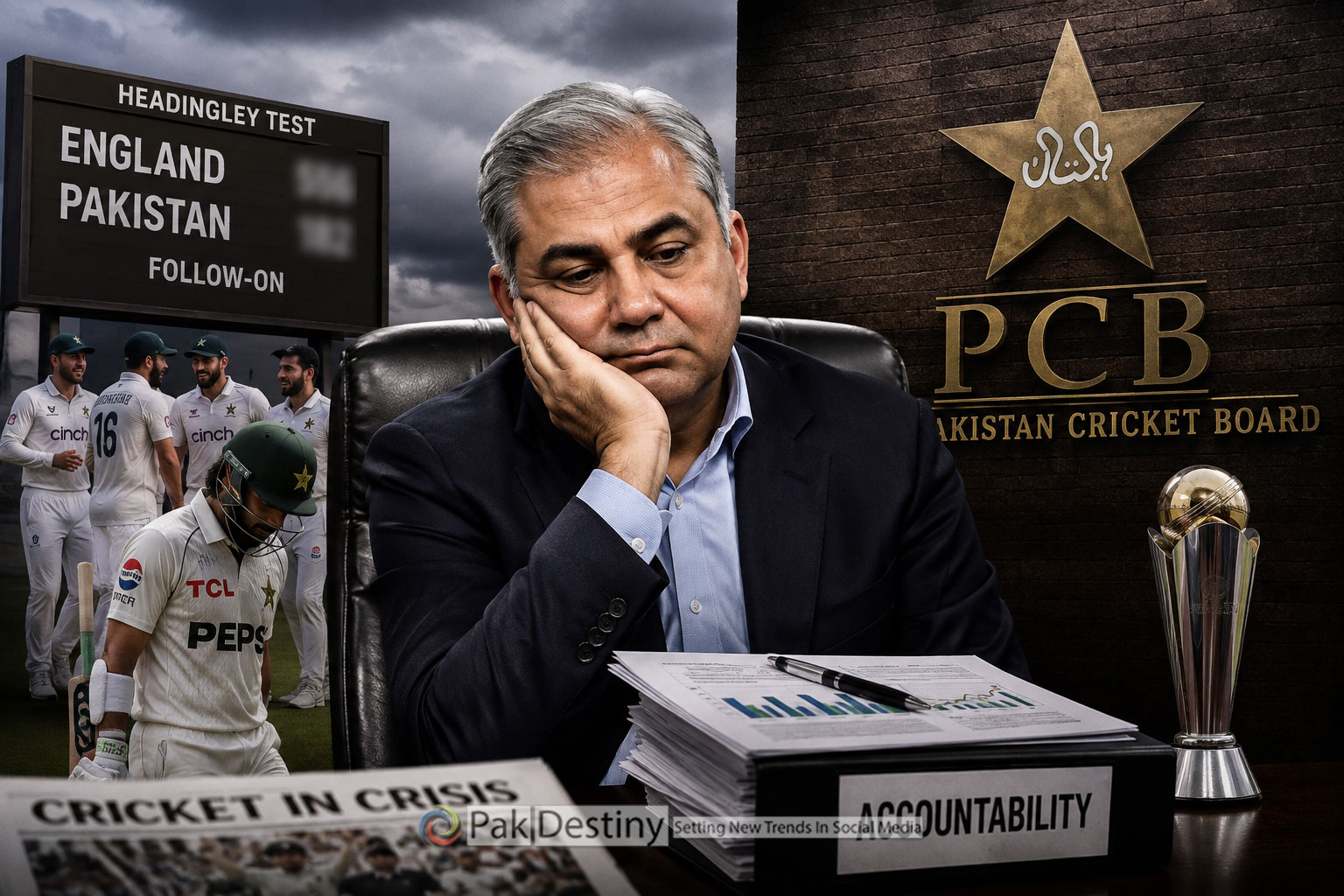
LAHORE:Pakistan’s humiliating defeat at Headingley has exposed something deeper than a bad Test match: the widening gap between Pakistan’s cricketing ambitions and the quality of its cricket administration.
England crushed Pakistan by an innings and 103 runs in the first Test, wrapping up the match inside three days. Pakistan were dismissed for 171 in their first innings and 135 in the second, while England piled up 409. The result was not merely a defeat; it was a comprehensive examination in batting technique, bowling quality, fielding standards, game awareness and leadership — and Pakistan failed almost every test.
The humiliation is particularly painful because England themselves are undergoing a transition. Joe Root has returned as captain following Ben Stokes’ retirement, while Brendon McCullum has left the red-ball coaching role. Yet it was England, not Pakistan, who looked like the settled side. Root’s leadership was composed, England’s fast bowlers were disciplined and their batting showed considerably greater application.
A batting collapse that cannot be blamed on conditions
Pakistan’s first-innings 171 was a warning. The second innings, 135, made it a crisis.
Abdullah Shafique’s 61 was one of the few positives, but England’s seamers repeatedly exposed Pakistan’s technical weaknesses. Ollie Robinson and Josh Tongue were able to extract wickets through movement, accuracy and intelligent changes of length. Jofra Archer also made crucial breakthroughs. England eventually took all 20 Pakistani wickets with pace bowling.
This is not simply a case of Pakistani batsmen being unable to handle English conditions. Test cricket demands that professional batsmen adapt. The more disturbing issue is that Pakistan appeared to have no convincing counter-strategy once England’s attack began to exploit their weaknesses.
The second innings was particularly damning. A team following on needs to demonstrate resistance, occupy the crease and force the opposition to work for victory. Pakistan instead surrendered in only 37.3 overs.
The bowling attack was equally troubling:
Pakistan’s attack was supposed to be one of its strengths. At Headingley, however, England’s batsmen were allowed to establish control far too easily.
There was one notable exception: debutant left-arm spinner Ali Usman, who claimed five wickets for 92. But even that performance highlights the problem. England scored 409 despite the spinner’s five-wicket haul, while Pakistan’s specialist seamers failed to provide sustained pressure.
A touring attack cannot afford to be lightweight at Headingley. The conditions offered opportunities for quality seam bowling, yet England’s bowlers exploited them much more effectively than Pakistan did.
Fielding: the old Pakistan problem has returned
Perhaps the most frustrating aspect was the fielding.
Harry Brook was dropped early and went on to score 91. That mistake proved costly as England turned a precarious position into a commanding first-innings lead.
At international level, dropped catches are not isolated incidents. They are manifestations of preparation, concentration and standards. England were sharper in the field, and that difference was visible throughout the match.
Pakistan cannot continue to talk about fitness and professionalism while producing performances in which basic fielding standards collapse under pressure.
The real question: where is the system?
This is where Mohsin Naqvi, as PCB chairman, inevitably comes under scrutiny.
It would be unfair to hold Naqvi personally responsible for every dropped catch, poor shot or bad bowling spell. The chairman does not bat, bowl or select every delivery. The immediate responsibility belongs to the players, coaches, captain and selection structure.
But the chairman is responsible for the system that produces those people.
And that is where Naqvi’s record deserves a much harder examination.
When Naqvi took charge in February 2024, he promised major surgery after Pakistan’s disastrous T20 World Cup campaign. He reorganised the selection committee and repeatedly spoke about improving professionalism, fitness, infrastructure and accountability.
More than two years later, the question is simple: where is the cricketing transformation promised by that surgery?
The national team remains vulnerable to dramatic collapses. Leadership has repeatedly changed. Coaching structures have been unstable. Selection policies have often appeared reactive rather than strategic. Pakistan’s Test cricket, in particular, does not look like a format receiving the long-term planning it requires.
Pakistan were already near the bottom of the World Test Championship table before the England series, and the Headingley defeat has further damaged their position.
Naqvi’s defence: not everything has failed
A fair assessment must also acknowledge what Naqvi has done well.
The redevelopment of Pakistan’s major cricket stadiums was a substantial administrative undertaking. The PCB invested heavily in upgrading Gaddafi Stadium, the National Stadium Karachi and the Rawalpindi venue ahead of the Champions Trophy.
The PSL has also expanded, with the 2026 edition featuring eight franchises. The board’s commercial ambitions and infrastructure drive show that Naqvi has not been inactive.
Financially and administratively, there are also indicators of progress. The PCB has reported strong financial results and has continued to expand the commercial footprint of the PSL.
But stadiums do not win Test matches.
Nor does a healthy balance sheet compensate for a dysfunctional talent-development pipeline.
That is the central criticism of Naqvi’s tenure: the visible administrative projects appear to have progressed faster than the cricketing product itself.
Too much attention on events, too little on Test cricket?
There is another structural concern.
Pakistan cricket has increasingly become obsessed with tournaments, ceremonies, stadium projects, political symbolism and the PSL. All of these matter. But Test cricket is the ultimate measure of a cricket system’s depth.
A country that produces world-class Test cricketers needs strong domestic first-class cricket, specialist coaching, proper A-team pathways, scientific workload management and continuity in selection.
Instead, Pakistan continues to search for quick solutions after every embarrassing defeat.
Naqvi himself used the phrase “major surgery” in 2024. The danger now is that Pakistan’s cricket administration has become trapped in a cycle of announcing surgery rather than completing rehabilitation.
The chairman cannot hide behind the players
Naqvi may reasonably argue that he did not make the 135 all out.
But that argument has a limit.
A PCB chairman cannot be blamed for an individual failure, but he can be questioned about repeated systemic failures. If the same problems continue across different captains, coaches and groups of players, the issue eventually moves beyond individual cricketers.
It becomes institutional.
That is why Headingley should be treated as a report card on the entire Pakistan cricket structure.
And the grade, at least in Test cricket, is poor.
What should happen now?
The answer is not another emotional purge.
Pakistan needs stability — but stability with accountability.
The PCB should establish a clearly defined red-ball strategy for the next three years. The first-class system must be strengthened, specialist Test batsmen and bowlers must be identified early, and the Pakistan Shaheens pathway should be directly connected to the national Test side.
Selection must also become more transparent and evidence-based. Players should know why they are selected, why they are dropped and what performance benchmarks are expected.
Most importantly, Pakistan needs to stop treating every defeat as a crisis requiring a new captain, coach or committee.
The next two Tests at Lord’s and Edgbaston will show whether Headingley was an isolated humiliation or another chapter in Pakistan cricket’s continuing decline.

About the author: Wajih Ahmad Sheikh is a senior journalist associated with DAWN with more than two decades.
He writes on sports for digital platforms. He is found on X @wajihsheikh
He can be reached at [email protected]