By Shehar Bano Khan
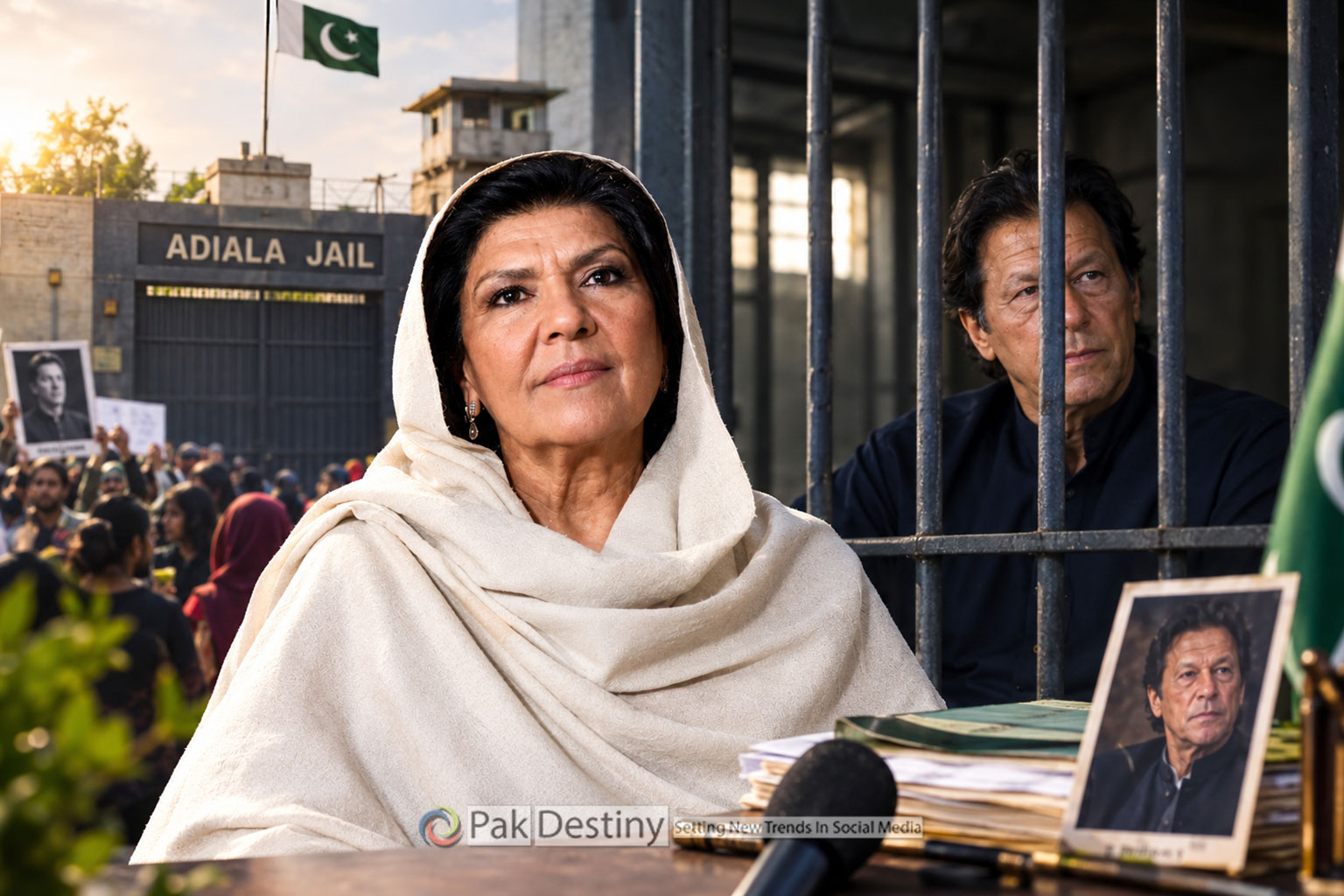
Incarcerated at the Adiala Jail in Rawalpindi, the former prime minister of Pakistan, Imran Khan, had become an intractable issue for the government of Pakistan.
Despite constant delegitimisation, the political doctrine of Imran Khan remained unhedged, primarily by a woman ‘outside’ the jail who had taken little time to reconfigure into an isomorphic threat to the state.
The government’s tunnel vision to obliviate Imran Khan had left it unprepared for a woman not willing to surrender to the state propaganda of turning her brother into a political pariah. Aleema Khan, the younger sister of Imran Khan, had evolved as his political isomorph. And rightfully so!
She spoke with the same candour as her brother. Valiantly defended his political doctrine of accountability and justice. Refused the use of metaphorical language to name those responsible for her brother’s imprisonment. For her, like her brother, there were no grey areas. She faced the media with the same unfazed authority her jailed brother once had in the not-too-distant past. If a journalist overstepped their protocol by launching a curveball, Aleema Khan’s stoic response without fail set the remit for the press.
If Aleema Khan had set the remit of the press, the same could not be applied to the Pakistan Tehreek i Insaf which considered itself exempt from her authority, exposing the deep rift between Imran Khan’s family members and the operational wing of the party. Guarded insinuations among some PTI members abounded, accusing Imran Khan’s sister of shadow whipping the party without any mandate. These murmurings were read by Ms Khan as no more than canards to cover up a tactical – rather than strategic – approach to free Imran Khan. Ironically, the not-so-delicate innuendoes had provided leverage to critics against Ms Khan, who, in any case, regarded them as a spin-off of the government’s propaganda against her.
Accusations of commandeering the party in the absence of her brother, in fact, exposed the party’s policy void in not being able to secure its leader’s release from jail. Instead of mobilising Imran Khan’s family as a coordinated front to galvanise public support for his release, twisting it into hereditary politics diluted the objective.
For Aleema Khan, her unwillingness to cede to government pressure to become less vocal was not an attempt at taking a political maximalist position, instead it was anchored in her faith in her brother’s ideological purity. On the other side of the spectrum was the party itself, wavering between a hard and a soft stance towards the establishment with invariable inconsistency. The PTI leadership appeared vocally critical one day, only to become functionally desultory the next.
It took an even more embarrassing turn when the party members showed their political insecurity by fearing a dynastic takeover. Mr Ali Muhammad, a PTI member of the National Assembly, questioned Aleema Khan’s role in addressing the media, following her meetings with her jailed brother to convey his ‘undiluted’ message to the public. Ali Muhammad, known for his theatrical display of grandiloquence in the National Assembly, perhaps felt redundant and decided to take a jibe at Ms Khan by invoking Imran Khan’s foundational philosophy of merit-based politics. “There’s no place for dynastic politics in the PTI,” Mr Ali Muhammad expressed to various media outlets.
Essentially, there should have been no place for dynastic politics, certainly not in the context of colonisation of Pakistan by dynasties. But Aleema Khan neither held a position in the party nor was she an elected member of any legislative body. That gave her a unique apolitical position of agitating and demanding her brother’s release without the critique and political responsibility surrounding the party officials. The fragmented party was concentrating more on pigeonholing Aleema Khan than on drafting a viable stratagem to negotiate their leader’s release.
On August 27, 2024, The News, a local daily English language newspaper quoted Ms Khan who categorically denied any intentions of joining politics. “We have no time for politics. Imran is our leader and brother…. and we will stand by him,” said Ms Khan.
Why could the PTI not accept Imran Khan’s family as another tier of opposition to the establishment? Why was the family’s intervention viewed as an indictment on the party by the PTI officials?
The dissensions were being played out in full view of the public who failed to understand the party’s senior leadership’s unwarranted broadside against the family. Aleema Khan’s reservations about certain party leaders playing into the hands of the establishment could not be outrightly rejected, not when a major rally scheduled to be held on August 22, 2024 at Tarnol, nearly 5 kms northwest of Islamabad, was cancelled after the government revoked its no-objection certificate to the party. Aleema Khan not only publicly criticised the decision to postpone, but also questioned why Mr Azam Swati, a senior PTI leader, had gone to meet Imran Khan at Adiala to request a rescheduling of the rally.
The rally eventually took place on September 8, 2024, in Sangjani, a suburb in the western part of Islamabad, but the seeds of discord between Ms Khan and the PTI were already sown. It seemed that her brother and the leader were two different people. While the senior party leadership ostensibly stood behind its leader, it was not willing to be subjected to Aleema Khan’s interrogation.
A familiar personality trait was emerging in Aleema Khan. Echoing her brother’s approach of not yielding to pressure tactics, verbal or otherwise, Ms Khan held her own media audience outside the Adiala Jail after the weekly meetings with her brother. Her words were unstilted, unfiltered – often verbatim as expressed by the jailed leader of the PTI. Her forthrightness did not go down well with the senior leadership, who felt exposed to the unnecessary scrutiny of the media and the PTI workers.
For the establishment, the danger of Aleema Khan was twofold: pushing Imran Khan into oblivion was next to impossible, not when his sister spoke with the same brutal candour. Secondly, Ms Khan was unmanageable, unlike the Gandapurs, the Marwats, the Mashal Yousufzais and several others purportedly preferring a non-confrontational stance against the establishment.
In December 2025, Imran Khan was placed in solitary confinement and denied access to his family and legal counsel. The establishment believed solitary confinement would weaken Aleema Khan’s role as a messenger. A severance of contact would automatically abort the relay of messages, thereby making Ms Khan redundant.
When news of Imran Khan’s visual impairment, caused by Central Retinal Vein Occlusion (CRVO), hit the country, the party and his family were confident about the end of his isolation.
The isolation and the solitary confinement continued. The party was not allowed to see Imran Khan. His lawyers were not given access to him. Each week, his family kept waiting outside the Adiala Jail for hours and each time they were turned away.
After nearly two years of facing the establishment and the senior PTI leadership, Ms Khan came up with a definitive conclusion. Her brother and the jailed leader were bifurcated as two different entities by the party. The insecurity, leading to accusations of assuming a political position within the PTI, was untenable. Both the government and some PTI office bearers did not want Aleema Khan, whose integrity in the eyes of the PTI electorate was unimpeachable, to become Imran Khan’s focal person.
She decided to hedge her bets and publicly declared what her brother had conveyed to her. “Those unable to carry the burden of the movement should step aside,” proclaimed Ms Khan.
In July 2026, Aleema Khan embarked on a whirlwind tour of Khyber Pukhtunkhwa, the official centre of PTI’s power, to garner support for the release and medical treatment of her brother. The tour was a run up to the September 27, 2026 rally initially announced by the PTI leadership and later postponed to October 4, 2026.
Her unprecedented welcome left many uncomfortable, not least from among the party whose primary preoccupation was focussed on reassuring the establishment that the Long March was not intended to ‘conquer Islamabad’.
Mr Gohar Ali Khan, PTI’s chairman’s conciliatory approach contrasted sharply with Ms Khan’s categorical non-appeasement stance. “The party had no intention of ‘conquering’ Islamabad and would deploy no state or provincial resources, and would not attempt to storm the gates of Adiala Jail,” stated Mr Gohar Ali Khan.
The establishment’s patience was bursting at the seams. All deployments against Mr Imran Khan were systematically dismantled by his sister whose style and political ethos were identical to those of her brother.
It was time to move against Ms Aleema Khan.
On September 20, 2026, Aleema Khan was arrested on the orders of Lahore’s deputy commissioner, Mr Muhammad Ali Ijaz, under the Maintenance of Public Ordinance for thirty days. The rationale adopted against Ms Aleema Khan was, the ‘mobilisation of Imran Khan’s supporters through use of social media and public gatherings’.
The October 4, 2026 Long March collapsed, leading to the imposition of the Governor’s rule in Khyber Pukhtunkhwa. Aleema Khan’s arrest, along with her two sisters, was mentioned in passing by the PTI leadership, not vehemently and not forcefully. The media gallery, set up by Aleema Khan outside the Adiala Jail, was vacant, silencing the echoes of Imran Khan rising from behind the high walls, for the moment.
About Author : Shehar Bano Khan is primarily a journalist, specialising political analyses and Gender Studies. She has worked as a journalist in the local media organisations and a gender specialist in international organisations.