
By Dr. Syed Imran Ahmad Shah
Abstract
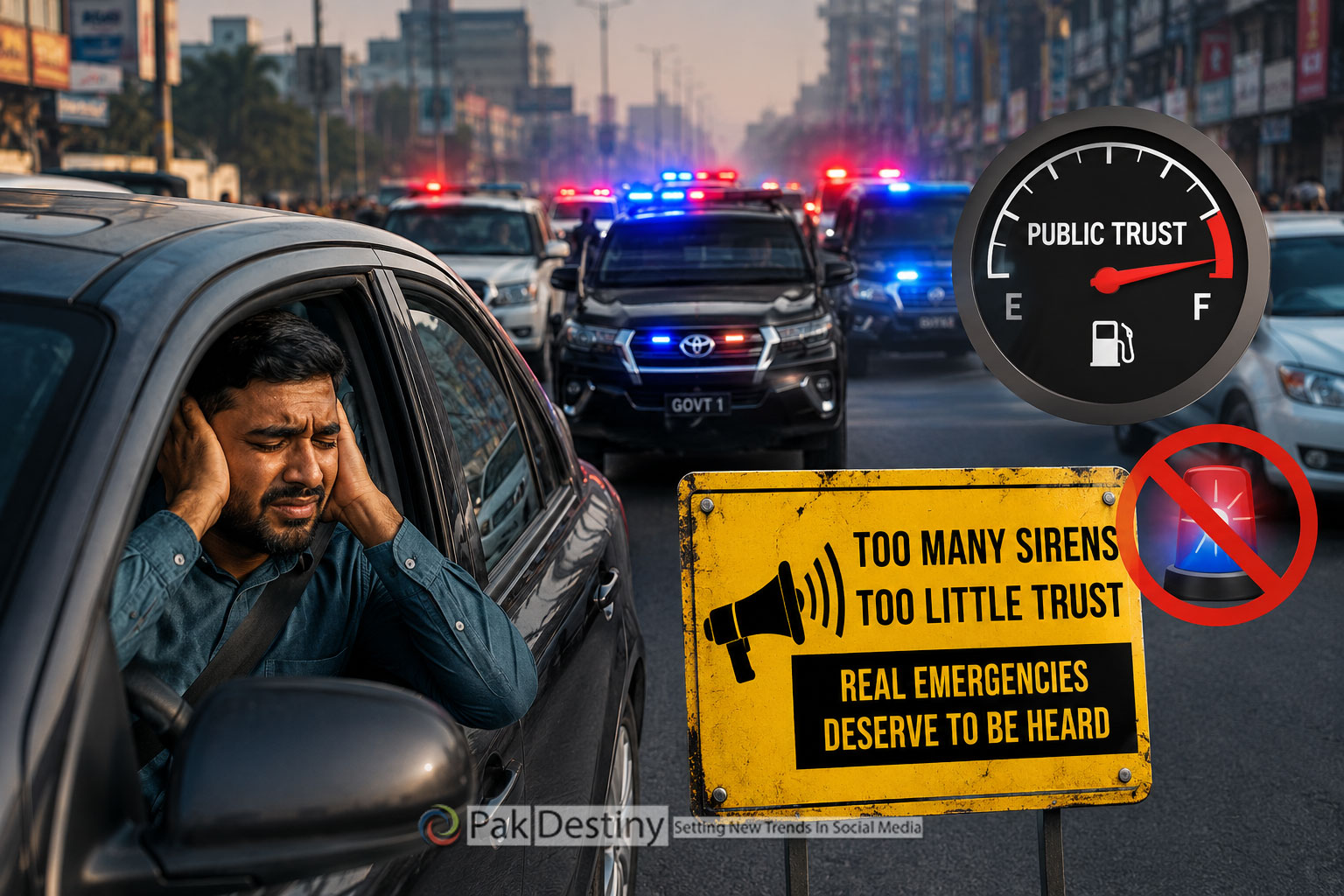
Emergency vehicle sirens are among society’s most critical public warning systems. Their effectiveness depends not merely on their loudness but on the public’s confidence that every siren signals a genuine emergency. However, in many developing countries, including Pakistan, the unnecessary use of sirens and pressure horns by certain official vehicles has become increasingly common. Such practices risk desensitizing road users, diminishing public trust, increasing environmental noise, and weakening compliance during genuine emergencies.
Drawing upon Habituation Theory, Signal Detection Theory, Social Learning Theory, Risk Communication Theory, and Deterrence Theory, this article explores how excessive or unjustified siren use can gradually reduce the effectiveness of emergency response systems. International case studies demonstrate that many countries regulate siren use through strict legislation, accountability mechanisms, and driver training. The article concludes by recommending evidence-based reforms aimed at restoring the credibility of emergency warning systems in Pakistan.
Introduction
Imagine a peaceful evening outside a school where children are attending classes or examinations. Suddenly, a government vehicle passes with its siren blaring despite an almost empty road. A few hours later, another official convoy activates pressure horns through a residential neighborhood after midnight. Residents wake abruptly, children become frightened, elderly patients experience distress, and drivers instinctively pull aside. Yet, no visible emergency exists.
Unfortunately, such scenes have become increasingly familiar in many urban centers across Pakistan.
Sirens were never designed as symbols of authority or administrative privilege. They were created to save lives by alerting the public that an ambulance, fire engine, rescue service, or law enforcement agency is responding to an emergency where every second matters.
Their effectiveness relies on one fundamental principle:
People must believe that every siren represents a genuine emergency.
Once that belief weakens, the warning system itself begins to fail.
This issue extends far beyond traffic management. It is fundamentally about public communication, behavioral psychology, and institutional credibility.
Communication scholars have long argued that the effectiveness of warning systems depends not only on technological capability but also on public trust. A warning loses value when people no longer perceive it as meaningful.
Emergency sirens are no exception.
Every unnecessary activation slightly weakens the psychological association between the siren and imminent danger.
Over time, drivers become accustomed to hearing warning devices during non-emergency situations. Consequently, when an ambulance transporting a cardiac patient or a rescue vehicle responding to a major accident approaches, some road users may hesitate before yielding because previous experiences have taught them that not every siren reflects a real emergency.
Although such hesitation may last only a few seconds, emergency medicine consistently recognizes that seconds often determine survival.
Consequently, preserving the integrity of emergency warning systems should be viewed as a matter of public safety rather than administrative discipline alone.
Understanding Sirens as Public Communication
Most people consider sirens purely as mechanical warning devices. In reality, they represent one of society’s oldest and most effective forms of non-verbal communication.
Unlike verbal messages, sirens communicate urgency instantly without requiring language, literacy, or explanation.
Communication researchers describe these as high-priority warning signals, designed to interrupt ordinary behavior and produce immediate action.
Every emergency warning system depends upon three essential components:
- Credibility
- Consistency
- Urgency
If any one of these elements deteriorates, public compliance declines.
Risk communication literature consistently emphasizes that warnings must remain rare enough to retain meaning. Frequent false alarms or unnecessary alerts gradually reduce compliance, a phenomenon observed in emergency management, disaster response, and transportation safety.
This phenomenon is equally applicable to road traffic.
Habituation Theory: When the Brain Stops Listening
One of the strongest explanations for declining public responsiveness is Habituation Theory, first described in experimental psychology by Thompson and Spencer (1966).
Habituation refers to the gradual reduction in behavioral response following repeated exposure to the same stimulus without significant consequences.
Simply stated:
The brain learns to ignore signals that repeatedly fail to predict important events.
This adaptive process helps humans filter unnecessary information from their environment.
For example, individuals living near railway tracks eventually stop noticing passing trains. Residents near airports often become less aware of aircraft noise over time.
The same psychological mechanism applies to emergency sirens.
If drivers repeatedly encounter official vehicles using sirens without apparent emergencies, their brains gradually classify these sounds as ordinary background events rather than urgent warnings.
The danger is subtle but significant.
When a truly life-threatening emergency occurs, public response may be slower because previous experiences have weakened the perceived urgency of the signal.
Research on warning systems consistently demonstrates that warning fatigue reduces behavioral compliance across multiple public safety contexts, including disaster alerts, medical alarms, and transportation systems.
Although sirens remain physically loud, their psychological volume decreases.
Sirens as Institutional Trust
Trust represents one of the most valuable assets of any public institution.
Every interaction between citizens and government contributes either to building or weakening that trust.
Emergency sirens symbolize authority because society assumes they are used responsibly.
When citizens repeatedly observe warning devices activated merely to bypass traffic congestion, clear intersections unnecessarily, or accelerate official travel, perceptions gradually shift.
Instead of viewing sirens as instruments of public protection, some citizens begin associating them with privilege.
This perception creates an unfortunate communication gap between institutions and the communities they serve.
The issue is therefore not simply about excessive noise.
It concerns preserving the legitimacy of one of society’s most recognizable emergency communication tools.
Signal Detection Theory: When Genuine Emergencies Become Indistinguishable from Routine Events
Beyond habituation, another important explanation comes from Signal Detection Theory (SDT), originally developed by Green and Swets (1966). The theory explains how people distinguish meaningful signals from surrounding background noise under conditions of uncertainty.
In everyday life, drivers constantly process multiple stimuli—traffic lights, vehicle horns, pedestrians, road signs, mobile phone notifications, and environmental sounds. An emergency siren is intended to stand out from this sensory environment because it communicates one message:
“Someone’s life, safety, or security may depend on your immediate response.”
Signal Detection Theory suggests that when a warning signal is used too frequently without genuine necessity, people gradually become less certain whether the signal represents a true emergency or merely another routine occurrence (Green & Swets, 1966).
This phenomenon is known as the “false alarm effect.”
Each unnecessary siren slightly reduces public confidence in future warning signals. Drivers may hesitate before giving way, waiting a few seconds to determine whether the approaching vehicle is actually responding to an emergency.
Those few seconds may appear insignificant.
For emergency medical services, however, they can represent the difference between life and death.
Studies of emergency warning systems consistently emphasize that warning devices must remain credible to ensure rapid public compliance (Wogalter, 2006).
Social Learning Theory: Public Officials as Role Models
Communication is not limited to speeches or media campaigns.
People also learn by observing behavior.
According to Albert Bandura’s Social Learning Theory, individuals imitate behaviors demonstrated by authority figures, particularly when those behaviors appear acceptable or go unchallenged (Bandura, 1977).
Government officials occupy highly visible positions within society.
When official vehicles routinely activate sirens despite the absence of observable emergencies, they unintentionally communicate several messages:
- Rules may be flexible for people in authority.
- Emergency warning devices can be used for convenience.
- Institutional privilege is more important than public discipline.
Such observations gradually influence social norms.
If road users repeatedly witness unnecessary use of emergency equipment, they may become less respectful toward genuine emergency responders.
Similarly, younger drivers who observe this behavior may eventually regard it as acceptable.
Road safety culture develops through daily observation.
Institutions therefore educate not only through formal campaigns but also through their everyday conduct.
Risk Communication Theory: Credibility Determines Compliance
Modern emergency management places enormous emphasis on Risk Communication Theory.
According to Covello (2003), successful warning systems depend upon four essential characteristics:
- Accuracy
- Consistency
- Timeliness
- Credibility
Among these, credibility is perhaps the most fragile.
Once people begin questioning whether warnings are genuine, compliance decreases dramatically.
This principle has been repeatedly demonstrated in disaster management, evacuation planning, tsunami warning systems, wildfire alerts, and public health emergencies.
Emergency sirens function in exactly the same manner.
Every unnecessary activation weakens public confidence.
Eventually, drivers begin evaluating the legitimacy of the warning rather than responding immediately.
Such hesitation undermines the very purpose of emergency communication.
Noise Pollution: An Overlooked Public Health Issue
The consequences of unnecessary sirens extend beyond traffic safety.
Environmental health researchers increasingly recognize noise pollution as a significant public health concern.
According to the World Health Organization (WHO), prolonged exposure to excessive environmental noise contributes to stress, sleep disturbance, cardiovascular disease, reduced concentration, and lower quality of life (WHO, 2018).
The impact is particularly severe for:
- Hospital patients
- Elderly citizens
- Children
- Individuals with autism spectrum disorders
- Students during examinations
- Night-shift workers attempting to sleep
Late-night siren use without operational necessity may therefore impose avoidable psychological and physiological burdens on communities.
Emergency warning devices should protect public health—not unintentionally compromise it.
International Case Studies
United Kingdom
The United Kingdom maintains one of the world’s most regulated emergency driving systems.
Police, ambulance, and fire-service drivers undergo extensive specialist training before being authorized to use emergency warning equipment.
Guidance emphasizes that sirens and blue lights are operational tools—not symbols of official status.
Drivers are expected to activate warning devices only when responding to emergencies requiring immediate progress through traffic.
Departments also conduct internal reviews of emergency driving practices to ensure accountability.
United States
In the United States, policies governing lights and sirens vary among states, but many emergency medical organizations have adopted evidence-based restrictions.
Several ambulance services limit routine use of lights and sirens because research indicates that the reduction in transport time is often modest while crash risk increases substantially.
The National Association of EMS Physicians recommends using emergency warning devices only when expected benefits clearly outweigh the associated risks.
Many EMS agencies therefore encourage careful clinical decision-making rather than automatic siren activation.
Australia
Australian emergency services similarly emphasize proportionality.
Driver education programs stress that warning devices should correspond to operational necessity rather than convenience.
Continuous professional training reinforces safe driving, public confidence, and legal accountability.
Germany
Germany provides perhaps one of the strongest examples of public compliance.
Motorists immediately create the famous “Rettungsgasse” (rescue corridor) when emergency vehicles approach.
This remarkable cooperation is supported by two factors:
- Strong public awareness.
- High public confidence that emergency warning devices are used appropriately.
Trust encourages compliance.
Compliance saves lives.
Japan
Japan combines strict regulation with exceptional civic discipline.
Emergency vehicle operators receive specialized instruction regarding the lawful use of warning devices.
Japanese drivers generally respond quickly because misuse of emergency sirens is comparatively uncommon.
The credibility of the warning signal remains intact.
Lessons for Pakistan
Pakistan has made significant progress in road safety awareness, motorway policing, rescue services, and emergency medical response.
However, preserving the effectiveness of emergency warning systems requires equal attention.
The issue should not be viewed as criticism of any single institution.
Rather, it represents an opportunity for all public organizations to strengthen professionalism, public trust, and operational efficiency.
When warning systems remain credible, every emergency service benefits.
When credibility declines, every emergency responder faces greater difficulty reaching those whose lives depend upon timely assistance.
Deterrence Theory: Rules Matter Only When They Are Enforced
One of the most widely accepted theories in criminology and public administration is Deterrence Theory, which argues that individuals are less likely to engage in undesirable behavior when they believe violations will be detected and followed by fair, consistent consequences (Beccaria, 1764/1986; Gibbs, 1975).
Applied to emergency warning systems, the implication is straightforward: if unauthorized or unnecessary use of sirens carries little or no accountability, misuse may gradually become normalized. Conversely, when institutions establish clear policies, monitor compliance, and respond consistently to violations, professional standards are more likely to be maintained.
The objective should not be punitive. Rather, accountability helps protect the integrity of a life-saving communication tool.
Institutional Trust: A Strategic Public Asset
Public trust is not built solely through speeches, advertisements, or awareness campaigns. It is built through everyday institutional behavior.
Political scientist Francis Fukuyama (1995) describes trust as a form of social capital that enables societies and institutions to function effectively. When citizens consistently observe responsible conduct by public institutions, confidence grows. When they repeatedly observe actions that appear inconsistent with official rules or public expectations, confidence can gradually erode.
Emergency sirens are part of that relationship.
Each justified activation reinforces the message that emergency responders are acting in the public interest. Each unnecessary activation may weaken that perception.
Trust, once diminished, requires considerable time and effort to restore.
Behavioral Economics: Small Changes Can Produce Big Results
Modern public policy increasingly relies on insights from Behavioral Economics, particularly the concept of Nudge Theory introduced by Thaler and Sunstein (2008).
Rather than relying exclusively on punishment, a “nudge” subtly encourages better decision-making.
For emergency vehicle operations, examples include:
- Digital reminders in official vehicles stating: “Activate sirens only during genuine emergencies.”
- Mandatory confirmation in fleet management systems documenting the operational reason for siren use.
- Periodic feedback reports showing drivers how frequently emergency warning devices were activated.
- Recognition programs highlighting exemplary compliance with operational standards.
Such interventions are relatively inexpensive but can significantly improve professional behavior.
Learning from International Practice
Although legal frameworks differ across countries, successful emergency services share several common principles.
Clear Operational Policies
Leading emergency organizations define precisely when warning devices may be activated. These policies reduce ambiguity and help ensure consistent decision-making.
Specialized Driver Training
Emergency driving requires more than vehicle handling skills. It also involves understanding risk perception, communication with road users, legal responsibilities, and ethical decision-making.
Many emergency services therefore require advanced certification before authorizing personnel to operate vehicles under emergency conditions.
Technology-Based Accountability
Fleet management technologies increasingly provide objective data regarding vehicle operations.
Examples include:
- GPS tracking
- Dashboard cameras
- Event data recorders
- Telematics systems
- Vehicle analytics
Rather than monitoring employees for disciplinary purposes alone, these technologies support organizational learning, identify training needs, and improve operational safety.
Why This Matters for Pakistan
Pakistan has made substantial investments in emergency response services over the past two decades. Modern motorway policing, rescue organizations, ambulance services, and disaster management institutions have significantly strengthened national emergency preparedness.
Protecting the credibility of emergency warning systems should become part of that broader modernization process.
The discussion is not about limiting emergency response.
It is about ensuring that every activation of a warning device continues to communicate genuine urgency.
If unnecessary siren use becomes routine, society pays a hidden price:
- Drivers respond more slowly.
- Public confidence weakens.
- Noise pollution increases.
- Genuine emergency responders face greater difficulty reaching those who need immediate assistance.
Ultimately, the greatest beneficiaries of responsible siren use are emergency responders themselves.
A Policy Framework for Responsible Siren Use
A comprehensive national approach could include the following elements:
1. National Standard Operating Procedures
Develop uniform operational guidelines describing circumstances under which sirens and emergency lights should be activated.
2. Specialized Driver Certification
Require periodic certification and refresher training for all personnel authorized to operate emergency vehicles.
Training should include:
- Emergency driving
- Risk communication
- Human factors
- Defensive driving
- Ethical decision-making
- Community relations
3. Periodic Operational Audits
Departments could periodically review emergency vehicle operations to identify trends, recognize good practice, and address areas requiring improvement.
The purpose should be organizational learning rather than routine punishment.
4. Public Awareness Campaigns
Citizens also have responsibilities.
Awareness campaigns should remind motorists that:
- Genuine emergency vehicles deserve immediate right of way.
- Delaying emergency responders can cost lives.
- Responsible cooperation protects the entire community.
When institutions and citizens work together, emergency response becomes significantly more effective.
5. Interagency Coordination
Developing common standards among emergency services, traffic authorities, police organizations, rescue agencies, and transport regulators would promote consistency and reduce confusion.
Discussion
The effectiveness of emergency warning systems depends less on the volume of a siren than on the credibility attached to its sound.
Behavioral science consistently demonstrates that repeated exposure to unnecessary warnings produces habituation. Communication research emphasizes that credibility determines compliance. Public administration literature highlights the importance of institutional trust. Criminology demonstrates the value of consistent accountability.
Together, these disciplines point toward the same conclusion:
Emergency sirens are not merely mechanical devices—they are strategic communication tools whose effectiveness depends upon responsible institutional use.
Reimagining the Siren as a Symbol of Public Trust
Throughout history, societies have relied on warning systems that demand an immediate response. Whether church bells signaling danger, civil defense alarms during wartime, tsunami warning systems, or modern emergency vehicle sirens, the effectiveness of every warning depends on one indispensable element: public trust.
Emergency vehicle sirens represent a social contract between public institutions and citizens. The contract is simple:
“When you hear this sound, someone urgently needs your cooperation because lives, property, or public safety may be at risk.”
The moment this understanding weakens, the warning system itself begins to lose value.
Behavioral psychology, communication studies, transportation research, and public administration all reach the same conclusion: warning signals retain their effectiveness only when they remain credible, purposeful, and consistently associated with genuine emergencies.
This article has examined the issue through multiple theoretical perspectives.
Habituation Theory explains why repeated exposure to unnecessary sirens reduces public responsiveness.
Signal Detection Theory illustrates how excessive false alarms make it more difficult for citizens to distinguish genuine emergencies from routine situations.
Social Learning Theory demonstrates that institutional behavior shapes public norms and expectations.
Risk Communication Theory emphasizes that credibility is the foundation of every successful warning system.
Deterrence Theory reminds policymakers that professional standards require consistent accountability.
Together, these theories converge on one important insight:
The effectiveness of an emergency siren depends far more on public confidence than on its volume.
The Human Cost of Desensitization
When discussions about siren misuse occur, they often focus on inconvenience or excessive noise.
The issue is much deeper.
Imagine an ambulance transporting a child with severe trauma.
Imagine firefighters responding to a rapidly spreading residential fire.
Imagine rescue personnel rushing to a motorway crash where victims remain trapped inside damaged vehicles.
If even a small proportion of drivers hesitate because previous experience has conditioned them to believe that sirens are frequently used without urgency, precious time may be lost.
Emergency medicine consistently recognizes the importance of the “golden hour,” while trauma and cardiac care frequently depend upon interventions delivered within minutes.
Every unnecessary siren therefore carries an invisible opportunity cost.
It may reduce the effectiveness of the next genuine emergency response.
Sirens Should Inspire Cooperation—Not Fear
Another overlooked dimension is the emotional impact of unnecessary warning devices.
Late-night sirens in residential neighborhoods disturb families.
Children may become frightened.
Hospital patients may experience interrupted sleep.
Older adults and individuals with anxiety disorders may experience unnecessary psychological stress.
Educational institutions, libraries, and examination centers require environments conducive to concentration and learning.
Emergency warning systems should therefore balance operational necessity with community well-being.
Responsible use strengthens respect.
Excessive use risks creating annoyance instead of cooperation.
Recommendations for Pakistan
A comprehensive national framework could include the following measures:
Policy and Regulation
- Develop uniform national guidelines defining when sirens and emergency lights may be used.
- Review existing legislation to ensure consistency across emergency services.
- Clearly distinguish between emergency response and administrative travel.
Professional Training
- Introduce mandatory certification for drivers of emergency and official vehicles.
- Include modules on communication psychology, public trust, ethics, and road-user behavior.
- Conduct regular refresher courses based on international best practices.
Technology and Monitoring
- Install telematics systems and dashboard cameras in government fleets.
- Use operational data for quality improvement and training.
- Conduct periodic audits to identify patterns of siren activation.
Institutional Accountability
- Encourage internal reporting and supervisory review.
- Reward departments that demonstrate exemplary compliance.
- Address misuse through transparent and proportionate administrative measures.
Public Awareness
- Launch campaigns reminding motorists of their legal and moral responsibility to yield to genuine emergency vehicles.
- Educate citizens about the purpose of emergency warning devices.
- Promote mutual respect between emergency responders and the public.
Research and Evaluation
- Universities, transportation authorities, and emergency services should collaborate on empirical research examining:
- Public response times.
- Driver perceptions.
- Community attitudes toward siren use.
- Operational outcomes.
- Noise exposure around hospitals, schools, and residential areas.
Evidence-based policymaking will ensure that future reforms are guided by data rather than assumptions.
Conclusion
Emergency warning systems are among the few communication tools capable of influencing thousands of people simultaneously within seconds.
Their power lies not merely in sound.
Their power lies in credibility.
Every justified use reinforces public confidence.
Every unnecessary use weakens it.
Pakistan has made remarkable progress in road infrastructure, emergency medical services, motorway policing, rescue operations, and disaster management. The next stage of progress should focus on preserving the credibility of emergency communication systems.
Responsible use of sirens is not simply an operational issue.
It is an investment in public trust.
It is an investment in road safety.
Most importantly, it is an investment in saving lives.
References
Bandura, A. (1977). Social Learning Theory. Prentice Hall.
Beccaria, C. (1986). On Crimes and Punishments. Macmillan. (Original work published 1764).
Covello, V. T. (2003). Best practices in public health risk and crisis communication. Journal of Health Communication, 8(S1), 5–8.
Fukuyama, F. (1995). Trust: The Social Virtues and the Creation of Prosperity. Free Press.
Gibbs, J. P. (1975). Crime, Punishment, and Deterrence. Elsevier.
Green, D. M., & Swets, J. A. (1966). Signal Detection Theory and Psychophysics. Wiley.
Thaler, R. H., & Sunstein, C. R. (2008). Nudge: Improving Decisions About Health, Wealth, and Happiness. Yale University Press.
Thompson, R. F., & Spencer, W. A. (1966). Habituation: A model phenomenon for the study of neuronal substrates of behavior. Psychological Review, 73(1), 16–43.
Wogalter, M. S. (Ed.). (2006). Handbook of Warnings. Lawrence Erlbaum Associates.
World Health Organization. (2018). Environmental Noise Guidelines for the European Region.
By Dr. Syed Imran Ahmad Shah
PhD (Media Studies)
Former Research Fellow, Michigan State University, USA
Public Relations Professional and Researcher