By: – Marib Noor Sajid, Surahbeel Bokhari, Nadia Ejaz
Unless the right opportunities are availed, the future of the country will be decided by the choices of today. To achieve any real progress, education has to result in meaningful employment, dignity and purpose. This is a grave problem that Pakistan is grappling with: the number of students completing their studies annually is in thousands, yet there is scarcity of employment opportunities out there. This is a loophole that is leading to increased unemployment and underemployment in educated young people. Though it takes years of effort, not all graduates get stable jobs. The number of jobs in the job market is not growing at the desired rate to absorb them and the youth have no idea of what to expect next. To solve this, the government and the business sector should come up to create opportunities. Education does not suffice; graduates require productive work in order to use their abilities. Otherwise, this problem might have an impact on the future development of the country.
The imbalance number of jobs and graduates is the essence of the problem. Universities are witnessing an unprecedented number of people because a degree is perceived to assure success. Job creation has however not been in tandem with this growth. Consequently, the graduates find themselves in a saturated job market with lots of competition and scarce opportunities of getting good jobs hence it is not easy to get stable jobs.
The issue of unemployment among the youths is on the rise in Pakistan. In 2024, approximately 9.8% of young people were unemployed, and the situation is not easy. Numerous degree graduates, particularly between the ages of 15 and 29 years, find it difficult to secure appropriate employment. This indicates that there is more to it in the economy that is not creating quality jobs to its educated populace. The increasing rate of unemployed graduates points to structural flaws which should be addressed immediately.
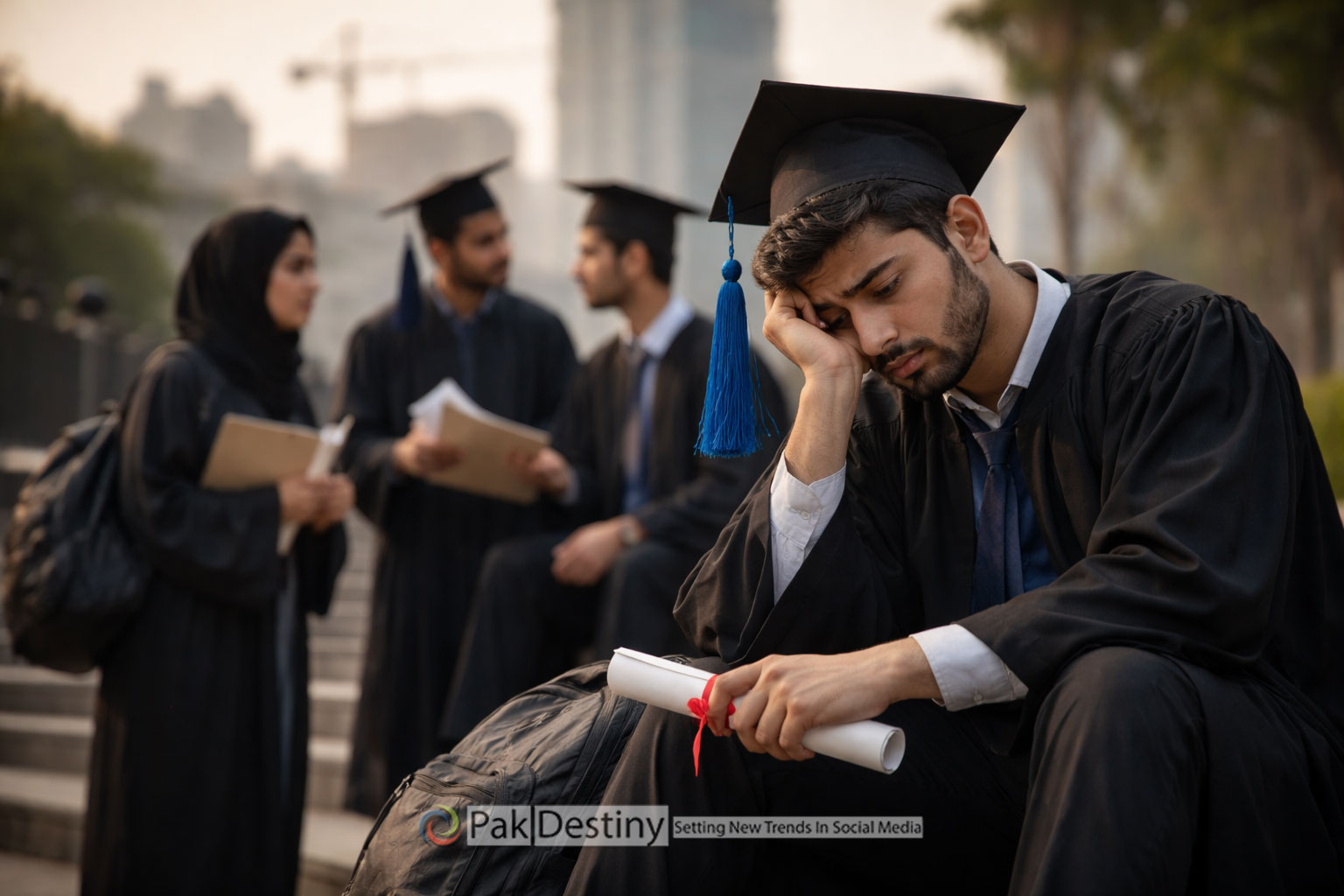
A degree is no longer a sure way to get a job. There are a number of good students who fail to get employment after completing their education, which creates frustrations and uncertainties. In most cases, the jobs available do not correspond to their qualifications and they are left to take jobs that are not related to their education. Such a mismatch results in discontent and confusion as graduates wonder whether their education was worthwhile and whether the system is just.
Because of the low opportunities at home, a high number of graduates are in search of jobs in foreign countries. Gulf and European countries are getting quality Pakistanis who seek higher wages and stability. As much as this benefits individuals, it causes brain drain to Pakistan since bright people move into other places and establish their own future. This undermines the workforce in the country in the long run dragging down development.
Alternatives to those who remain are freelancing and online work. Although these options are flexible, they are not always stable and have regular earnings. Most of the graduates find themselves in jobs that are not related to their graduates e.g. an engineer doing content writing or a business graduate performing simple office duties. As much as adaptability is good, it is also an indicator that their education is not being put into full use, hence wastage of potential.
The other major challenge is that employers would wish that people should have an experience before they are employed. Fresh graduates do not have experience. They often demand one to two years of experience on the job where the jobs would be at the beginner level. This raises a problem: in what way are they going to get experience when there is no one to give them an opportunity? This poses a difficulty to young people to join the workforce and start their careers.
One of the problems is the mismatch between industry and education requirements. Numerous institutions are very much theory based as opposed to skill based. Consequently, graduates might possess the knowledge but not the practical experience. Fresh graduates are disadvantaged by the fact that employers want employees who can make an immediate contribution. Such a discrepancy keeps widening the employment gap.
This unemployment crisis has more than financial implications. A very neglected aspect is its impact on the minds of people. When young educated people are faced with unemployment over some time, they become stressed, anxious and lose their self-confidence. They feel that they are not good enough due to constant rejection. They begin to question the worth of their education and their future possibilities.
In the long run this results in frustration and alienation of the society not only by persons but also by the community, in entirety. Home financial issues are dauntingly difficult when individuals are unemployed temporarily. Many young people who leave college face difficulties with getting a job and providing for their families. This would make them have low self-esteem. Similarly, they do not have control over their lives. This is because in our society being employed is quite intertwined with the way people perceive us thus unemployment is not a financial issue but a personal one.
The education system should change in order to make the situation better. The institutions must integrate the theory with practical training, internship, and projects. Graduates are supposed to graduate the university equipped to work and not with academic knowledge alone. Critical partnerships between schools and industries are needed to be able to provide students with the skills that are relevant. Meanwhile, companies ought to invest in training young professionals to equip them to work.
The government too plays a vital role. It should facilitate creation of jobs through enhancement of industries, technology and entrepreneurship. With financial and policy assistance, small businesses, in particular, can create jobs. Also, the society should re-evaluate its biasness towards government employment and promote alternative careers, such as professional trades or employment in the private sector.
To sum up, the problem is not only unemployment but a lack of contact between education, skills and market needs. The young generation in Pakistan is an asset which is not being utilized.