By Dr. Syed Imran Ahmad Shah
Abstract
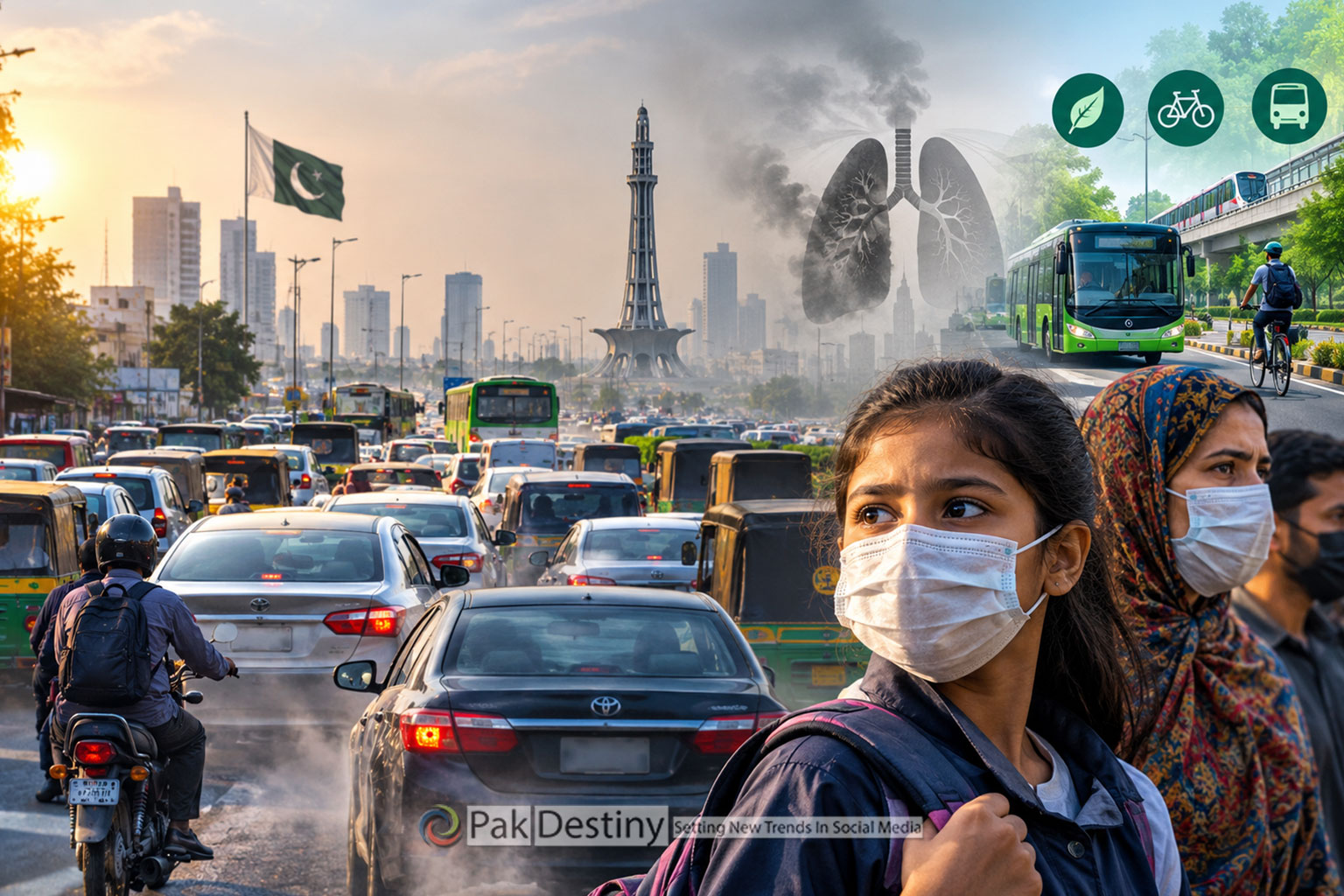
Pakistan has experienced substantial growth in its motor vehicle population over the past three decades, intensifying concerns about urban air pollution, greenhouse gas emissions, public health, and road safety. According to figures reported in recent research, the country’s vehicle population increased from approximately 4.47 million in 1990 to more than 39 million in 2025, representing an increase of over 770%.
During a comparable period, annual carbon dioxide (CO₂) emissions reportedly increased from 13.8 million tonnes in 1990 to 43.6 million tonnes in 2023. Transport-related emissions have become an important environmental concern in major urban centres, including Lahore, Karachi, Islamabad, Rawalpindi, and Peshawar. Reported estimates indicate that transport accounts for 81.3% of CO₂ emissions in Lahore, while its contribution to air pollution is estimated at 33% in Karachi, 53% in Islamabad and Rawalpindi, and 51% in Peshawar. Air pollution is also associated with substantial reductions in life expectancy in Pakistan.
This article examines the relationship between vehicle growth, transport emissions, air quality, and public health through a secondary-data-based analytical review. It discusses the implications for sustainable mobility, environmental governance, road safety communication, and public awareness. The article recommends integrated transport planning, stricter vehicle-emission standards, improved public transportation, cleaner vehicle technologies, and evidence-based communication campaigns. It further identifies the potential role of the National Highways and Motorway Police in promoting environmentally responsible driving and supporting national road-safety and emissions-reduction objectives.
1. Introduction
Air pollution has emerged as a major environmental and public health challenge in Pakistan. Rapid urbanization, population growth, increasing mobility requirements, industrial development, and dependence on fossil-fuel-powered transportation have contributed to growing pressure on the country’s urban environment. The expansion of the vehicle fleet is particularly significant because road transportation generates greenhouse gases and several air pollutants that affect environmental quality and human health.
According to figures reported in a recent news account of research findings, Pakistan’s vehicle population increased from approximately 4.47 million in 1990 to more than 39 million in 2025. This represents an increase of approximately 772%, demonstrating the scale of motorisation over the period. The same report indicates that carbon dioxide emissions increased from 13.8 million tonnes in 1990 to 43.6 million tonnes in 2023 (Geo News Urdu, 2026).
These trends raise important questions about the sustainability of Pakistan’s transport system. While motorisation facilitates economic activity, employment, trade, and access to services, poorly managed vehicle growth can increase fuel consumption, traffic congestion, emissions, and public exposure to harmful pollutants.
The challenge is especially important in large cities, where dense traffic, older vehicles, inadequate public transportation, industrial activity, and unfavourable meteorological conditions can combine to produce unhealthy air quality. Research published in Scientific Reports has also identified poor air quality across several Pakistani cities and examined the relationship between urban agglomeration, vehicle numbers, and environmental indicators (Scientific Reports, 2025).
This article examines the growth of Pakistan’s vehicle population and its relationship with transport emissions, urban air pollution, public health, and sustainable mobility. It also explores how road-safety institutions and communication strategies can contribute to a broader response to the environmental consequences of transportation.
2. Research Objectives
The article has five principal objectives
1. To examine the reported growth in Pakistan’s motor vehicle population between 1990 and 2025.
2. To analyse the reported increase in carbon dioxide emissions and the contribution of transportation to urban air pollution.
3. To discuss the potential implications of transport-related pollution for public health and quality of life.
4. To identify policy interventions for cleaner transportation and sustainable urban mobility.
5. To explore the potential contribution of road-safety communication, public awareness, and the National Highways and Motorway Police to environmentally responsible mobility.
3. Research Methodology
This article adopts a secondary-data-based analytical review approach. It draws on reported national vehicle-population and emissions figures, published research on environmental conditions in Pakistani cities, and a recent assessment of transport-sector emissions and mitigation scenarios.
The analysis uses descriptive comparison to examine changes in vehicle numbers and reported CO₂ emissions. It also applies a thematic approach to discuss four interconnected areas: transport-related environmental pressure, public health implications, policy responses, and communication-based interventions.
The article is exploratory and policy-oriented rather than an original econometric study. The figures reproduced from the recent news report are treated as reported estimates, not as independently verified measurements. The underlying primary study, its data sources, and its calculation methods should be obtained before the article is submitted to a peer-reviewed journal. Similarly, the city-level percentages are reproduced as reported and should be checked against the original research.
4. Growth in Pakistan’s Vehicle Population
The reported expansion of Pakistan’s vehicle fleet illustrates the increasing importance of road transportation in the country’s economic and social development.
Table 1. Reported vehicle population and CO₂ emissions
| Indicator | Reported value |
| Vehicle population in 1990 | 4.47 million |
| Vehicle population in 2025 | More than 39 million |
| Approximate increase in vehicle population | More than 772% |
| CO₂ emissions in 1990 | 13.8 million tonnes |
| CO₂ emissions in 2023 | 43.6 million tonnes |
| Approximate increase in reported CO₂ emissions | 216% |
Source: Figures reported by Geo News Urdu (2026). Percentage changes are calculated from the reported values.
5. Rising Carbon Dioxide Emissions and Transport-Related Pollution
The reported increase in annual CO₂ emissions from 13.8 million tonnes in 1990 to 43.6 million tonnes in 2023 represents an approximate 216% increase. Carbon dioxide is a major greenhouse gas associated with climate change. Although CO₂ is not the principal pollutant responsible for the immediate toxic effects of urban smog, its growth signals increasing pressure on the climate system.
Road transportation also produces pollutants with more direct implications for local air quality. These include particulate matter (PM₂.₅ and PM₁₀), nitrogen oxides, carbon monoxide, and volatile organic compounds. Their concentrations depend on the characteristics of vehicles, fuel combustion, road dust, atmospheric conditions, and other emission sources.
A 2026 study published in Sustainability developed a detailed transport-sector emissions inventory for Pakistan and assessed potential mitigation scenarios through 2050. Its findings identify road transportation as the dominant source within the transport sector for most of the pollutants examined. The study also suggests that combining vehicle electrification, stronger emission standards, and structural transport reforms can deliver benefits for both air quality and climate mitigation (Mir et al., 2026).
These findings indicate that Pakistan’s environmental response should not focus exclusively on the number of vehicles. It should also address the emissions intensity of the fleet, the quality of fuels, the efficiency of transport services, and the broader organisation of urban mobility.
6. Urban Differences in Transport-Related Air Pollution
The reported city-level estimates indicate that transportation has a substantial environmental footprint in several major Pakistani cities.
Table 2. Reported city-level transport contributions
| City | Reported transport contribution |
| Lahore | 81.3% of CO₂ emissions |
| Karachi | 33% of air pollution |
| Islamabad and Rawalpindi | 53% of air pollution |
| Peshawar | 51% of air pollution |
Source: Geo News Urdu (2026). Indicators are reproduced as reported; definitions and denominators require verification from the original study.
6.1 Lahore
Lahore faces recurring episodes of severe smog and unhealthy air quality. Transport emissions are an important part of the pollution challenge, although industrial emissions, crop-residue burning, construction dust, waste burning, regional pollution transport, and meteorological conditions also influence air quality.
Measures such as reliable public transportation, vehicle-emission testing, improved traffic flow, cleaner fuels, and better enforcement of environmental regulations could help reduce transport-related pollution. Such measures should be supported by continuous monitoring to establish which interventions produce measurable improvements.
6.2 Karachi
Karachi’s extensive road network, freight movement, commercial activity, and large urban population create substantial transportation and environmental-management demands. Improving mass transit, reducing unnecessary idling, maintaining commercial vehicles, and strengthening emission monitoring could contribute to lower exposure to traffic-related pollution.
6.3 Islamabad and Rawalpindi
The interconnected urban areas of Islamabad and Rawalpindi experience commuting between residential, commercial, and administrative centres. Coordinated metropolitan transport planning, improved public transport integration, and better management of traffic corridors could reduce unnecessary vehicle use and congestion.
6.4 Peshawar
Peshawar requires an integrated approach that combines cleaner public and commercial transport, vehicle inspection, traffic management, and wider air-quality monitoring. Policy interventions should be designed around locally measured emission sources rather than relying exclusively on national averages.
7. Public Health Implications
Air pollution is associated with significant public health risks, particularly for people who experience prolonged exposure. Fine particulate matter can penetrate deep into the lungs and contribute to cardiovascular and respiratory diseases. Exposure to nitrogen dioxide and other traffic-related pollutants can also aggravate respiratory conditions.
Children, older adults, outdoor workers, and people with pre-existing respiratory or cardiovascular conditions may be particularly vulnerable. Traffic police officers, motorway patrol personnel, roadside workers, delivery riders, and commuters may experience repeated exposure because of the time they spend near roadways.
The reported estimate that air pollution may reduce average life expectancy in Pakistan by approximately seven years underscores the potential scale of the problem. However, this figure should be understood as a population-level estimate, not as a prediction that every individual will lose seven years of life. Its geographical coverage, reference year, methodology, and specific pollutant basis should be verified from the original source before formal academic publication.
The public health response should therefore include stronger air-quality monitoring, public advisories during severe pollution episodes, preventive healthcare, and targeted measures to reduce exposure in high-traffic locations.
Environmental protection and road safety should also be considered together. Traffic congestion, inefficient driving, poorly maintained vehicles, and excessive fuel consumption can create both transport-safety and environmental concerns. Integrated policies can address these problems simultaneously.
8. The Role of the National Highways and Motorway Police
The National Highways and Motorway Police (NHMP) has an established public-safety mandate that includes traffic enforcement, driver education, road-safety awareness, and the promotion of responsible road use. Its nationwide communication reach provides an opportunity to complement environmental initiatives with practical information about vehicle use and transport-related pollution.
8.1 Environmentally Responsible Driving
Public awareness campaigns could encourage motorists to avoid unnecessary engine idling, maintain appropriate tyre pressure, follow vehicle-maintenance schedules, and avoid aggressive acceleration and braking. These practices can improve fuel efficiency and, under appropriate conditions, reduce emissions.
8.2 Vehicle Maintenance and Emission Compliance
Motorists should be encouraged to maintain engines, replace defective emission-control components, and comply with applicable vehicle-emission requirements. Coordination with environmental protection agencies and transport authorities could strengthen public understanding of the relationship between vehicle condition and air quality.
8.3 High-Visibility Safety and Environmental Messaging
Roadside signs, electronic message boards, motorway service areas, radio announcements, and social media can communicate concise messages about safe and fuel-efficient driving. Campaigns should avoid distracting drivers and should deliver information at appropriate locations.
8.4 Data-Driven Public Communication
The NHMP could explore collaboration with environmental authorities and research institutions to develop evidence-based campaigns using air-quality data, traffic trends, and seasonal risk information. Where supported by reliable data, public messages could explain how congestion, excessive idling, and poorly maintained vehicles affect both fuel consumption and environmental quality.
8.5 Interagency Collaboration
Reducing transport-related emissions requires coordinated action by environmental protection agencies, transport departments, urban planners, vehicle regulators, public transport operators, and law-enforcement institutions. The NHMP could contribute through awareness, enforcement within its legal mandate, public reporting, and research partnerships rather than independently assuming responsibility for environmental regulation.
9. Policy Recommendations
The findings support a coordinated policy framework built around the following priorities.
First, strengthen vehicle-emission standards and inspection. Periodic testing, effective compliance mechanisms, and measures addressing high-emitting vehicles can help reduce pollution from the existing fleet.
Second, improve public transportation. Reliable, affordable, and accessible mass transit can reduce dependence on private vehicles, particularly in densely populated cities.
Third, accelerate cleaner vehicle technologies. Electric vehicles and other lower-emission technologies can contribute to cleaner transport, provided that charging infrastructure, electricity generation, vehicle affordability, and lifecycle environmental impacts are appropriately considered.
Fourth, improve fuel quality and vehicle efficiency. Cleaner fuels, modern emission-control systems, and better-maintained vehicles can reduce the emissions produced by each journey.
Fifth, integrate land-use and transport planning. Urban development that improves access to public transport, workplaces, education, and essential services can reduce unnecessary travel and congestion.
Sixth, strengthen air-quality monitoring. More comprehensive monitoring of PM₂.₅, PM₁₀, nitrogen dioxide, and other relevant pollutants would improve the identification of pollution hotspots and the evaluation of interventions.
Seventh, develop sustained public-awareness campaigns. Communication should focus on practical actions, measurable outcomes, and the shared responsibility of motorists, public institutions, transport operators, and communities.
Eighth, evaluate policies through measurable indicators. Relevant indicators include vehicle-emission compliance, public transport use, fuel consumption per passenger-kilometre, ambient pollutant concentrations, and changes in exposure among vulnerable populations.
10. Future Research Directions
Further research should examine the relationship between vehicle growth, transport emissions, public awareness, and individual driving behaviour in Pakistan. A robust research programme could combine vehicle-registration data, fuel-consumption statistics, air-quality monitoring, traffic counts, and public surveys.
A comparative study of Lahore, Karachi, Islamabad–Rawalpindi, and Peshawar could identify differences in the contribution of transport to particulate matter and greenhouse gas emissions. Such a study should distinguish between directly measured pollution, emissions estimated through inventories, and pollution attributed to specific sectors using statistical or atmospheric models.
Another promising direction is the evaluation of road-safety communication campaigns. Researchers could assess whether targeted messages about vehicle maintenance, unnecessary idling, safe driving, and fuel efficiency influence knowledge, attitudes, and reported behaviour.
Artificial intelligence could also support environmental communication by helping analyse traffic patterns, identify high-risk pollution periods, and tailor public advisories. However, AI-supported recommendations should be validated against reliable data and should not replace scientific monitoring or expert judgement.
11. Limitations
This article is based on secondary information and does not present original field measurements, a new emissions inventory, or an independent statistical model. Several headline figures are reproduced from a news report rather than verified directly against the underlying primary research.
The city-level percentages refer to different reported indicators and should not be interpreted as a uniform comparison of transport’s contribution to all pollutants. Furthermore, the growth in the vehicle fleet does not establish that vehicle growth alone caused the entire increase in emissions or air pollution.
Future research should verify the original data sources, document uncertainty, distinguish between national and urban emissions, and account for other sources of pollution and meteorological influences. These steps are essential before drawing causal conclusions or submitting the work as a completed empirical study.
12. Conclusion
Pakistan’s reported increase of more than 770% in its vehicle population between 1990 and 2025 highlights the growing challenge of managing transportation in an environmentally sustainable manner. The reported increase in CO₂ emissions and the substantial contribution attributed to transport in major cities reinforce the need for a coordinated response.
Vehicle growth should not be viewed exclusively as a transport-sector issue. It is connected to public health, urban planning, climate change, economic development, and road safety. Addressing these challenges requires cleaner vehicle technologies, effective emission standards, improved public transportation, stronger monitoring, and sustained public engagement.
The National Highways and Motorway Police can contribute through road-safety education, environmentally responsible driving messages, and collaboration with relevant environmental and transport institutions. Its role should complement, rather than replace, the regulatory responsibilities of environmental protection agencies and transport authorities.
Ultimately, Pakistan needs a transition towards a transport system that is safer, cleaner, more efficient, and more accessible. Evidence-based policymaking and interdisciplinary research will be essential to ensuring that mobility and economic development do not come at an unacceptable environmental and public health cost.
References
Geo News Urdu. (2026, October 15. https://www.geonewsurdu.tv/latest/443951-
Mir, K. A., Purohit, P., Mehmood, S., & Goheer, A. (2026). Air quality and climate co-benefits of Pakistan’s transport sector: A multi-pollutant scenario assessment. Sustainability, 18(8), 3954. https://doi.org/10.3390/su18083954
Scientific Reports. (2025). An empirical investigation of environmental impacts of agglomeration economies in major cities of Pakistan. https://www.nature.com/articles/s41598-025-03871-2
By Dr. Syed Imran Ahmad Shah
PhD (Media Studies)
Former Research Fellow, College of communication Arts and Sciences
Michigan State University, USA
Public Relations Professional and Researcher
Mian Azmat Farooq
Foreign Service of Pakistan
Iqra Yaseen
Metallurgical and Materials Engineer, UET Lahore.