By Dr. Syed Imran Ahmad Shah
Uses and Gratifications in the Age of Digital Transition
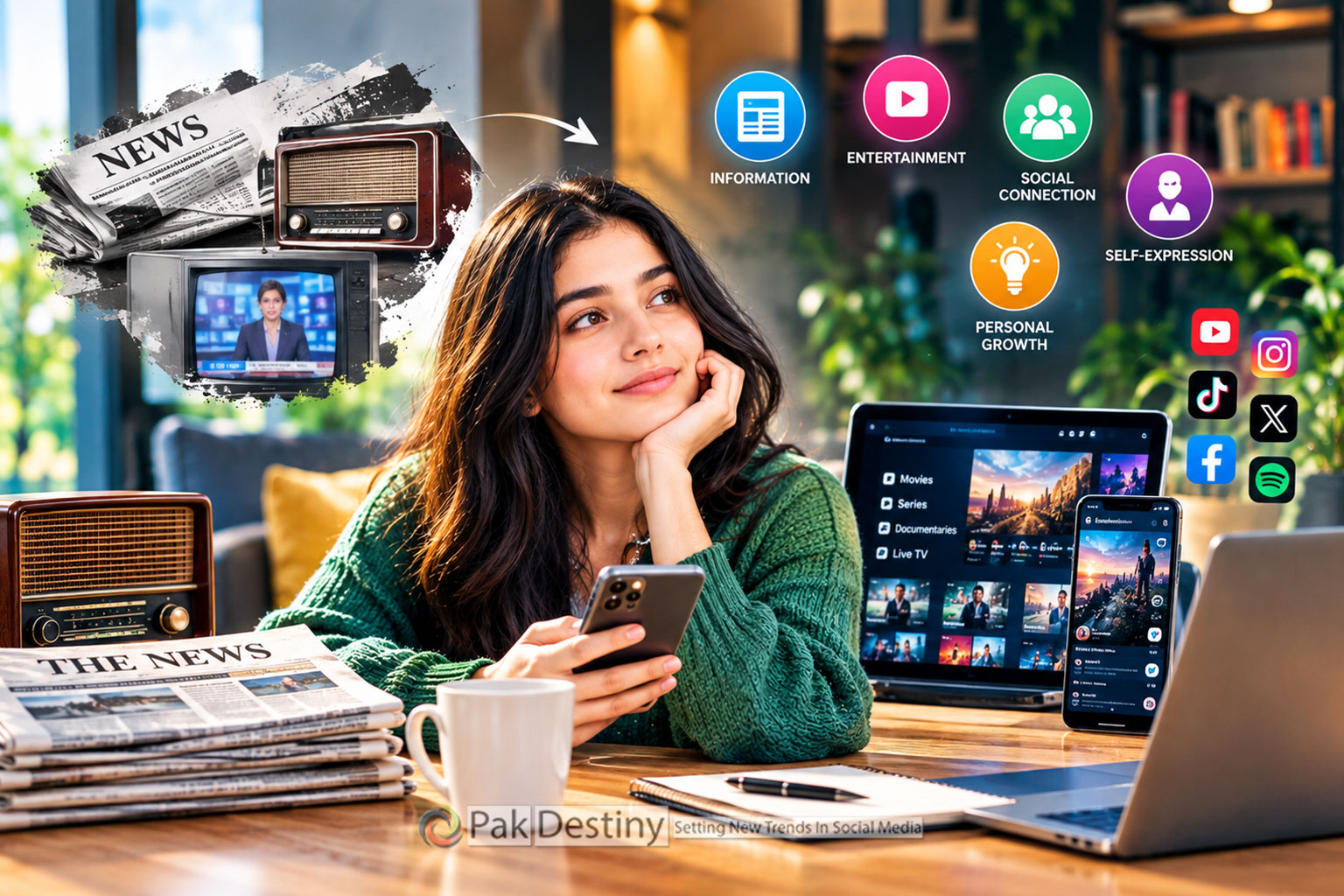
The contemporary media ecosystem is experiencing a seismic realignment as traditional legacy formats, such as print newspapers and linear television, undergo a structural decline, while interactive, algorithm-driven social spaces capture global attention. For decades, communication scholars have relied on the Uses and Gratifications Theory (UGT) to decode the mechanics of media selection. Originally conceptualized by Elihu Katz, Jay Blumler, and Michael Gurevitch (1973) to explain radio and early newspaper habits, UGT posits that audiences are not passive vessels; they are active consumers who intentionally select specific media formats to satisfy deeply ingrained psychological and social needs.
As legacy distribution networks falter, platforms like TikTok, Meta, and YouTube have engineered automated ecosystems of “super-gratification.” However, analyzing this shift requires contrasting UGT with historical, passive-audience paradigms to understand how the digital age has inverted traditional power dynamics between media producers and consumers.
1. Theoretical Paradigm Shift: UGT vs. Legacy Media Effects Models
To fully appreciate how UGT explains the modern digital transition, it must be contrasted against older, foundational communication theories developed during the mid-to-late 20th century. These earlier frameworks generally treated the audience as a uniform, relatively helpless mass acted upon by powerful media gatekeepers.
Cultivation Theory vs. UGT
Developed by George Gerbner (1976) in the context of linear television, Cultivation Theory argues that long-term exposure to media shapes or “cultivates” a consumer’s perception of reality. Gerbner proposed that heavy television viewers develop a distorted worldview (e.g., the “Mean World Syndrome”) because they passively absorb repetitive, standardized prime-time programming.
UGT radically inverts this logic. From a UGT perspective, individuals do not passively sit and let television dictate their reality. Instead, an active audience member seeking tension-release gratifications might choose to watch a lighthearted comedy to escape stress, or someone seeking cognitive gratifications might deliberately seek out a documentary. Under UGT, the consumer’s psychological state dictates the media effects, rather than the media unilaterally dictating the consumer’s psychological state.
Agenda-Setting Theory vs. UGT
Introduced by Maxwell McCombs and Donald Shaw (1972), Agenda-Setting Theory asserts that mass media news organizations do not tell people what to think, but they are stunningly successful at telling audiences what to think about. By prioritizing certain headlines and burying others, traditional editorial gatekeepers established a universal public agenda.
In the digital landscape, UGT demonstrates that algorithmic social media has fractured this top-down agenda-setting power. On platforms like Facebook, Instagram, or X, the user’s specific cognitive and personal integrative needs dictate their feed. By interacting with particular topics, users instruct personalized algorithms to fetch hyper-specific content, effectively allowing the consumer to establish their own individual agenda. The corporate editor has been replaced by a decentralized, crowdsourced loop governed by active user psychology.
2. The Core Typology of Audience Gratifications
According to Katz et al. (1973), human motivations for media consumption are divided into five distinct clusters. Modern social ecosystems have optimized the delivery mechanisms for each of these needs:
- Cognitive Needs: Acquiring information, knowledge, and environmental surveillance.
- Affective Needs: Seeking emotional, aesthetic, or highly pleasurable experiences.
- Personal Integrative Needs: Bolstering individual credibility, confidence, status, and identity performance.
- Social Integrative Needs: Fostering affiliation, social interaction, and a sense of belonging with peer networks.
- Tension-Release Needs: Escaping real-world anxieties, relaxing, and engaging in boundaryless digital escapism.
3. Case Study: TikTok vs. Linear Television for Gen Z
The migration of young audiences away from linear television networks toward TikTok highlights a structural generational shift in how affective and tension-release needs are satisfied.
Linear television presents high commitment hurdles, demanding that audiences sit through fixed programming blocks interspersed with standardized commercial advertisements. TikTok solves this friction by utilizing a highly responsive recommendation engine. Market research conducted by Metricool (2026) notes that Generation Z users spend an average of 152 minutes per day on the platform, significantly outperforming legacy television formats.
TikTok’s framework minimizes the time to reward by evaluating micro-behaviors such as exact loop counts, caption clicks, and scroll velocity to curate a personalized video stream. This immediate delivery system completely satisfies tension-release needs without the cognitive burden of active searching.
Furthermore, TikTok effortlessly fulfills personal integrative needs. Linear television operates on strict stratification where a small elite creates content for a silent audience. TikTok transforms the passive spectator into an active “prosumer” an agent who simultaneously produces and consumes media (Root Digital, 2025). By publishing user-generated content, ordinary consumers receive quantified social validation via likes, stitch metrics, and algorithmically boosted visibility, satisfying their identity-building needs in ways legacy broadcast structures never could.
4. Case Study: Meta Platforms vs. Traditional Newspapers for Breaking News
The steep decline of the legacy newspaper print model illustrates the changing dynamics of cognitive and social integrative needs.
A printed newspaper operates on a rigid 24-hour manufacturing and delivery framework, rendering it structurally incompatible with a continuous global news landscape. Data published by the Pew Research Center (Liedke & St. Aubin, 2024) reveals that over 53% of adults frequently source their daily news directly from social media platforms, with ecosystems owned by Meta Platforms specifically Facebook and Instagram serving as leading hubs.
When breaking news events transpire, Meta’s networks utilize decentralized citizen journalism to distribute eyewitness footage and real-time commentary long before corporate camera crews arrive. This immediacy directly satisfies the user’s cognitive need for environmental surveillance.
More crucially, social platforms address social integrative needs that legacy print media inherently ignore. News consumption on social networks is communal; users do not merely read information in isolation. They comment on threads, debate opposing perspectives, tag friends to alert them, and share content to signal their alignment with socio-political groups. The news piece transitions from a static text into an interactive forum for social negotiation.
5. Case Study: YouTube vs. Legacy Film and Educational Television
The disruption of long-form video consumption specifically documentary, educational, and cinematic media by YouTube demonstrates how digital platforms offer superior gratification over traditional networks like PBS, the Discovery Channel, or cinema.
Legacy educational television relies heavily on broad-appeal formulas constrained by high production cycles and top-down scheduling. To satisfy cognitive and affective needs, consumers had to conform to predetermined broad-genre categories. YouTube completely bypasses these constraints by enabling access to micro-niche instructional, technical, and historical content on-demand. Whether an individual seeks a highly technical coding tutorial or a deeply researched multi-hour historical breakdown, YouTube offers targeted cognitive gratification instantaneously.
Crucially, YouTube bridges the gap between passive long-form learning and intense social integrative fulfillment. Legacy television leaves the curious viewer in absolute isolation. On YouTube, creators engage directly with their audiences through community tabs, live video chats, and long-form comment discussions. The platform also provides an unmatched avenue for personal integrative goals, where enthusiasts can pivot from casual viewing into recognized community educators, completely dismantling the traditional institutional monopoly on instructional authority.
6. The Pathologies of Hyper-Gratification: Algorithmic Vulnerabilities
While digital platforms excel at satisfying user desires, the ruthless optimization of these spaces has introduced distinct negative psychological and social phenomena. When media consumption moves from deliberate selection to algorithmic dependency, the structural benefits of UGT can warp into behavioral liabilities.
The precision curation designed to maximize cognitive and personal integrative satisfaction frequently results in the formation of ideological echo chambers. Because algorithms prioritize content that aligns with a user’s historical engagement patterns, consumers are systematically shielded from opposing viewpoints. This creates a feedback loop where existing biases are continually reinforced, eroding nuance and driving systemic political and cultural polarization.
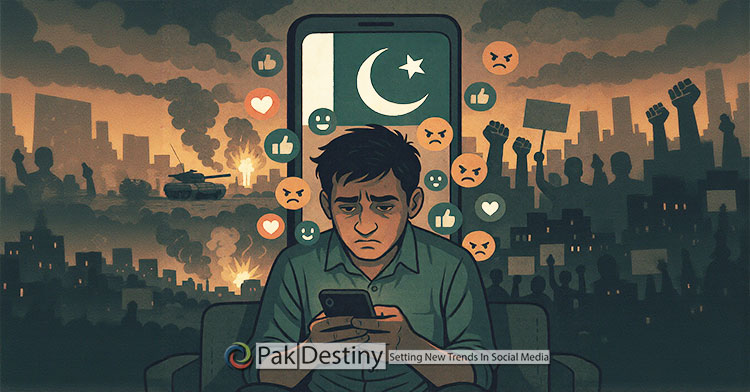
The frictionless design of modern interfaces exemplified by infinite vertical scrolling and automated video playback weaponizes the user’s quest for tension-release and affective gratification. This architectural setup often leads to “doomscrolling,” an unhealthy behavioral pattern where users compulsively consume negative or distressing news feeds without a natural stopping point. Instead of relieving stress, this cycle frequently exacerbates psychological distress. Public health reviews indicate that frequent, problematic engagement with short-form video feeds is closely correlated with increased symptoms of anxiety, depression, and cognitive fragmentation, particularly among demographics under the age of 24 (National Institutes of Health, 2025).
7. Structural Comparison of Media Paradigms and Theoretical Effects
| Need / Element | Traditional Media (Dying Paradigm) | Social Media Platforms (Emerging Paradigm) | Dominant Passive Theoretical Lens |
| Cognitive Fulfillment | Generalized, slow, gatekeeper-filtered news and educational TV. | Real-time, decentralized, crowdsourced, and micro-niche video streams. | Agenda-Setting Theory: Gatekeepers dictate public priority. |
| Affective Experience | Passive, scheduled programming grids and broadcast film. | Active, short-form and personalized long-form algorithmically optimized loops. | Cultivation Theory: Mainstreams a standardized reality worldview. |
| Social Integration | Isolated consumption; limited feedback or community options. | Participatory networks; real-time commenting, community tabs, and sharing. | Hypodermic Needle Model: Direct, uniform message injection. |
| Personal Integration | Consumption-based; static alignment with mainstream brands. | Production-based; active identity performance, user content creation, metrics. | Elite Hegemony Models: Reinforces top-down social hierarchies. |
| Tension-Release | Highly structured, time-restricted programming windows. | Frictionless, on-demand, 24/7 boundaryless digital escapism. | Behavioral Conditioning: Passive audience relies on external grids. |
8. Conclusion
The ongoing decline of legacy print and broadcast networks alongside the rise of digital ecosystems is a clear validation of Uses and Gratifications Theory. Traditional media formats are not losing audience share due to a drop in civic interest or a decline in the human desire for storytelling. Rather, they are constrained by a rigid, top-down delivery architecture that can no longer compete with the immediate, personalized, and interactive nature of digital spaces.
By transforming passive media consumers into active creators and network nodes, platforms like TikTok, YouTube, and Meta have set a new standard for psychological and social fulfillment. Yet, as society navigates the consequences of algorithmic dependency, echo chambers, and doomscrolling, it is clear that hyper-gratification comes at a cost. The challenge for modern audiences lies in balancing active digital media consumption with a conscious awareness of the algorithmic loops shaping their perception of the world.
References
Gerbner, G., & Gross, L. (1976). Living with television: The violence profile. Journal of Communication, 26(2), 172–199. https://doi.org/10.1111/j.1460-2466.1976.tb01397.x
Katz, E., Blumler, J. G., & Gurevitch, M. (1973). Uses and gratifications research. The Public Opinion Quarterly, 37(4), 509–523. https://doi.org/10.1086/268109
Liedke, J., & St. Aubin, S. (2024). Social media as a primary news source. Pew Research Center.
McCombs, M. E., & Shaw, D. L. (1972). The agenda-setting function of mass media. Public Opinion Quarterly, 36(2), 176–187. https://doi.org/10.1086/267990
Metricool. (2026). TikTok user engagement and platform metrics report.
National Institutes of Health. (2025). Exploring problematic short-form video usage and youth mental health trends. U.S. Department of Health and Human Services.
Root Digital. (2025). Gen Z consumer preferences and digital behavioral trends.
By Dr. Syed Imran Ahmad Shah
PhD (Media Studies)
Former Research Fellow, Michigan State University, USA
Public Relations Professional and Researcher