By Dr. Syed Imran Ahmad Shah
Africa’s Football Revolution Is Reshaping the Global Game
“Football is changing before our eyes. The question is no longer whether Africa can compete with the traditional giants. The question is whether the old football order is beginning to crumble.”
When the final whistle blew in Mexico, the United States and Canada to conclude another dramatic day at the FIFA World Cup 2026, millions of football fans witnessed something that would have seemed almost impossible just two decades ago.
Morocco had eliminated the Netherlands.
Cape Verde had pushed defending champions Argentina to extra time.
Belgium survived Senegal by the narrowest of margins.
England needed every ounce of experience to overcome a fearless DR Congo.
Canada struggled to defeat South Africa.
Colombia escaped Ghana by a single goal.
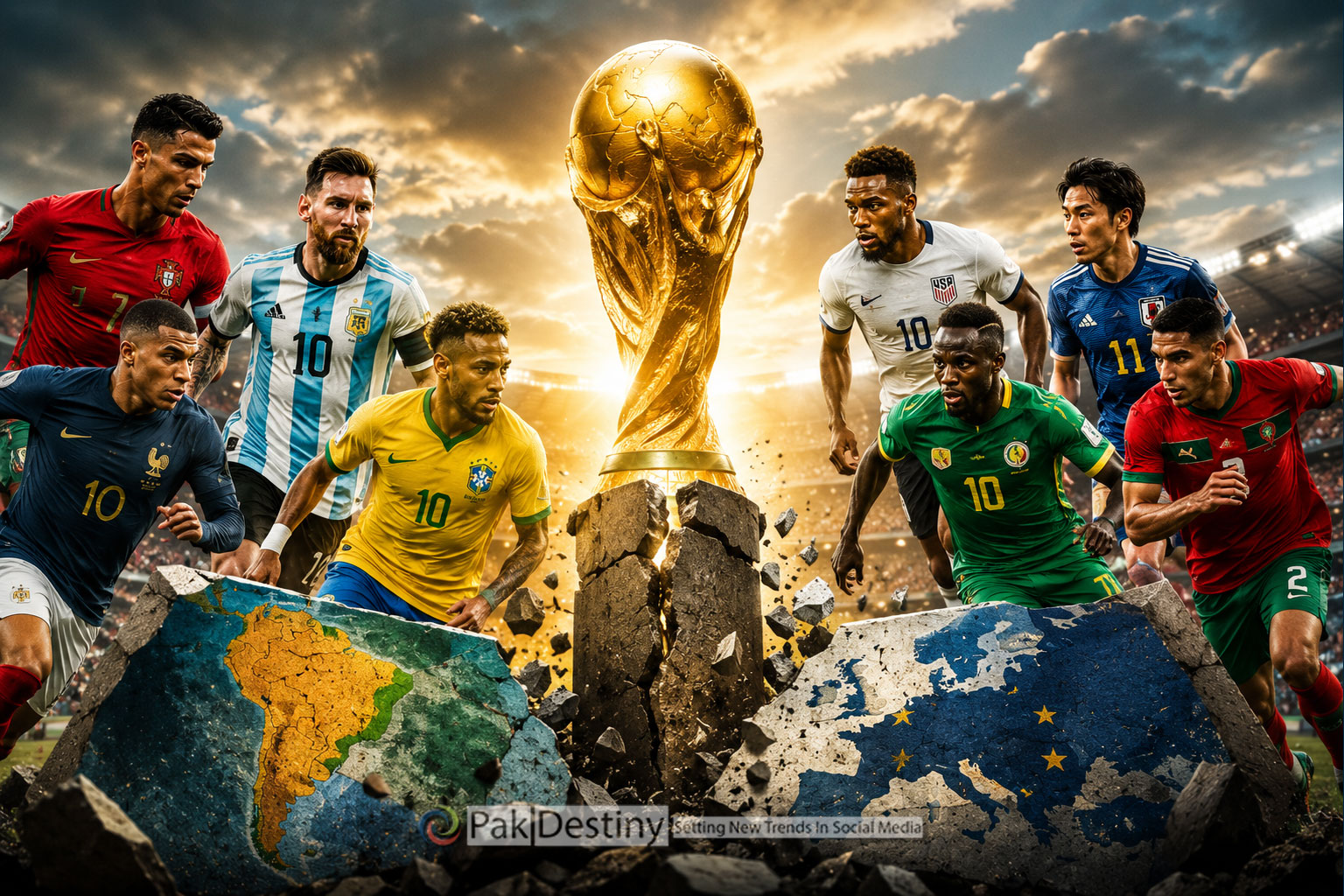
These were not isolated upsets. Together, they reflected a broader shift in world football. The long-standing assumption that European and South American teams would comfortably dominate the rest of the world is increasingly being challenged.For nearly a century, the FIFA World Cup has been defined by two continents. Since the inaugural tournament in 1930, every world champion has come either from Europe or South America. Brazil have won five titles, Germany and Italy four each, Argentina three, France two, while Uruguay, England and Spain have each lifted the trophy once.
The statistics are overwhelming.
- 22 FIFA World Cups have been completed before 2026.
- 100 percent of the champions have come from Europe or South America.
- Europe has produced 12 champions.
- South America has produced 10 champions.
- No team from Africa, Asia, North America or Oceania has ever reached a World Cup final.
For decades, football analysts described Europe and South America as football’s “two superpowers.” European clubs possessed the world’s strongest leagues, while South America produced some of history’s greatest players—from Pelé and Diego Maradona to Lionel Messi and Neymar.
Yet football has never stood still.
Mad respect to Mo Salah. He and Egypt gave everything but there's only so much you can do against corruption.
— Syed Abbas Araghchi Commentary (@Araghchhi) July 7, 2026
Legend. ❤️ pic.twitter.com/DFIvsdx7kN
A Different World Cup
The 2026 FIFA World Cup is historic for another reason.For the first time, FIFA expanded the tournament from 32 to 48 teams, creating twelve groups and introducing an entirely new Round of 32. Critics initially argued that expansion would weaken the tournament by allowing smaller nations to qualify. Instead, the opposite has happened. The expanded format has exposed how dramatically the global standard of football has improved, giving emerging nations a greater opportunity to demonstrate their quality on the biggest stage. No continent has benefited more than Africa.
As soon as Egypt scored their first goal, Messi walked over to the referee, visibly frustrated, shaking his head in disagreement.
— Shirin Khan (@Shirink_13) July 7, 2026
Moments later, Egypt’s second goal was ruled out. pic.twitter.com/2QKThqau6F
Africa’s Historic Presence
Africa arrived at the 2026 World Cup with unprecedented ambition. Never before had the continent sent so many competitive teams to football’s biggest tournament. The expanded qualification system allowed African football to showcase its remarkable depth.
Nine African nations reached the knockout stage:
- Morocco
- Senegal
- Egypt
- Ghana
- Algeria
- Ivory Coast
- South Africa
- DR Congo
- Cape Verde
This represents the strongest collective African performance in World Cup history. Several nations reached the knockout rounds for the first time, while debutants Cape Verde became one of the tournament’s most inspiring stories.
Morocco: From Surprise Package to Global Power
Four years ago, many football observers regarded Morocco’s remarkable run to the semifinals in Qatar as a once-in-a-generation achievement. Today, nobody calls Morocco a surprise anymore.
Against the Netherlands in the Round of 32, Morocco demonstrated exceptional tactical organization, defensive discipline and composure under pressure. After a 1-1 draw, the Atlas Lions triumphed in a dramatic penalty shootout, eliminating one of Europe’s traditional football powers.
This victory was about more than one match.
It symbolized Africa’s growing confidence.
Morocco no longer measures success by respectable defeats. They now expect to defeat Europe’s elite.
هيثم حسن ازاي مر منهم بالسهولة دي ؟
— HUSSIEN BARCA 🇵🇸 (@HUSSIENFCB2) July 7, 2026
pic.twitter.com/ZHZL3t6282
Cape Verde: The Smallest Giant
Perhaps the greatest fairy tale of the tournament belongs to Cape Verde.
With a population of little more than half a million people, the island nation became one of the smallest countries ever to reach the World Cup knockout stage.
The Blue Sharks did not simply participate.
They competed.
They drew every group-stage match, including a memorable draw against Spain, before forcing defending champions Argentina into extra time in one of the tournament’s most dramatic contests. Goalkeeper Vozinha produced a series of extraordinary saves that earned admiration across the football world. Although Argentina eventually prevailed 3-2, Cape Verde departed with global respect rather than disappointment.
Their journey proves that football success is no longer determined solely by population size, economic power or historical reputation.
🚨ورلڈکپ 2026،محمدصلاح کاانٹرنیشنل کیرئیربھی ختم،صلاح نے115انٹرنیشنل مقابلوں میں68گول کئے،صلاح مصرکیلئےسب سے زیادہ69گول کرنےکاریکارڈبرابرنہ کرسکے،ایفکون کپ،ورلڈکپ میں مصر کوکئی میچ جتوائے،کبھی گول،کبھی شاندارپاس سےمیچ کا پانسہ پلٹنےوالےمحمدصلاح کاکیرئیراختتام پذیر۔۔۔!!! pic.twitter.com/TEjqNskik5
— Ali Tanoli (@alitanoli889) July 7, 2026
No More Easy Victories
Perhaps the most striking feature of Africa’s performances has been competitiveness. In previous decades, European teams often defeated African opponents comfortably.
That trend has changed.
Belgium required a late surge to edge Senegal 3-2.
England overcame DR Congo by only one goal.
Canada defeated South Africa by the narrowest possible margin.
Colombia eliminated Ghana 1-0.
Norway survived a stern challenge from Ivory Coast.
Australia needed penalties before Egypt’s campaign came to an end.
Each result reinforced the same conclusion: African teams are no longer making up the numbers. They are forcing the traditional powers to earn every victory.
The End of Football’s Old Geography?
For almost a century, football geography was simple.
Europe produced tactical excellence.
South America produced flair.
The rest of the world attempted to catch up.
That map is becoming outdated.
African footballers now captain Europe’s biggest clubs.
Thousands develop in elite academies across England, France, Spain, Germany and Italy before returning to represent their ancestral nations. Modern coaching, sports science, improved youth academies and increased investment have transformed the continent into one of football’s fastest-growing forces.
The result is visible at World Cup 2026.
The gap has not disappeared completely.
But it has become dramatically smaller.
If the twentieth century belonged to Europe and South America, the twenty-first century may become the era in which Africa finally claims its place among football’s true superpowers.
The African Revolution—How Nine Nations Challenged Football’s Traditional Giants
The 2026 FIFA World Cup will be remembered as the tournament in which African football crossed a historic threshold.
For decades, African teams were admired for their flair, athleticism and individual brilliance but criticised for inconsistency. At every World Cup, they produced memorable moments, yet rarely sustained success deep into the tournament.
That narrative is changing.
Nine African nations reached the knockout stage—an unprecedented achievement made possible by the expanded 48-team tournament and years of investment in coaching, youth academies and infrastructure. More importantly, these teams did not merely qualify; they competed as equals against football’s established powers.
Morocco: Africa’s New Football Superpower
Morocco’s remarkable semifinal appearance at the 2022 World Cup was initially viewed as an extraordinary exception.
The 2026 tournament has proved otherwise.The Atlas Lions remained unbeaten in the group stage, holding Brazil to a 1-1 draw before defeating Scotland and Haiti to top their group. In the Round of 32, they eliminated the Netherlands on penalties after another disciplined defensive display.
What makes Morocco exceptional is not simply the result but the manner in which they play.
European tactical organization is combined with North African technical brilliance. Their squad contains players developed in Spain, France, Belgium and the Netherlands, yet united by a distinctly Moroccan identity.
Morocco no longer seeks respect. They demand it.
Egypt: Finally Breaking New Ground
No African nation has won more Africa Cup of Nations titles than Egypt.Ironically, World Cup success had always eluded the Pharaohs.
In 2026 that barrier finally fell.
After remaining unbeaten during the group stage, Egypt defeated Australia in a dramatic penalty shootout to reach the Round of 16 for the first time in their history. Mohamed Salah’s leadership, combined with Omar Marmoush’s creativity and a disciplined defensive system, demonstrated that African football can balance attacking quality with tactical maturity.
For Egyptian football, this achievement carries enormous symbolic value.
Africa’s most decorated continental champion has finally become a genuine World Cup contender.
Senegal: Courage Against Europe’s Golden Generation
Senegal’s journey was anything but straightforward.
After difficult opening defeats, the Lions of Teranga responded with an emphatic victory over Iraq to qualify before producing one of the tournament’s most entertaining knockout matches.
Belgium eventually prevailed 3-2.
Yet the scoreline tells only part of the story.
Senegal repeatedly exposed one of Europe’s strongest defences with pace, pressing and fearless attacking football. Even in defeat, they reminded the world why African teams are increasingly feared rather than underestimated.
Cape Verde: The Cinderella Story
If Morocco represented African excellence, Cape Verde embodied African possibility.
A nation of barely half a million people reached the World Cup for the first time and immediately became one of its biggest stories.
Their group campaign included draws against Spain, Uruguay and Saudi Arabia.
Many expected Argentina to end the dream comfortably.
Instead, Cape Verde pushed the defending champions into extra time before eventually losing 3-2.
Goalkeeper Vozinha produced one of the tournament’s defining performances, while the Blue Sharks showed extraordinary tactical discipline.
Sometimes football history is written not only by champions but also by courageous underdogs.
Cape Verde may have departed the tournament, but they left with the admiration of the football world.
DR Congo: Africa’s Physical Powerhouse
DR Congo perhaps best illustrated Africa’s physical and tactical evolution.
After drawing with Portugal during the group stage and defeating Uzbekistan to qualify, the Leopards faced England.
The English eventually won 2-1.
However, for long periods England struggled to contain DR Congo’s relentless pressing, athleticism and direct attacking play.
Only experience—and perhaps a little fortune—separated the two sides.
A decade ago, such a contest might have ended in a comfortable English victory.
Today, the margins are remarkably small.
Ghana: Narrow Defeat, Huge Progress
Ghana has always possessed one of Africa’s richest football traditions.
Their quarterfinal appearance in 2010 remains one of the continent’s greatest achievements.
In 2026, the Black Stars again demonstrated why they remain among Africa’s elite.
After holding England during the group stage and qualifying from a difficult group, Ghana lost only 1-0 to Colombia in the knockout phase.
The narrow defeat reflected how tactically disciplined Ghana have become.
Rather than relying solely on physicality, they now combine technical quality with intelligent game management.
Ivory Coast: Champions Continue to Grow
Fresh from continental success, Ivory Coast entered the World Cup with confidence.
Victories over Ecuador and Curaçao secured knockout qualification before a closely contested 2-1 defeat to Norway.
Their technical midfield, disciplined structure and attacking transitions confirmed that the country’s recent Africa Cup of Nations triumph was not an isolated achievement but part of a broader football renaissance.
South Africa: History Rewritten
South Africa achieved another national milestone by reaching the World Cup knockout rounds for the first time.After recovering from an opening defeat to Mexico, Bafana Bafana defeated South Korea to qualify before narrowly losing 1-0 to Canada.
The defeat was disappointing.
The performance was encouraging.
South Africa demonstrated that intelligent organisation can compensate for differences in individual talent.
Algeria: A Fighting Spirit Returns
Algeria recovered brilliantly after losing their opening group match to Argentina. Victories over Jordan and a dramatic 3-3 draw with Austria secured qualification.
Although Switzerland eventually ended Algeria’s campaign, the Desert Foxes displayed the resilience and attacking ambition that once carried them to famous victories over Germany and South Korea in previous World Cups.
Why Has Africa Improved So Dramatically?
The rise of African football is not accidental.
Several interconnected developments have reshaped the continent over the past two decades.
First, thousands of African players now receive elite tactical education in Europe’s top academies. Modern footballers such as Achraf Hakimi, Mohamed Salah, Victor Osimhen, Ademola Lookman and many others have developed in the world’s strongest professional environments before representing African nations.
Second, CAF and national federations have invested heavily in youth academies, coaching education and sports science.
Third, African coaches increasingly employ sophisticated tactical systems rather than relying solely on athletic ability.
Finally, the African diaspora has strengthened national teams, with many players born in Europe proudly choosing to represent their ancestral homelands.
The result is a generation of footballers who combine African passion with European tactical discipline. Coaches and football officials across the continent describe this progress as the product of long-term investment rather than luck.
The Balance of Power Is Shifting
The greatest lesson from World Cup 2026 is not that Africa has already overtaken Europe or South America.
It has not.
Europe still possesses the world’s richest leagues.
South America still produces extraordinary football talent.
However, the era when traditional giants expected comfortable victories has clearly ended.
Football’s competitive map has become flatter than ever before.
Africa is no longer chasing the world’s elite.
It is becoming part of that elite.
Beyond 2026—Can Africa Produce the First Non-European, Non-South American World Cup Champion?
Throughout FIFA World Cup history, football has been governed by an unwritten rule: the ultimate prize belongs to Europe or South America.
From Uruguay’s triumph in 1930 to Argentina’s victory in Qatar in 2022, every World Cup champion has emerged from one of these two continents. Brazil (5 titles), Germany and Italy (4 each), Argentina (3), France (2), Uruguay (2), England (1) and Spain (1) have shared football’s greatest honour.
That remarkable statistic has survived for almost a century.
Yet statistics do not last forever.
History eventually changes—not suddenly, but gradually. Before a dynasty falls, warning signs begin to appear. The FIFA World Cup 2026 may well be remembered as one of those moments when football’s global balance of power started to shift.
The Decline of Guaranteed Dominance
Traditional football powers remain among the world’s strongest teams.
France continue to produce world-class talent.
Spain remain masters of possession football.
Portugal combine experience with a gifted new generation.
Argentina and Brazil still inspire fear wherever they play.
However, something fundamental has changed.
Victories that were once routine have become difficult.
Matches that were expected to be one-sided have become fiercely competitive.
Football’s elite no longer enter the field expecting easy wins against teams from Africa, Asia or North America. Instead, they prepare for tactical battles where the smallest mistake can end a World Cup campaign.
The gap has narrowed—not because Europe and South America have dramatically declined, but because the rest of the football world has improved at an extraordinary pace.
Africa’s Golden Generation
African football today is stronger than at any point in its history.
Unlike previous generations that relied mainly on individual brilliance, today’s African teams combine technical excellence, tactical discipline, physical power and psychological confidence.
The continent now boasts stars playing for Europe’s biggest clubs.
Players such as Achraf Hakimi, Mohamed Salah, Victor Osimhen, Ademola Lookman and many others have become leaders at elite clubs before returning to represent their national teams.
Equally important is the emergence of outstanding African coaches, modern football academies, sports science programmes and improved youth development structures.
Football is no longer developing by chance.
It is developing through planning.
The Diaspora Advantage
One of the defining features of modern African football is the strength of its global diaspora.
Many African internationals were born or raised in France, Belgium, England, the Netherlands, Spain and Germany. They learned football in some of the world’s finest academies before choosing to represent the countries of their parents and grandparents.
This has created a unique blend of tactical education and cultural identity.
Morocco’s historic achievements are perhaps the best example.
Most of their squad gained experience in Europe’s elite leagues while remaining deeply connected to their Moroccan heritage.
Increasingly, other African nations are following the same model.
Investment Is Finally Paying Off
Another reason behind Africa’s rise is long-term investment.
Over the past two decades, the Confederation of African Football (CAF) and national federations have expanded coaching education, improved youth competitions, invested in football infrastructure and strengthened professional leagues.
Private academies have also transformed player development.
Young footballers who once depended on raw talent now receive structured coaching from childhood.
Modern African football increasingly values tactical intelligence, sports psychology, nutrition, performance analysis and data-driven coaching—areas once dominated by Europe.
The result is a generation capable of competing on equal terms with the world’s best.
The Expanded World Cup Has Changed Everything
The expansion of the FIFA World Cup from 32 to 48 teams has been criticised by some observers.
Yet the tournament has demonstrated one major advantage.
It has accelerated football’s globalisation.
More nations have gained valuable World Cup experience.
More young players have competed under the sport’s greatest pressure.
More federations have invested seriously because qualification has become more achievable.
This broader participation is likely to strengthen football worldwide rather than weaken it.
The quality displayed by African nations in 2026 suggests that expansion has revealed existing talent rather than creating artificial competitiveness.
Could Africa Lift the Trophy in 2030?
This question no longer sounds unrealistic.
If Morocco could reach the semifinals in 2022…
If multiple African nations could reach the knockout stages in 2026…
If European and South American giants continue to struggle against African opponents…
Then why should an African champion remain impossible?
Several nations appear capable of making deep runs in future tournaments.
Morocco have established themselves among the world’s elite.
Senegal continue to produce exceptional talent.
Egypt have rediscovered their World Cup identity.
Ivory Coast possess one of Africa’s strongest youth systems.
Ghana remain consistent producers of international players.
Emerging nations such as Cape Verde and DR Congo have shown that organisation and belief can overcome historical disadvantages.
Whether the breakthrough comes in 2030 or later, it increasingly feels like a question of when, not if.
A New Football Geography
The traditional football map divided the world into two categories.
There were football superpowers.
And there were challengers.
That distinction is becoming obsolete.
North America is improving rapidly through Major League Soccer and increased investment.
Asian football continues to develop, led by Japan, South Korea and other emerging nations.
Africa has experienced perhaps the most dramatic transformation of all.
The modern World Cup is no longer simply Europe versus South America.
It is becoming a genuinely global competition.
Lessons Beyond Football
Africa’s success carries significance beyond sport.
It demonstrates the power of long-term planning, youth investment and international collaboration.
For developing nations around the world, African football offers an important lesson: sustainable progress comes through education, infrastructure and patience rather than short-term solutions.
Football has become a mirror of wider global change.
Talent is no longer concentrated in a few traditional centres.
Opportunity is spreading.
Conclusion: The Beginning of a New Era
The FIFA World Cup 2026 may ultimately be won by a European or South American nation.
If that happens, the century-old record will remain intact.
But records can sometimes conceal deeper truths.
This tournament has shown that the old hierarchy is under unprecedented pressure.
African teams are no longer satisfied with honourable defeats.
They now expect to compete, to eliminate football giants and, ultimately, to challenge for the World Cup itself.
The journey from outsiders to contenders has taken decades.
The journey from contenders to champions may take only one more tournament.
When historians look back on the evolution of global football, they may conclude that the FIFA World Cup 2026 was not merely another edition of the tournament.
It was the tournament that announced the arrival of a new football world.
The age of unquestioned European and South American supremacy is no longer guaranteed.
The future of football is becoming more diverse, more competitive and more global than ever before.
And at the heart of that transformation stands a continent that waited nearly a century for its moment.
That continent is Africa.
Dr. Syed Imran Ahmad Shah
PhD (Media Studies)
Former Research Fellow, Michigan State University, USA
Public Relations Professional and Researcher