
Dr Sadia Murad
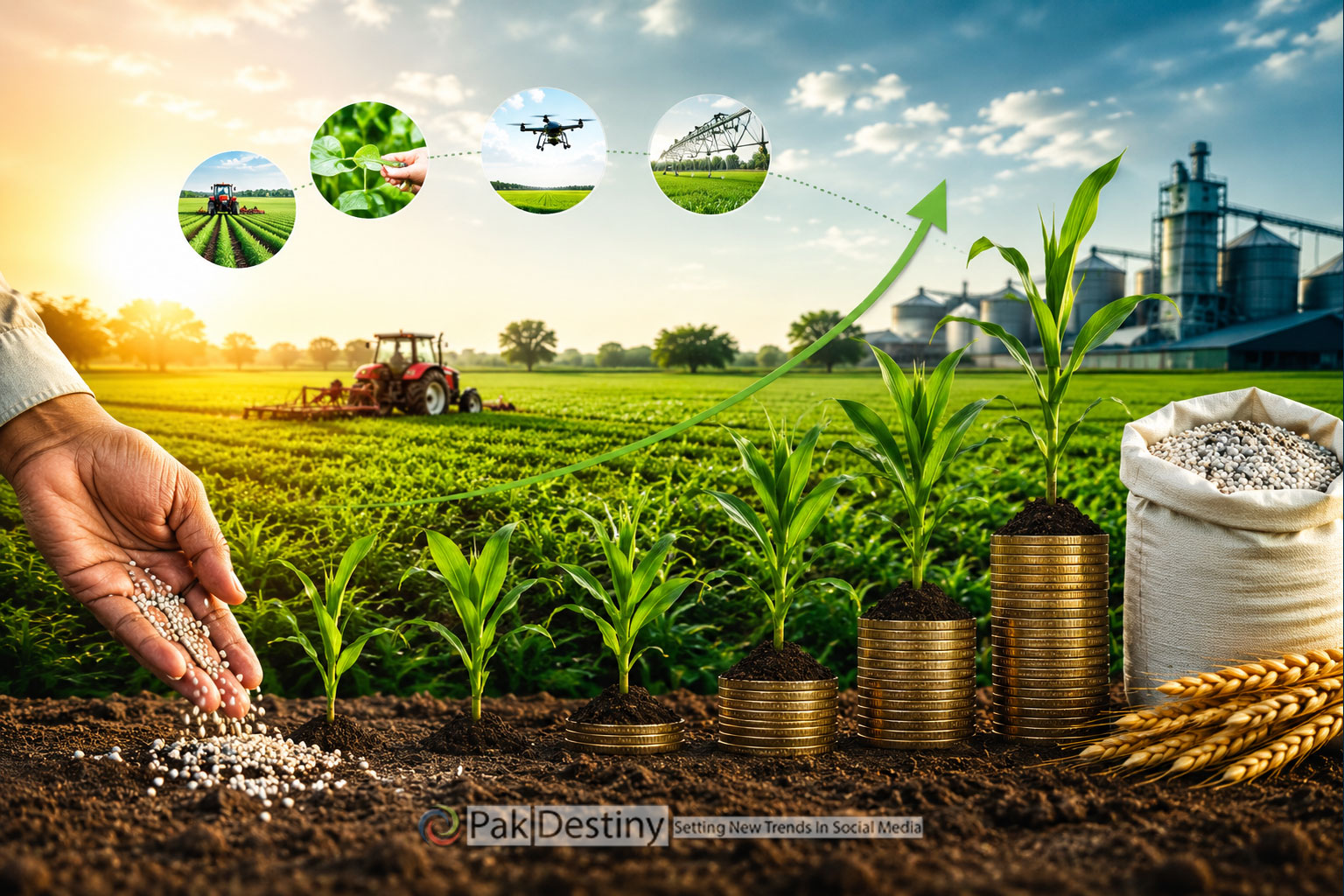
Pakistan’s agricultural transformation over the past three decades tells a remarkable story. The fertilizer use has increased by three times to reach 144kg/ha which contributes to nearly half of our food production. Despite their significant contribution, a new problem arises: how can we guarantee that each kilogram of fertilizer provides farmers with the maximum benefit while protecting the environment for future generations?
The answer lies not in abandoning conventional fertilizers that have served us well, but in embracing their next evolution: Enhanced Efficiency Fertilizers (EEF’s). These innovative products are designed to release nutrients in accordance to plant demand for their better uptake.
Studies have shown that approximately half of the applied nitrogen and phosphorus is lost through leaching, volatilization or soil fixation. To a farmer who is using fertilizer that is valued at 50,000 per season, this is an unrealized value money spent but fails to be used to produce a product. If we multiply this with Pakistan’s 22 million hectares of cultivated land the economic impact becomes staggering. On other hand the environmental impact is also of similar importance. Surplus of nutrients that enter water bodies and the atmosphere cause ecological stress impacting both ecology and sustainability of agriculture.
Enhanced efficiency fertilizers are not a single product, but a family of innovative technologies designed to ensure that the nutrients reach the plants at the right time and in the right amount. These are controlled/slow release fertilizers coated with polymers, micronutrients or other materials; stabilized fertilizers treated with urease or nitrification inhibitors to minimize nutrient losses and nano- or microbial-based formulations. The coating technology creates a physical barrier which decomposes gradually in soil and results in the release of the nutrients through controlled microbial action, hydrolysis and photolysis instead of being directly dissolved. Economic benefits of these fertilizers are substantial. Field studies showed that farmers can reduce application rates by 20-30% while maintaining or even improving yields. The global EEF’s market valued at $2.37 billion in 2018, is projected to reach $3.86 billion in 2026, a 6.37% annual growth rate reflecting worldwide recognition of these benefits.
Agronomic advantages extend beyond nutrient efficiency. EEF’s prevent the high local salt concentrations that conventional fertilizers sometimes create near application sites, reducing osmotic stress and seedling damage. This is particularly valuable during establishment phases when young plants are most vulnerable. Environmental benefits align with Pakistan’s sustainability commitments as well. Reduced nutrient losses mean less contamination of water resources and lower greenhouse gas emissions from nitrogen volatilization.
Although the market is evolving, several EEF’s have already entered the Pakistani agricultural market. The most used formulations are zinc-coated urea, which simultaneously mitigates nitrogen and zinc deficiency, neem-coated urea, with natural compounds which resists nitrogen loss and urea treated with synthetic nitrification inhibitors for regulated nitrogen release. Additionally, biofertilizer-coated formulations combining beneficial microorganisms with conventional nutrients are also gaining attention. Despite their potential, the implementation of these innovative products in Pakistan is constrained by elevated initial costs, little farmer awareness and insufficient local production.
This gap must be filled by offering policy incentives and subsidies or tax incentives on the production and adoption of EEF’s and to the greatest extent to small holder farmer who has the highest financial constraints. The local production can be accelerated with the help of public-private partnerships. Pakistan’s fertilizer industry has shown its ability to produce the world class products. By means of the proper incentives and technology transfer schemes, the cost can be minimized in the production of EEF’s, while creating high-value manufacturing job opportunities.
Transferring knowledge is equally important. Agricultural extension services need to be prepared to use field tests in rural communities to show the advantages of EEF’s. Adoption happens naturally when farmers observe that nearby plots are producing the same results but using 20% less fertilizer. The training programs should target the progressive farmers since they will be able to act as local champions of the technologies. Applying the proper fertilizer at the appropriate rate, at the right time, and in the right location is crucial for sustainable agricultural intensification in Pakistan, as has always been discussed by agricultural experts. Perhaps the most realistic approach to realize this goal is through EEF’s especially for crops like maize where yield gaps are still significant.
For agricultural sector of Pakistan, EEF’s offer a way out to deal with the dual challenge of feeding a growing population while managing environmental resources responsibly. They are not only a marginal increase, but a fundamental rethinking of how we deliver nutrition to crops. Whether or not Pakistan will use enhanced efficiency fertilizers is not the question; rather, it is how soon we can make them available and reasonably priced for the farmers who need them the most. We can guarantee that every rupee spent on fertilizer provides the most benefit to farmers, consumers and Pakistan’s agricultural future by coordinating efforts from the government, industry and agricultural organizations.
Author’s Profile:
I’m Dr. Sadia Murad, currently serving as Executive Marketing (AS) in Fauji Fertilizer Company Limited, Pakista’s largest fertilizer manufacturer. With two years of direct engagement with farming communities through FFC’s Agri Services Department, I’m trying to provide science-based solutions for soil health and crop nutrition.

