By Zulqernain
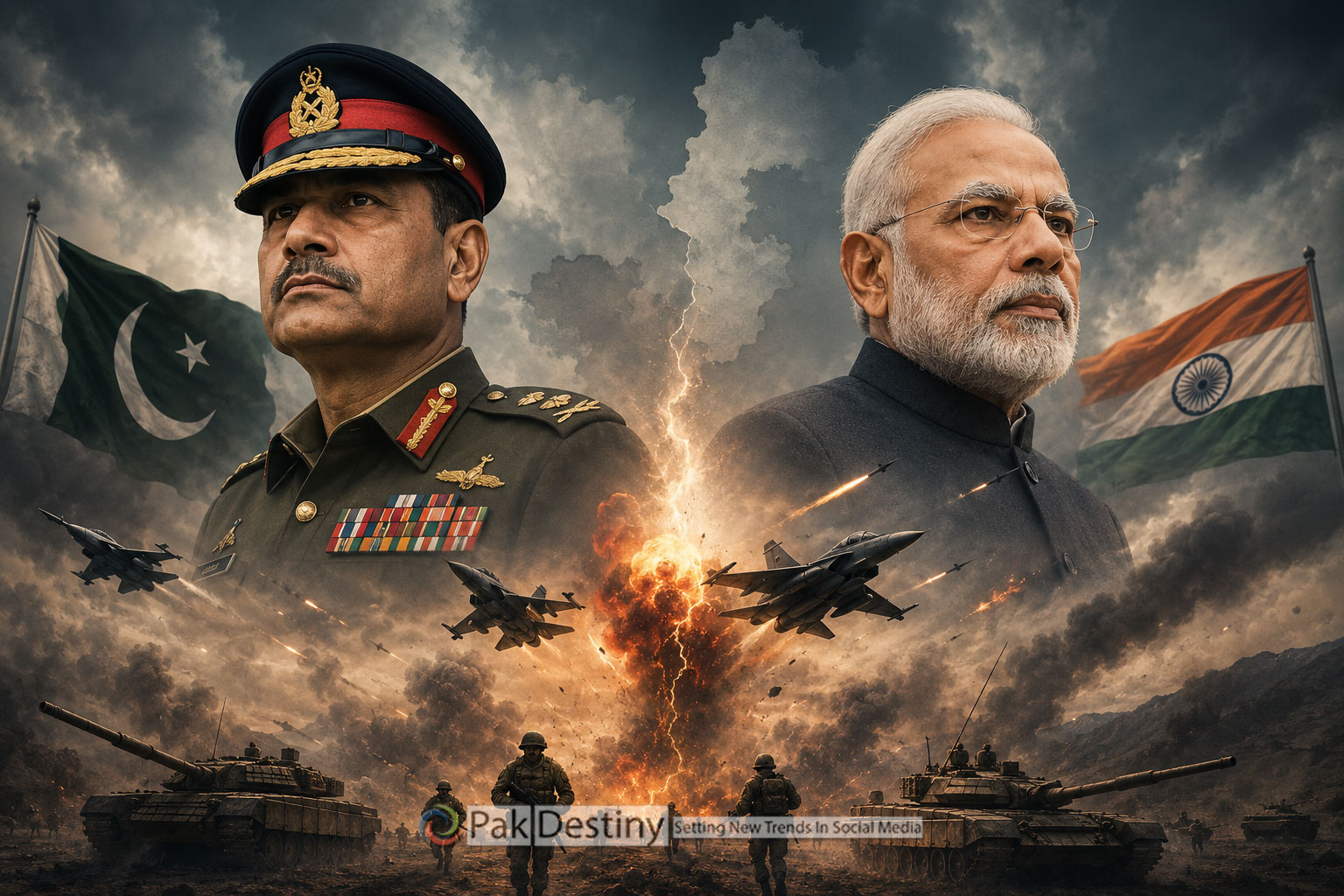
By early May 2025, tensions between Pakistan and India had already reached a dangerous level.
Diplomatic exchanges had grown increasingly hostile, military deployments intensified along the Line of Control (LoC), and political rhetoric in both countries hardened amid rising nationalist sentiment. Yet few anticipated that the crisis would escalate into one of the most serious military confrontations between the two nuclear-armed neighbours in recent years.
For four tense days, the region stood on edge as fighter jets roared across contested skies, artillery exchanges intensified along border regions, cyber narratives flooded social media, and fears of a wider war gripped millions across South Asia. Although the confrontation stopped short of a full-scale war, the brief conflict exposed deep vulnerabilities in regional security and demonstrated how rapidly escalation can spiral between rival nuclear states.
The Spark Behind the Conflict
The immediate trigger emerged after a deadly militant attack in Indian-administered Kashmir, where several security personnel were killed. Indian authorities swiftly blamed Pakistan-based militant elements, alleging cross-border support and facilitation. Islamabad strongly denied the accusations, insisting New Delhi had failed to provide credible evidence and accusing India of exploiting the incident for political and strategic purposes.
As public anger mounted in India, pressure increased on the government to respond decisively. Within days, India launched what it described as “precision military operations” targeting alleged militant infrastructure across the Line of Control. Pakistan rejected the claims, maintaining that civilian areas had been targeted instead.
The strikes marked the beginning of four days of dangerous escalation.
Air Battles and Border Fire
The conflict quickly expanded beyond limited strikes. Pakistani and Indian fighter aircraft conducted aggressive patrols near contested zones, while artillery exchanges intensified across multiple sectors of Kashmir.
Pakistan claimed its air force intercepted Indian aircraft attempting deeper incursions and asserted that several Indian military targets were hit in retaliatory operations. India, meanwhile, maintained that its actions were calibrated, limited, and aimed solely at dismantling militant capabilities.
As both governments projected confidence domestically, competing narratives dominated television channels and social media platforms. Information warfare became nearly as intense as the military confrontation itself, with claims and counterclaims difficult to independently verify in real time.
Residents living near the LoC described nights filled with explosions, displacement, and fear. Schools were closed in several border districts, while emergency services remained on high alert.
International Alarm
The confrontation immediately triggered concern among major world powers.
The international community feared that even a limited exchange between Pakistan and India could unintentionally escalate into a broader regional war.
The United Nations called for restraint, while countries including the United States, China, Saudi Arabia, Türkiye, and the United Kingdom engaged in urgent diplomatic contacts with both capitals.
Diplomatic channels worked continuously behind the scenes to prevent further escalation. International observers noted that the speed of the crisis highlighted the fragility of regional deterrence mechanisms in South Asia.
Pakistan’s Narrative — Diplomatic and Military Success
In Pakistan, the state and political leadership portrayed the outcome as a strategic and diplomatic success. Officials argued that Pakistan had effectively responded militarily while avoiding uncontrolled escalation.
Islamabad also emphasized that the international community did not fully endorse India’s allegations regarding cross-border terrorism.
Pakistani diplomats launched an extensive outreach campaign in global capitals, insisting that unresolved political disputes — particularly Kashmir — remained at the heart of regional instability.
Pakistani leaders argued that national unity during the crisis strengthened the country’s position internationally.
Public rallies, televised speeches, and political statements repeatedly framed the confrontation as evidence of Pakistan’s resilience and defensive capability.
India’s Position: Deterrence and Strategic Messaging
India, however, presented a very different interpretation of the conflict.
New Delhi argued that its operations demonstrated a willingness to respond forcefully to militant attacks and established a new threshold for deterrence.
Indian officials maintained that the military response sent a clear message regarding cross-border militancy and reinforced India’s strategic posture in the region. Government supporters hailed the operations as evidence of military preparedness and political resolve.
At the same time, Indian analysts acknowledged that the rapid escalation revealed the risks of military signaling between nuclear rivals, particularly in an era shaped by fast-moving information warfare and public pressure amplified through digital media.
The Nuclear Shadow
Perhaps the most alarming aspect of the four-day confrontation was the renewed reminder of the nuclear dimension underlying Pakistan-India relations.
Although neither side openly threatened nuclear use, global concern intensified as military activity expanded.
Analysts warned that the compressed decision-making timelines during crises between nuclear-armed states leave little room for miscalculation.
Security experts also observed that modern warfare — including cyber operations, drones, precision strikes, and information manipulation — has complicated traditional deterrence models in South Asia.
Economic and Regional Impact
The confrontation also carried economic consequences. Financial markets in both countries experienced volatility, airlines adjusted regional flight routes, and investors expressed concern about instability in one of the world’s most densely populated regions.
Trade prospects, already limited between the two neighbours, suffered further setbacks. Regional cooperation initiatives remained effectively frozen, while diplomatic engagement deteriorated sharply in the aftermath of the conflict.
The crisis additionally reinforced concerns among neighbouring countries that South Asia remains vulnerable to sudden military escalation despite decades of confidence-building efforts.
The Outcome
Militarily, both countries claimed success.
Politically, both governments used the confrontation to strengthen domestic narratives.
Diplomatically, however, the crisis demonstrated that neither Pakistan nor India can afford prolonged military escalation without significant regional and international consequences.
While the guns eventually fell silent after four tense days, the deeper disputes that fuel hostility between the two nations remain unresolved. Kashmir continues to be the central flashpoint, while mistrust, nationalism, and competing security doctrines continue to shape bilateral relations.
The May confrontation served as another stark reminder that in South Asia, even a localized incident can rapidly evolve into an international crisis — one capable of unsettling not only the region, but the wider world as well.