
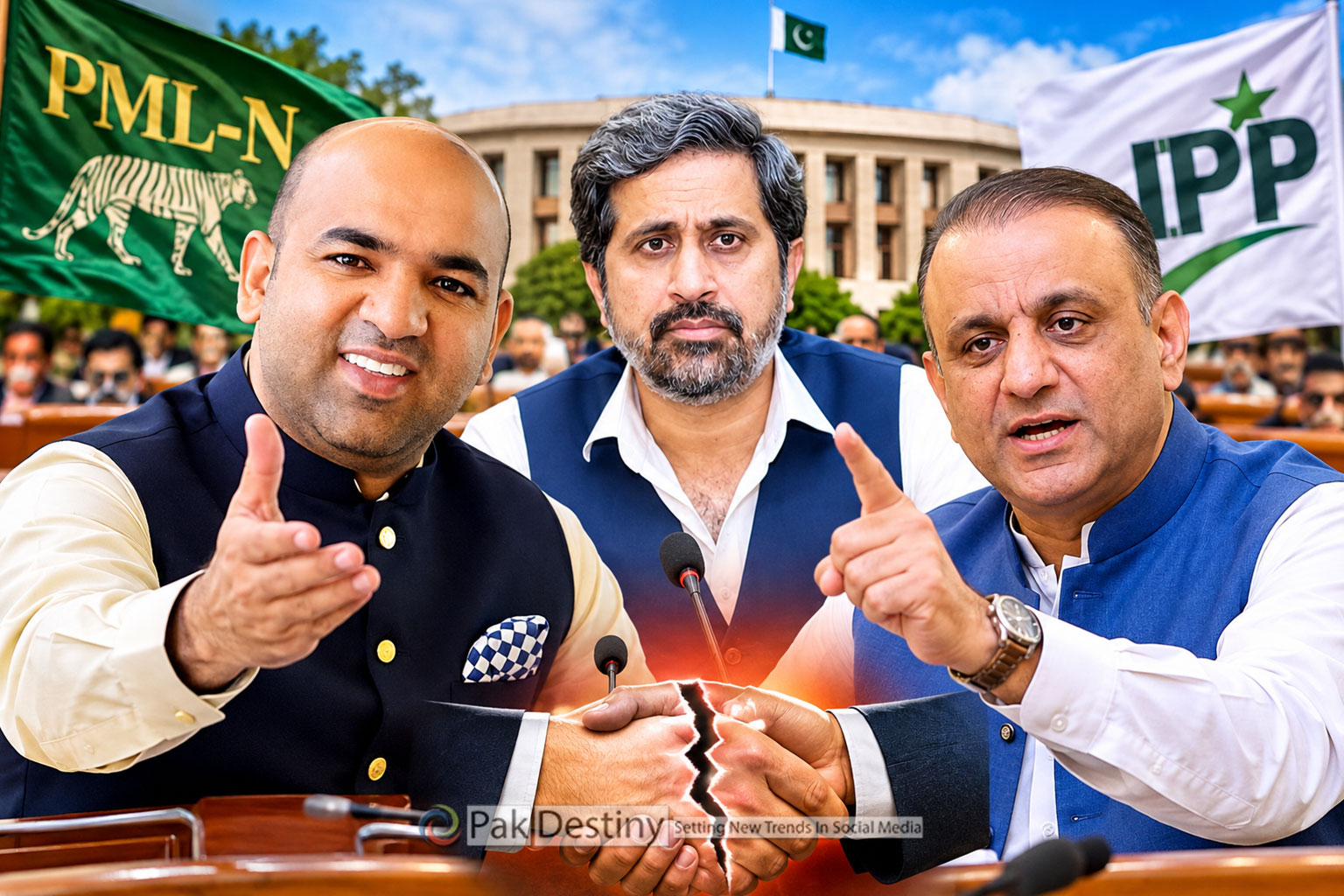
Rana Sikandar, Fayyazul Hasan Chohan exchange barbs over Aleem Khan
— Latest row exposes growing cracks in Maryam-led Punjab government’s alliance management
By Irum Saleem
The PML-N-led Punjab government appears to be finding it increasingly difficult to keep its coalition partners on the same page, as another public confrontation with an ally has erupted, this time involving the Istehkam-i-Pakistan Party (IPP), with political differences quickly descending into personal attacks, allegations and threats.
Barely had the ruling PML-N managed to contain its bitter exchange with the Chaudhry family of the PML-Q than Punjab Education Minister Rana Sikandar Hayat and IPP spokesperson Fayyazul Hasan Chohan traded barbs over remarks concerning IPP president Abdul Aleem Khan, exposing fresh cracks in the coalition’s political understanding.
The latest episode raises an uncomfortable question for the Maryam Nawaz administration: can a government afford to repeatedly antagonise parties whose support is essential to its political strength, particularly when disagreements are increasingly being aired through public insults rather than resolved through coalition consultations?
The confrontation began when Mr Chohan publicly reprimanded the Punjab government over what he described as derogatory remarks by its ministers against Mr Aleem. Drawing a parallel with the recent controversy involving PML-Q leader Chaudhry Salik Hussain, he questioned why the provincial leadership was repeatedly picking fights with its own allies.
He asked whether the chief minister and information minister’s earlier harsh exchanges with the Chaudhry family had not been enough, and why another coalition partner was now being drawn into a similar confrontation.
Calling it politically unwise to target the leadership of an allied party, Mr Chohan reminded the PML-N that the IPP was part of its governments both at the Centre and in Punjab.
But his statement was hardly an exercise in political restraint either. While accusing the provincial minister of lacking political experience, he took a personal swipe at his political credentials, saying his career had only become known after the February 8, 2024 general elections, whereas Mr Aleem was a seasoned politician.
He also defended Samaa TV and other media organisations’ right to criticise the government, arguing that ministers should respond with patience rather than resorting to personal attacks or attempts to intimidate journalists and media owners.
In a particularly pointed passage, Mr Chohan defended Mr Aleem against references to his financial standing and his journey from travelling on a motorcycle to owning an aircraft. Instead of displaying jealousy, he advised the minister to work hard and build his own standing.
He went on to suggest that the minister could take inspiration from his own party leadership if he did not regard Mr Aleem as a role model.
Although Mr Chohan claimed to have deliberately exercised restraint because the IPP was a coalition partner, his warning that alliance politics could move from “silent mode” to “violent mode” betrayed the depth of resentment within the party.
Rana’s counterattack
Mr Hayat, however, was in no mood to let the criticism pass unanswered. In an equally combative response, he questioned whether a provincial minister was not even entitled to name the leaders of powerful and wealthy political parties.
“Have you been intimidating everyone, switching political parties and committing fraud?” he asked, making serious allegations against the IPP spokesperson.
The education minister also accused the IPP of displaying hostility towards education, telling Mr Chohan that he had chosen the wrong portfolio and the wrong minister to confront.
Escalating the personal dimension of the dispute, Mr Hayat claimed to possess the complete account of Mr Aleem’s rise from a motorcycle to an aircraft and threatened to expose it.
“Keep your arrogance about your wealth to yourself,” he said, adding that the public was rejecting what he termed the IPP’s blackmailing tactics.
The exchange has turned what could have been a routine disagreement between coalition partners into an embarrassing public spectacle, with neither side appearing willing to exercise the restraint expected of political allies sharing power.
More troubling is the apparent pattern. The PML-Q has already had a bitter public encounter with the Punjab leadership over allegations and political differences involving Chaudhry Salik Hussain. Now the IPP, another coalition partner, has felt compelled to publicly warn the government against targeting its president.
For a government that depends on political cooperation, such repeated confrontations raise questions not only about its coalition management but also about the political judgement of those entrusted with defending it.
Coalition partners are not necessarily expected to agree on every issue. Nor does their participation in government make their leadership immune from criticism. But there is a difference between legitimate political disagreement and the sort of personal mudslinging that turns allies into public adversaries.
The irony is that both sides claim to be defending political dignity, yet their exchanges have revolved around personal wealth, alleged political histories, physical appearance, intimidation and threats of exposure rather than policy or governance.
For the education minister, the more pressing test of his portfolio would arguably be to answer questions about the state of Punjab’s schools rather than engage in a public contest over the business fortunes of a coalition leader. Similarly, the IPP’s claim to political maturity sits uneasily with its own threat of moving coalition politics into a ‘violent mode’.
Ultimately, the episode reflects a troubling culture in which coalition partners appear more comfortable trading insults on social media than resolving differences through political dialogue.
If the PML-N leadership fails to rein in such exchanges and restore some discipline within its ranks, the repeated alienation of allies could become a political liability for the Maryam Nawaz government.