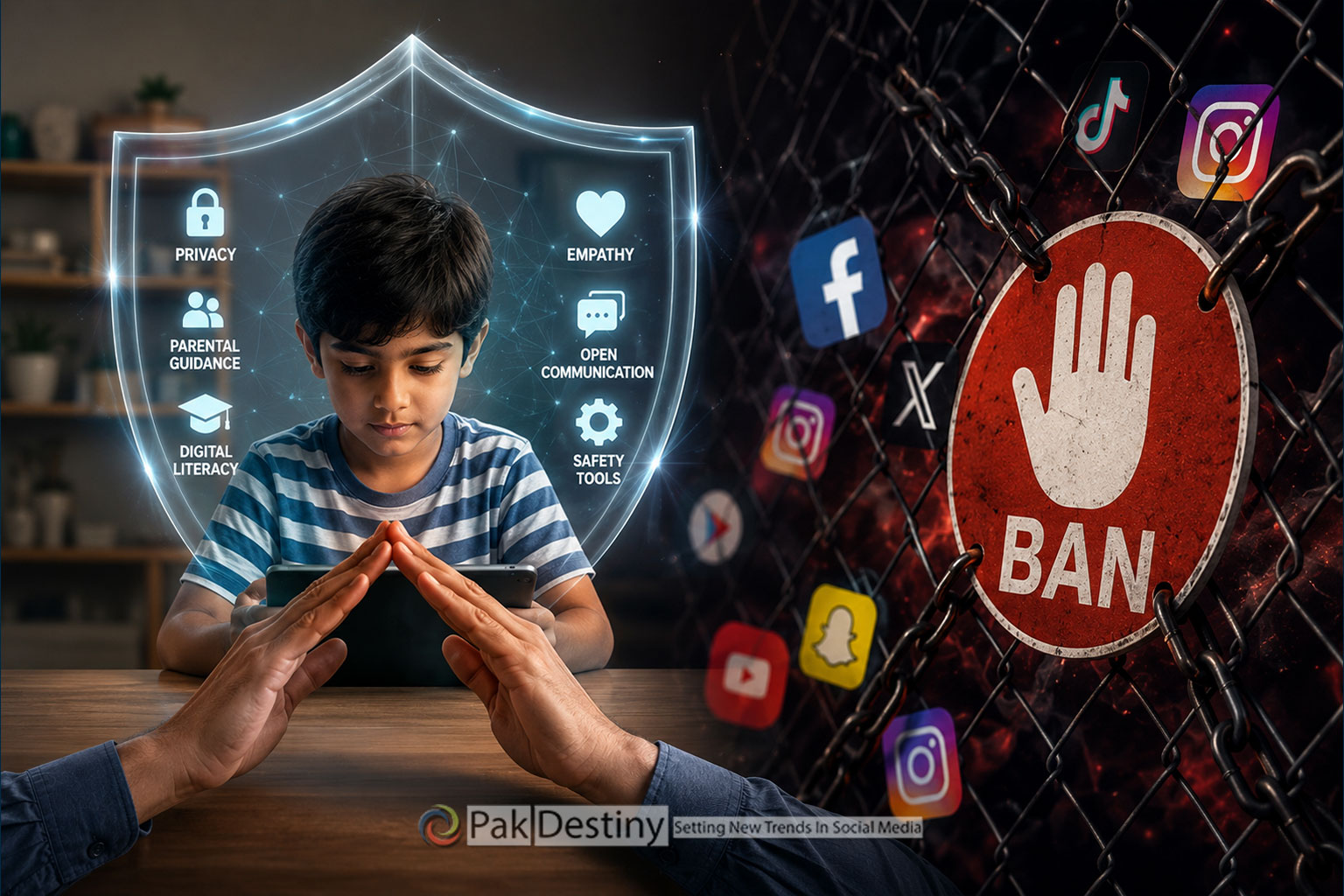
— As governments consider banning children from social media, the real challenge lies in making digital platforms safer through stronger safeguards, better regulation and informed parenting
By Asad Baig
In a Los Angeles courtroom, 20-year-old Kaley G.M. described a childhood shaped by social media.
She started using YouTube at the age of six and Instagram at nine. At one point, she said, she spent up to 16 hours a day on Instagram.
By the age of 10, she had uploaded 240 videos and created nine additional accounts just to like and comment on her own posts.
She told the jury that social media disrupted her sleep, education and friendships, while worsening her anxiety, depression and body-image concerns.
Meta and Google argued that her problems stemmed from other factors, including bullying and difficulties at home. Her lawyers, however, focused on the platforms themselves, arguing that features such as autoplay, endless scrolling and constant notifications were deliberately designed to keep users online. After more than 40 hours of deliberation, the jury found both companies negligent.
The verdict was historic because it came in the first US jury trial to hold social media companies responsible not for content posted by users, but for the way their platforms were designed and operated.
Kaley’s story is not unique. In 2024, Meta chief executive Mark Zuckerberg faced grieving parents during a US Senate hearing.
Holding photographs of children who had died after being exploited or harmed online, they demanded accountability.
Zuckerberg turned to them and apologised.
The risks go far beyond addiction. Social media gives predators direct access to children, making it easier to groom, exploit and blackmail them.
A simple message, compliment or fake friendship can become the start of abuse. Children are also exposed to cyberbullying, self-harm content, violent material and unrealistic beauty standards.
As screen time increases, sleep, studies and real-life relationships often suffer.
The problem is not only that children come across harmful content.
It is that many platforms are deliberately designed to keep them engaged for as long as possible.
The companies have known about these dangers for years.
Their response has largely been limited to moderation tools, reporting systems, parental controls and age restrictions. These measures have not been enough.
Harmful content continues to spread, predators easily create new accounts, and children regularly bypass age limits.
The failure is becoming harder to ignore.
In 2024, the US Federal Trade Commission concluded that major social media platforms had failed to provide adequate safeguards for children and teenagers.
In 2026, European regulators said Meta had failed to stop children under 13 from using Instagram and Facebook. Around the same time, Britain’s communications regulator, Ofcom, reported that 73 per cent of children aged 11 to 17 had encountered at least one form of harmful online content during the previous four weeks. These findings show that platforms often respond only after scandals, rather than preventing harm in the first place.
Growing concern has pushed governments towards stricter action.
Australia became the first country to require social media companies to take reasonable steps to prevent children under 16 from opening accounts. The law came into effect in December 2025.
Britain has announced similar plans, expected to take effect in spring 2027, along with tighter rules on livestreaming and contact between children and strangers.
Pakistan is considering a similar approach.
A resolution submitted to the Punjab Assembly proposes restricting social media accounts for children under 16 unless they have verified parental consent. It calls on the federal government to introduce legislation, asks the Pakistan Telecommunication Authority to enforce age verification, and urges platforms to remove harmful content more quickly.
A ban may appear to offer a simple solution to a serious problem. But its political appeal may be greater than its practical impact.
It allows governments to appear decisive while avoiding the more difficult task of enforcing regulations, holding platforms accountable and investing in long-term child protection.
Pakistan also faces practical challenges. Economic disparities, digital inequality and limited administrative capacity make it difficult to implement a fair age-verification system. Identity checks, facial age estimation and parental verification could create new privacy concerns and exclude many users.
Children may still bypass restrictions by using false dates of birth or an adult’s account.
Even countries with stronger regulatory systems face similar problems.
In July 2026, researchers created 50 Australian accounts claiming the users were exactly 16 years old. None of the accounts was asked to verify the age.
The experiment did not show that younger children could easily register, but it highlighted how much enforcement depends on platforms detecting false information and deciding when additional checks are needed.
A blanket ban may also give parents a false sense of security. If they believe children cannot use Instagram or TikTok, they may assume the danger has disappeared. In reality, children could simply move to less visible spaces such as WhatsApp or Telegram groups, Discord servers, online gaming communities or platforms like Roblox. The risks remain but become harder to monitor.
That is why education must be part of the solution. The government should invest in long-term digital safety programmes for parents, teachers and children. Families need to learn how to recognise grooming, sextortion, cyberbullying and addictive online behaviour, and where to seek help. Parents cannot protect children from dangers they do not understand.
Pakistan therefore needs a broader strategy than simply banning children from social media. Platforms should be required to make children’s accounts private by default, limit contact from strangers, ban targeted advertising aimed at minors, redesign recommendation systems and respond quickly to reports of grooming and sexual exploitation.
Reporting tools and parental controls should also be available in Urdu and regional languages, while independent audits should regularly test whether these protections actually work.
Pakistan can also build on its role in global cyber governance. The country supported the UN Convention against Cybercrime and played an active part in negotiations on capacity building, technology transfer and international cooperation. Although the convention does not specifically regulate social media platforms, Pakistan’s participation shows it can help shape international digital policies rather than simply follow them.
An even stronger opportunity lies in the Global Digital Compact, which calls for a safer digital environment for children and regular monitoring of platform policies on online child sexual exploitation and abuse.
Pakistan should work with other developing countries to push for common safety standards, greater transparency and meaningful penalties for companies that repeatedly fail to protect children.
The goal should not be to keep children away from the digital world. It should be to ensure that the digital world is held responsible for how it treats them.
The writer is the founder of Media Matters for Democracy.
The article first appeared in Dawn