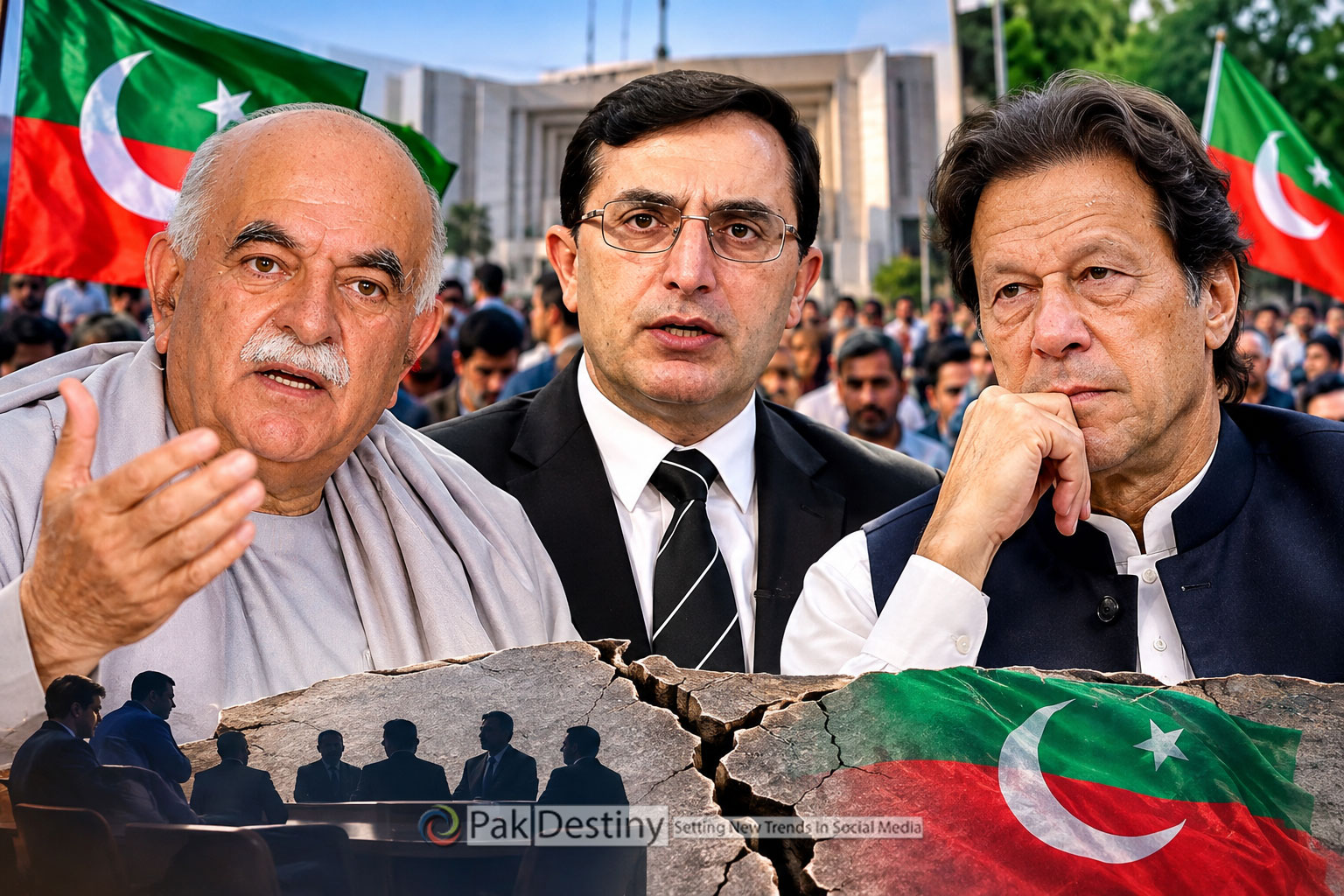
— Mahmood Khan Achakzai’s call for a national government and sweeping political reforms has exposed a growing coordination problem within the opposition alliance, with the PTI distancing itself from its chief’s proposals
By Zulqernain
Instead of floating competing political arrangements, the opposition needs to agree on a common agenda to defend democratic rights and prepare for credible elections.
The opposition alliance is once again struggling to speak with one voice. This time, the fault line has emerged over a proposal by its own chief, Mahmood Khan Achakzai, for the formation of a national government and sweeping political and constitutional reforms.
The PTI’s decision to distance itself from the proposal, without issuing a formal public statement, has raised an uncomfortable question: does Mr Achakzai speak for the entire opposition alliance or merely articulate his own political vision?
Background conversations by PTI leaders with the media suggest that the party was neither consulted nor fully on board before the proposal was made public. If so, the episode exposes a serious weakness in the Tehreek Tahaffuz-i-Ayeen-i-Pakistan (TTAP), which was expected to provide a united platform for opposition parties confronting the government.
This is hardly the first sign of trouble. A similar disconnect surfaced a couple of months ago when the PTI announced a protest march on Islamabad, apparently without securing the support of its alliance partners. Repeated episodes of this nature suggest that the alliance has yet to develop even a basic mechanism for consultation and collective decision-making.
Mr Achakzai’s emphasis on constitutional supremacy, parliamentary sovereignty and the restoration of democracy is, of course, difficult to dispute. His concerns about deteriorating security in Khyber Pakhtunkhwa, Balochistan and Azad Jammu and Kashmir also deserve serious consideration. But identifying the country’s problems is one thing; proposing a workable political solution is quite another.
The idea of a national government, in particular, raises more questions than it answers. Who would constitute such a government? On what constitutional and political mandate would it operate? How long would it remain in office, and what would be its principal objectives? Without clarity on these fundamental questions, the proposal risks adding another layer of uncertainty to an already polarised political environment.
More importantly, Pakistan does not need another political experiment whose contours, mandate and exit strategy remain undefined. Any attempt to replace the existing arrangement without broad political consensus could deepen divisions rather than resolve them.
The opposition’s immediate challenge, therefore, is not to come up with competing formulas for a new political setup but to establish a credible common agenda. It must first decide whether it wants to function as a parliamentary opposition, a protest movement or a coalition seeking an alternative arrangement. These objectives are not necessarily incompatible, but they require coordination, political discipline and a shared strategy.
There is still considerable ground on which opposition parties can build consensus. Protection of civil liberties, restrictions on freedom of expression, political prisoners and the restoration of normal democratic administration in KP are issues that directly affect the quality of governance and the credibility of the political system.
Instead of allowing internal disagreements to overshadow these concerns, the opposition should use the remaining parliamentary term to hold the government accountable. Sustained parliamentary engagement, backed by public mobilisation on democratic rights, would be a more meaningful exercise than floating proposals that even alliance partners appear reluctant to endorse.
There is also an urgent need for political forces on both sides of the aisle to start discussing the framework for the next general elections.
Agreement on electoral safeguards, the neutrality of state institutions and a level playing field for all political parties is essential if the country is to avoid another disputed electoral exercise.
The government, too, cannot remain indifferent to this responsibility. A credible electoral process cannot be secured through unilateral decisions or by keeping major political stakeholders outside the political conversation.
Ultimately, constitutional supremacy cannot be demanded from the government while being ignored within political alliances themselves. If opposition parties cannot consult one another before announcing major political initiatives, their claim to offer a more democratic alternative will remain unconvincing.
Mr Achakzai and his alliance partners would do well to put their house in order before demanding a new one for the country.
The opposition still has an opportunity to rebuild public confidence through parliamentary politics, political engagement and a united campaign for credible elections. Squandering it on premature proposals and public contradictions would only strengthen the impression that it is united more by its opposition to the government than by any common vision for Pakistan.