By Irum Saleem
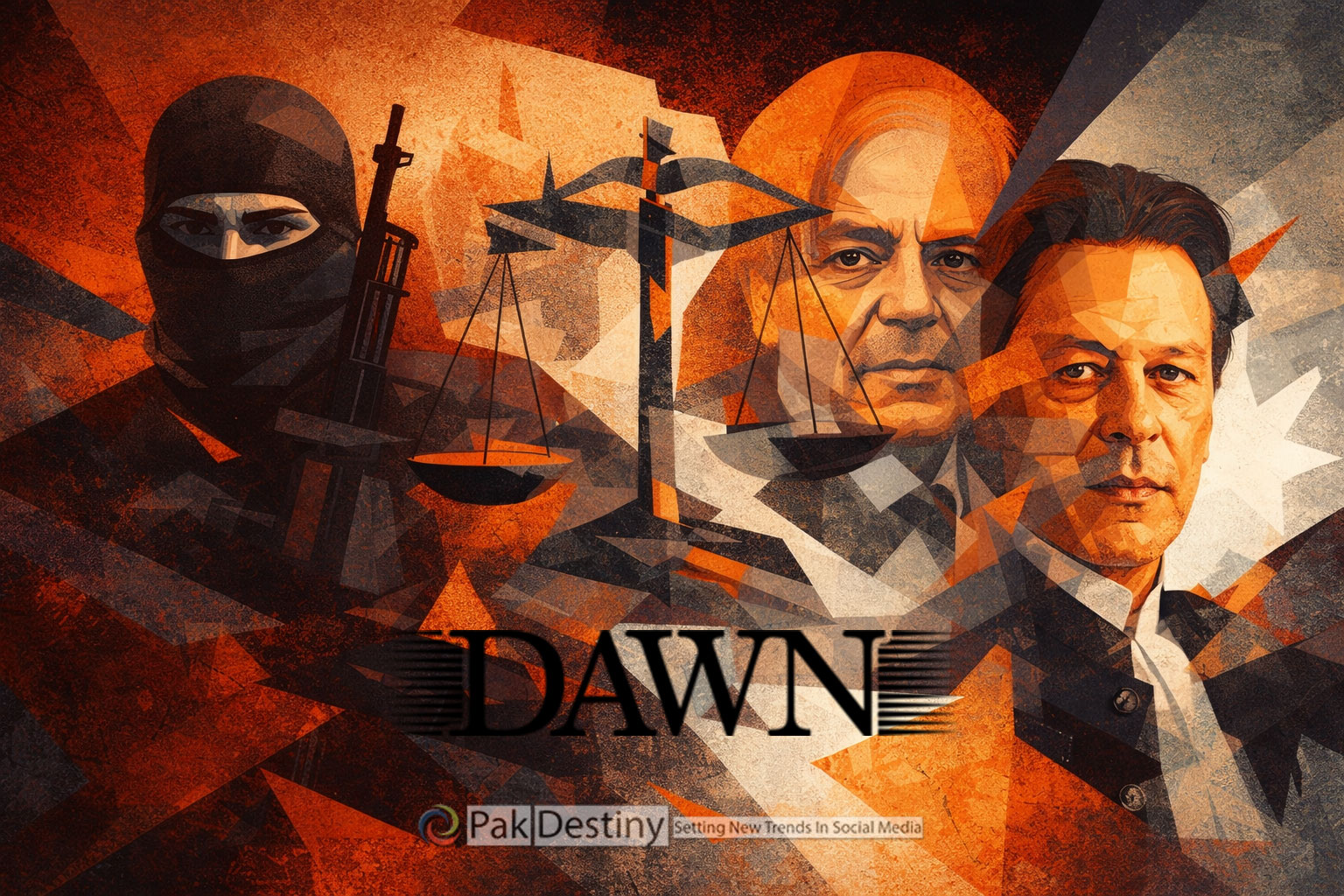
Dawn has exposed the “justice system” currently prevailing in Pakistan with one classic example.
“Even as the country faces heightened risks of attacks from actual terrorists, an anti-terrorism court in Rawalpindi was this week occupied with sentencing 47 individuals, including several prominent political leaders, to 10 years’ imprisonment in terrorism cases long criticised as weak and politically motivated,” Dawn writes in its editorial.
The accused’s crimes were certainly not trivial, yet they do not seem to qualify as ‘terrorism’.
“The charges of arson, vandalism, attacks on police officials and damage to government property were proven against the accused,” the judgement reads.
The court also imposed fines of Rs500,000 on each convict and the confiscation of their properties. Was this necessary, it must be asked.
Indeed, the verdict and its unfortunate timing have shone a rather unflattering light on where the state’s priorities appear to lie, with Pakistan’s western front seized with war and destruction and national stability facing a particularly severe threat from unforeseen economic shocks.
This is a time one would expect a healing touch and a more forgiving approach from those in power, as well as sincere efforts to build bridges so that the nation may confront its challenges as one.
Instead, this judgement will more likely polarise the polity than unite it.
It is important to keep perspective. There are dark clouds over the entire region, as powerful global stakeholders attempting to exploit internal political divisions in a neighbouring state have triggered a war that is quickly spiralling out of control.
Pakistan itself is engaged in an indefinite military operation against another western neighbour, Afghanistan, to stamp out threats to its national security that emanate from there.
Meanwhile, oil supply disruptions have further imperilled the Pakistani economy and threaten to trigger another round of painful turmoil that could have unanticipated sociopolitical spillovers.
“This seems like a time for all stakeholders to close ranks against the external threats faced by the nation, not weaken it internally by provoking greater political divisions,” the paper says.
This applies equally to the political opposition. This should be a time when even the bitterest of differences are set aside so that imminent challenges can be tackled with unity of purpose.
Choosing political differences over reconciliation will do no service to the people of Pakistan; it will merely complicate the country’s responses to the looming crisis. “The people deserve better from their leaders. It is time the latter turned over a new leaf,” Dawn lambasted.