By Zulqernain
In an increasingly fragmented and volatile world order, where diplomacy is being reshaped by shifting alliances, economic rivalries, technological competition, and regional conflicts, the role of independent policy institutions has become more important than ever.
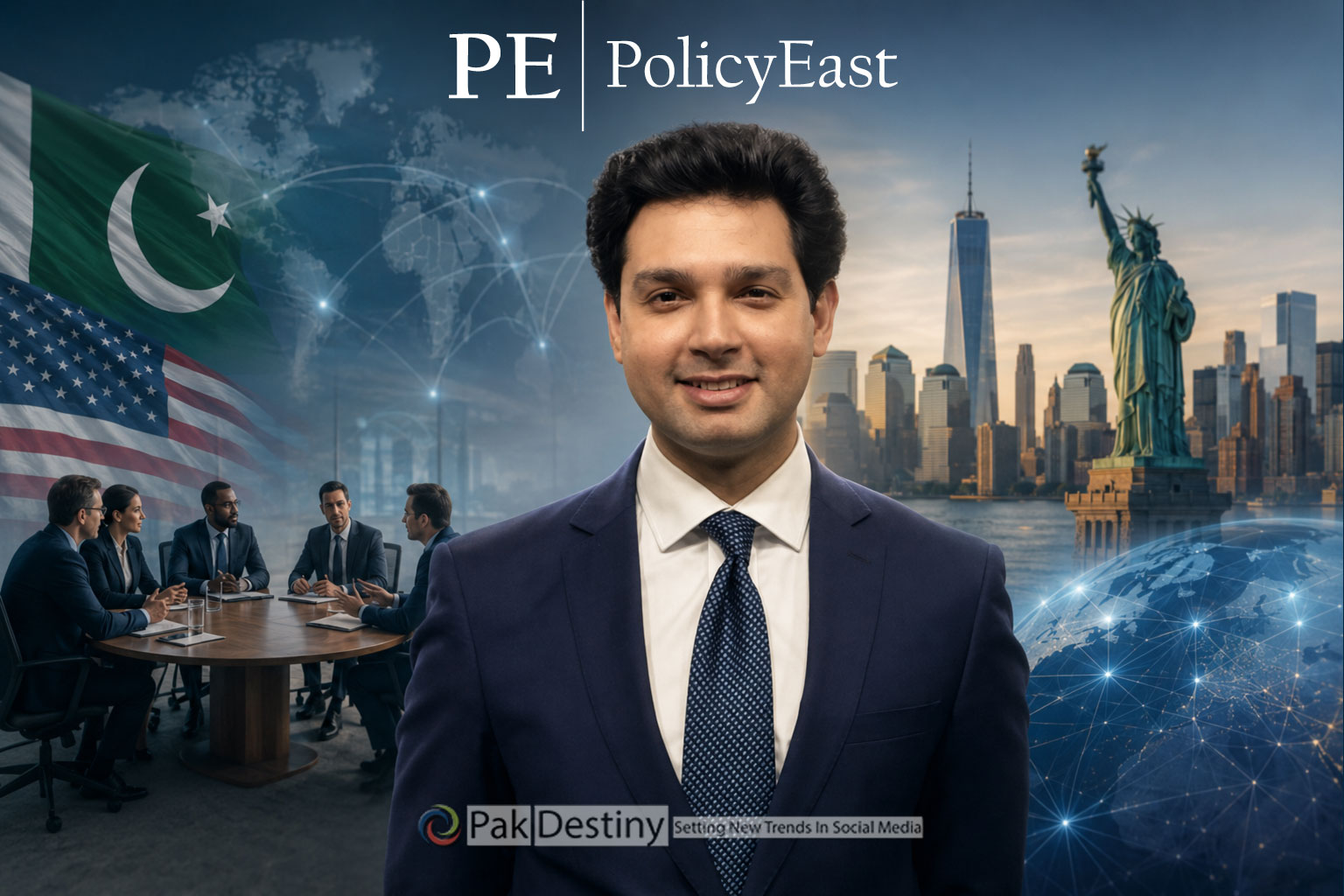
Against this backdrop, Pakistan-origin think tank Policy East is emerging as a dynamic intellectual force, positioning itself at the crossroads of global strategic debate with an ambitious expansion into New York City — the diplomatic nerve centre of the world.
The move signals more than a geographical expansion. It represents a strategic effort to amplify Pakistani intellectual engagement on the global stage and contribute meaningfully to discussions shaping the future of international politics, regional security, economic transformation, and geopolitical realignments.
By establishing a footprint in New York, Policy East aims to become a vital bridge between Pakistan and the United States, fostering deeper understanding through rigorous research, academic collaboration, and policy dialogue.
The initiative seeks to create a sophisticated platform where scholars, diplomats, policymakers, and strategic experts from both East and West can engage in meaningful intellectual exchange free from conventional political limitations.
Expanding Pakistan’s intellectual presence globally
At a time when South Asia, the Middle East, and the Indo-Pacific are becoming central theatres of global competition, Policy East is positioning itself as a hub for nuanced, evidence-based analysis capable of interpreting rapidly evolving geopolitical realities.
The think tank’s leadership believes there is growing international demand for informed perspectives originating from Pakistan and the wider region — perspectives that can explain regional complexities with greater depth and authenticity.
Its New York expansion reflects a broader vision — integrating Pakistani intellectual capital into mainstream global discourse and ensuring that voices from the global south contribute actively to international policymaking debates.
From regional conflicts and strategic competition to economic connectivity and emerging technologies, Policy East aims to offer research-driven policy recommendations that move beyond rhetoric and contribute toward practical, forward-looking solutions.
As part of its transformation into a globally connected institution, Policy East has expanded its outreach to a diverse network of professionals and scholars.
The organization is opening new avenues for academics seeking to publish rigorous, peer-reviewed work on international affairs and regional security;
researchers analysing political stability, governance, economic transitions, and emerging markets;
diplomats and foreign policy practitioners interested in high-level Track II diplomacy and strategic engagement;
policy experts exploring new frameworks for cooperation between Asia, the Middle East, Europe, and North America.
The think tank’s leadership believes such engagement is essential in an era where traditional diplomatic mechanisms are increasingly complemented by intellectual diplomacy and research-based dialogue.
Rather than remaining a passive observer of world affairs, Policy East aims to become an active engine of ideas capable of shaping policy conversations at regional and international levels.
Dr. Taimur Shamil’s vision for a global Think Tank
At the centre of this ambitious expansion stands Dr. Taimur Shamil, the President and Executive Director of Policy East, whose vision is driving the organization’s transformation from a regional policy platform into a globally recognised strategic institution.
Known for advocating intellectual engagement and cross-regional dialogue, Dr. Shamil sees the New York initiative as part of a larger mission to connect Asian and Middle Eastern perspectives with global policymaking centres.
“Our presence in New York is more than just a physical expansion; it is a commitment to excellence,” Dr. Shamil said while outlining the organization’s future direction.
“Policy East is here to ensure that Pakistani intellectual capital is integrated into the global discourse. We are building a bridge of knowledge that connects the Middle East and Asia to the global stage, providing the world with research that is as sharp as it is relevant,” he added.
Under his leadership, the think tank is seeking to establish itself as a top-tier global policy institution capable of producing influential research, hosting strategic dialogues, and facilitating collaboration among international scholars and policymakers.
Analysts view Policy East’s expansion as particularly significant at a time when Pakistan-U.S. relations are entering a new phase shaped by evolving geopolitical realities, economic cooperation, regional security concerns, and changing strategic priorities.
The organization hopes to contribute toward a more mature and multidimensional relationship between Islamabad and Washington by encouraging informed discussion on issues ranging from regional stability and counterterrorism to trade, technology, climate security, and energy cooperation.
Observers say think tanks are increasingly becoming critical actors in international relations by creating informal channels of communication that complement official diplomacy.
In this environment, Policy East’s New York presence may help open new pathways for dialogue between policymakers, academics, business leaders, and strategic communities from both countries.
A New Intellectual Frontier
As geopolitical competition intensifies and global institutions face mounting challenges, the emergence of research-driven platforms capable of connecting diverse regions and perspectives is becoming increasingly important.
Policy East’s expansion into New York represents an effort to place Pakistani scholarship and strategic thinking at the centre of these conversations.
With ambitions of becoming a globally influential policy institution, the think tank is positioning itself not merely as a research organisation, but as a platform for intellectual diplomacy — one designed to shape debates, influence ideas, and contribute to a more interconnected global policy landscape.