
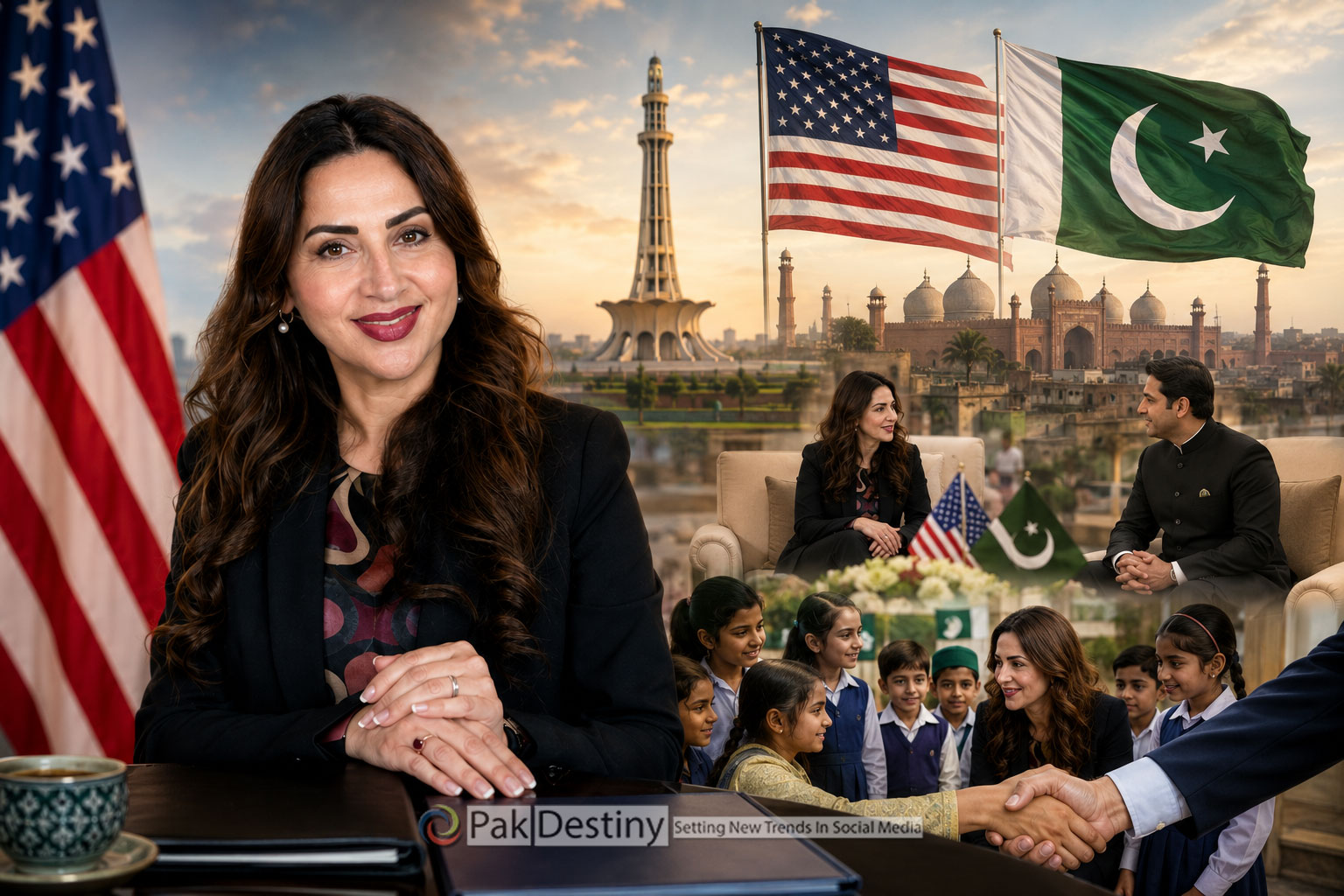
By Dr. Syed Imran Ahmad Shah
Introduction: Can One Person Change the Image of a Nation?
One of the most intriguing questions in Public Relations and Media Studies is whether a single individual can influence public opinion and contribute to reshaping the image of an entire nation. Governments spend billions of dollars annually on international communication campaigns, image building, opinion making, media outreach, cultural exchanges, and strategic diplomacy. Yet history repeatedly demonstrates that sometimes a single credible, visible, and relatable individual can accomplish what large-scale communication campaigns struggle to achieve.
From the perspective of a researcher in Media Studies and a Public Relations practitioner with more than twenty years of professional experience, I find the public diplomacy efforts of U.S. Chargé d’Affaires to Pakistan, Natalie A. Baker, to be a remarkable contemporary case study in strategic communication, image building, soft power, and public opinion formation.
Her engagement with Pakistani society demonstrates how modern diplomacy has evolved beyond government-to-government interactions and entered the realm of relationship building, cultural integration, and people-centered communication.
Beyond Traditional Diplomacy
Traditionally, diplomacy has been associated with formal meetings, policy discussions, diplomacy, gestures diplomatic negotiations, and official statements. However, modern communication theories suggest that successful diplomacy in the twenty-first century requires something much deeper: emotional connection and public engagement. People rarely develop opinions about countries through policy documents. Instead, they form perceptions through stories, experiences, images, relationships, and human interactions.
This understanding appears to be at the heart of Chargé d’Affaires Natalie A. Baker’s communication strategy.
Rather than remaining confined to diplomatic circles, she has consistently engaged with Pakistani communities, students, entrepreneurs, women, youth groups, media , local culture, sports enthusiasts, cultural organizations, and ordinary citizens. Whether attending cultural events, interacting with young people, appreciating Pakistani traditions, enjoying local cuisine, participating in sporting activities, or wearing traditional Pakistani dresses, she has projected an image of accessibility, humility, and respect.
To an ordinary observer these may appear to be routine public appearances. To a Public Relations scholar, however, they represent a highly sophisticated and effective communication strategy grounded in established theories of relationship management and public opinion formation.
Public Relations in Action
Most Public Relations textbooks define PR as the strategic management of relationships between organizations and their publics. Public relations is a strategic communication process that builds mutually beneficial relationships between organizations and their publics. Modern PR is no longer limited to publicity, press releases, and media management. Instead, it focuses on building trust, credibility, mutual understanding, and long-term relationships. The work of leading scholars such as Grunig and Hunt emphasizes that successful communication is based on dialogue rather than one-way persuasion. The most effective organizations are those that listen, engage, and develop meaningful relationships with stakeholders.
Baker’s activities reflect these principles in practice.
Her public engagements communicate a simple but powerful message: respect for Pakistani culture, appreciation for local traditions, and willingness to connect with people beyond official diplomatic channels. This is Public Relations at its finest. With deep penetration impact—not communication through speeches alone, but communication through actions.
Public Opinion Theory: Changing the “Pictures in Our Heads”
To understand the broader significance of her activities, it is important to examine how public opinion is formed.
Public opinion scholar Walter Lippmann argued that people often respond not to reality itself but to the “pictures in their heads.” These perceptions are shaped by media representations, personal experiences, cultural narratives, and social interactions.
For many people, perceptions of foreign countries are often based on political events, media coverage, historical experiences, and stereotypes. Such perceptions can remain deeply entrenched for years. However, positive human interaction has the potential to challenge these assumptions.
When Pakistanis see a foreign Chargé d’Affaires participating in local traditions, celebrating cultural diversity, interacting warmly with communities, enjoying Pakistani food, supporting youth initiatives, or attending local events, new perceptions begin to emerge. Gradually, abstract political images are replaced by human experiences.
This is one of the most powerful mechanisms through which public opinion evolves.
The Two-Step Flow of Influence
The Two-Step Flow Theory developed by Lazars Feld and Katz provides another useful lens for understanding her impact. The theory suggests that information rarely influences the public directly. Instead, it often passes through opinion leaders who interpret and share messages with wider audiences.
In today’s digital environment, journalists, academics, social media influencers, community leaders, students, and bloggers serve as modern opinion leaders.
Every time Baker participates in a cultural event or community activity, those interactions are amplified through social media, television coverage, newspapers, and online discussions. The impact therefore extends far beyond the immediate audience present at the event. Through this process, positive messages travel across society and contribute to broader perception building.
The Power of Cultural Integration
One of the most significant elements of Natalie A. Baker’s public diplomacy has been her willingness to embrace Pakistani culture.
Public Relations scholars consistently emphasize that cultural sensitivity is essential for effective communication. People respond positively when they feel respected, valued, and understood.
When a foreign diplomat wears traditional Pakistani attire, attends cultural celebrations, enjoys local cuisine, appreciates local customs, or participates in activities that resonate with ordinary citizens, these actions communicate far more than words.
A single photograph and video of a diplomat enjoying Pakoras may generate greater emotional engagement than dozens of carefully crafted policy statements.
Why?
Because people connect emotionally before they connect intellectually.
This is a fundamental principle of communication psychology and Public Relations.
Humanizing a Superpower
One of the greatest challenges facing any major power is overcoming stereotypes and political perceptions. Countries are often viewed through the lens of international conflicts, geopolitical competition, or historical controversies.
Public diplomacy offers a different pathway.
Rather than communicating through power, it communicates through relationships.
Rather than emphasizing authority, it emphasizes understanding. Rather than projecting distance, it creates proximity. Through her interactions across Pakistani society, Natalie A. Baker’shas contributed to presenting a more approachable and relatable image of the United States.
She has helped humanize a superpower.
Her public appearances communicate warmth rather than formality.
Her interactions reflect accessibility rather than distance.
Her engagement projects friendship rather than hierarchy. This is the essence of modern soft-power diplomacy.
Soft Power and Nation Branding
Political scientist Joseph Nye argued that influence is often achieved not through coercion but through attraction. Countries become influential when people admire their values, culture, educational opportunities, innovation, and relationships. This concept, known as Soft Power, is highly relevant to Baker’s communication strategy.
Every interaction with students.
Every conversation with community members.
Every cultural engagement.
Every appearance in traditional attire.
Every sporting event attended.
Every local meal shared.
Together these activities contribute to a larger narrative of friendship, respect, and partnership.
This is nation branding in its most human form. Social Media, Visual Storytelling, and Agenda Setting, Modern Public Relations is increasingly driven by visual communication.
Images travel faster than speeches.
Photographs communicate emotions more effectively than policy documents. Agenda-Setting Theory suggests that media influence what people think about by highlighting certain issues and themes. Through consistent visibility in positive and community-oriented activities, Natalie A. Baker’s has helped shape public conversations around educational cooperation, cultural exchange, youth engagement, entrepreneurship, and people-to-people relations. Every image shared on social media contributes to a cumulative process of image construction. Over time these repeated positive messages create familiarity. Familiarity creates trust and contributes to reputation, reputation ultimately shapes public opinion.
Building Trust through Visibility
Trust remains the most valuable asset in Public Relations. Research consistently demonstrates that trust cannot be demanded it must be earned through consistent actions. Her communication strategy has attracted attention is her visibility across diverse segments of Pakistani society.
Her engagement extends beyond political elites.
She interacts with students, educators, entrepreneurs, women, cultural groups, sports communities, development organizations, and ordinary citizens. This broad-based outreach reflects one of the core principles of stakeholder engagement: successful communication requires reaching all relevant publics. By doing so, she expands opportunities for dialogue, understanding, and trust-building.
Lessons for Public Relations Professionals
For students, researchers, diplomats, and communication practitioners, Chargé d’Affaires Baker’s experience offers several valuable lessons:
- People trust people more than institutions.
- Public opinion is shaped through experiences, not merely messages.
- Cultural respect enhances communication effectiveness.
- Visibility creates familiarity.
- Familiarity builds trust.
- Trust strengthens reputation.
- Authenticity is more persuasive than promotion.
- Images often communicate more effectively than speeches.
- Soft power produces long-term influence.
- Relationship building remains the foundation of successful Public Relations.
A Model worth Studying
As a PhD in Media Studies, former Research Fellow at Michigan State University, and a Public Relations practitioner with extensive experience in strategic communication, I believe Chargé d’Affaires Natalie A. Baker’s public diplomacy efforts deserve scholarly examination as a contemporary case study in image building, public diplomacy, nation branding, and public opinion management. Her activities demonstrate that successful communication is not simply about transmitting information.
It is about creating relationships.
It is about building trust.
It is about understanding cultures.
It is about connecting with people.
Most importantly, it is about transforming perceptions through genuine human engagement.
At a time when global communication is increasingly influenced by digital media, political polarization, and competing narratives, her approach serves as a reminder of a timeless truth. People are more likely to trust those who genuinely seek to understand them.
In the language of Public Relations, this reflects effective relationship building.
In the language of Public Opinion Theory, it is perception transformation through human interaction.
In the language of diplomacy, it represents a notable example of public diplomacy.
Indeed, Natalie A. Baker’s work in Pakistan stands as a remarkable example of how one individual, through consistent visibility, cultural respect, emotional intelligence, and authentic engagement, can positively influence public opinion, strengthen people-to-people ties, and contribute to the image of a nation.
It is not merely a success story in diplomacy.
It is a noteworthy case study in Public Relations.
Note : The views expressed are solely those of the author and are presented for academic discussion and research purposes
.
Dr. Syed Imran Ahmad Shah
PhD (Media Studies)
Former Research Fellow, Michigan State University, USA
Public Relations Professional and Researcher


Great observation and excellent narration of acts, behavior and conduct of a professional diplomatic which has created impact on hearts & minds of thousands peoples…..
The United States and Pakistan share a long and resilient friendship rooted in mutual respect and shared goals. From countering terrorism to advancing regional stability, promoting trade, education, and people-to-people ties, our partnership continues to deliver value for both nations. sir you highlighted all this good job sir
The United States and Pakistan share a long and resilient friendship rooted in mutual respect and shared goals. From countering terrorism to advancing regional stability, promoting trade, education, and people-to-people ties, our partnership continues to deliver value for both nations. sir you highlighted all this good job sir