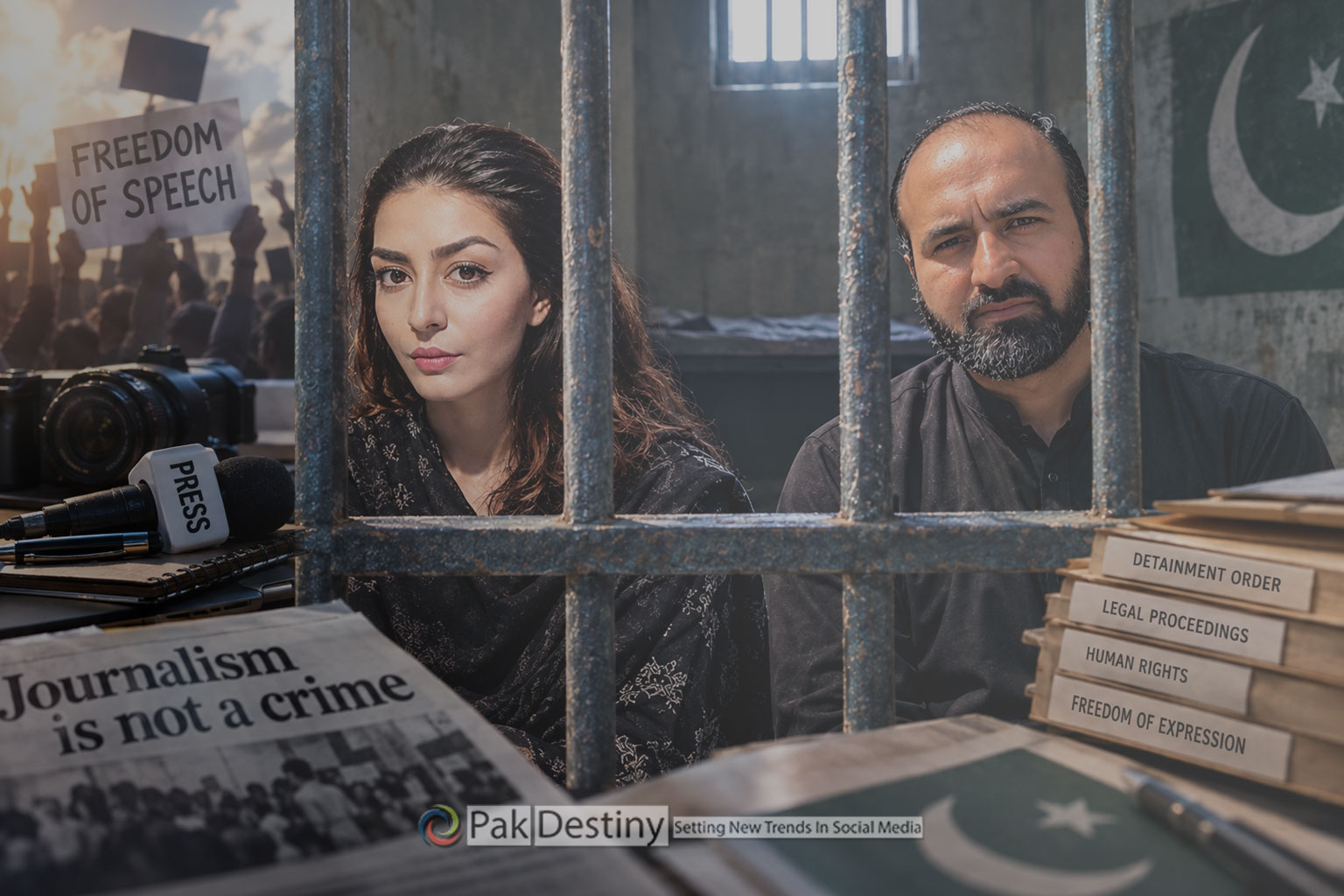
— The decade-long prison sentences handed to two human rights lawyers raise questions about proportionality, fair trial and the price of defending the vulnerable in Pakistan.
By Irum Saleem
For Imaan Zainab Mazari-Hazir and Hadi Ali Chattha, the courtroom has become another battleground — one in which two lawyers who have spent years defending others must now fight for their own freedom.
On Thursday, an anti-terrorism court sentenced the couple to 10 years in prison each in a case concerning the alleged removal of road barriers placed along a route designated for the security of an international cricket team in Islamabad in October 2024.
The verdict has added another chapter to a series of legal battles that have kept the two lawyers behind bars, deepening concerns among rights advocates about the use of criminal proceedings against those who challenge state policies and defend marginalised communities.
At the heart of the case lies a question that extends beyond the fate of two individuals: how far can the state go in invoking its security powers, and what safeguards remain when those facing prosecution accuse the authorities of targeting them for their work?
The prosecution maintained that the couple obstructed public officials and disrupted security arrangements. Imaan and Hadi denied the allegations, arguing that the proceedings were part of a campaign of reprisals for their human rights work.
Their competing accounts must ultimately be tested against the evidence. But the severity of the sentences, combined with concerns about the circumstances of the trial, makes independent judicial scrutiny essential.
Lawyers who became defendants
Imaan and Hadi built their professional lives around cases involving people who often struggle to make themselves heard: families searching for relatives allegedly subjected to enforced disappearance, activists facing prosecution, journalists and people accused under controversial laws.
Their work placed them in direct confrontation with powerful institutions and sensitive questions of accountability. For their supporters, the couple represent a legal profession willing to take up cases others might avoid. For the state, the charges against them concern alleged criminal conduct that must be addressed through the courts.
The distinction matters. A lawyer’s reputation or human rights credentials cannot place anyone above the law. Equally, the state cannot use the existence of criminal charges to avoid scrutiny of whether the evidence supports a conviction and whether the punishment fits the offence.
The principle should be simple: the law must protect both the public interest and the rights of the accused.
A reprieve that did not last
The latest conviction cannot be viewed in isolation.
In January, a sessions court sentenced Imaan and Hadi to 17 years in prison each in a separate case involving social media posts. The convictions drew criticism from rights organisations and legal observers, who questioned the use of cybercrime provisions and the fairness of the proceedings.
In September, the Supreme Court suspended those sentences pending the final outcome of their appeals. The relief, however, was short-lived. Police arrested the couple again within hours in connection with the security-barrier case.
Thursday’s verdict has now resulted in another lengthy prison sentence for each of them.
The sequence of events has prompted questions about whether successive cases are being pursued on their individual merits or whether their cumulative effect is to keep two outspoken lawyers incarcerated. That question cannot be settled by allegation alone; it requires transparent proceedings, reasoned judgments and meaningful appellate review.
But it is a question the authorities should be prepared to answer.
The courtroom behind prison walls
The setting of the trial has added to the concerns.
The proceedings were held at Adiala Jail, with the couple appearing behind a cage-like structure, according to their statements reported by Dawn. They argued that the arrangement restricted effective communication with their counsel and the court. They also challenged the legality of conducting the trial inside the prison.
The defence arrangements have attracted further scrutiny. The court appointed a state counsel, who cross-examined prosecution witnesses. The prosecution presented seven witnesses, according to Dawn’s report.
These procedural details are important.
The appointment of a state lawyer does not, by itself, establish that a trial was unfair. Nor does holding proceedings inside a prison automatically invalidate them. The decisive questions are whether the accused had an effective opportunity to defend themselves, challenge the evidence and receive an impartial hearing.
Those questions become especially important in cases carrying sentences measured in decades rather than months.
A fair trial is not a concession granted by the state to a cooperative defendant. It is a legal guarantee that must remain intact even when the allegations are serious and the accused are outspoken critics of those in power.
What does ten years mean?
A prison sentence is more than a number announced in court. It represents years removed from a person’s life, professional work and family relationships.
For Imaan and Hadi, the sentences come after months in detention and the earlier convictions that were subsequently suspended by the Supreme Court. Their legal battles have already exacted a substantial personal cost.
The wider question is proportionality. If the prosecution established that the couple obstructed officials or interfered with security arrangements, the court was entitled to consider the applicable law and evidence. But the use of anti-terrorism provisions and the imposition of a decade in prison demand a clear explanation of why such severe punishment was warranted.
Protecting an international cricket team’s security is a legitimate state responsibility. No one should be permitted to endanger players, police personnel or members of the public. Yet the importance of that responsibility does not remove the need to distinguish between different forms of alleged misconduct or to ensure that the punishment reflects the conduct proved.
Security cannot become a substitute for proportionality, just as human rights advocacy cannot become a defence against every criminal charge.
Concern beyond Pakistan
The verdict has drawn criticism from international rights organisations.
Amnesty International described the convictions as an indictment of Pakistan’s justice system, arguing that the couple had been denied an open and fair trial and that anti-terrorism charges were being used to punish their advocacy. These are the organisation’s assessments, not findings established by an appellate court.
The International Commission of Jurists has also previously condemned the couple’s prosecution in the separate social media case.
Such criticism carries significance because Pakistan’s constitutional commitments to due process and fundamental freedoms are not merely domestic concerns. The country’s courts and authorities are judged by whether those guarantees are upheld in difficult cases, especially when the defendants have challenged powerful institutions.
The government and prosecution have a responsibility to establish their case through lawful means. The defence, in turn, must be allowed to contest it effectively. Neither the identity of the accused nor the political sensitivity of the allegations should determine the outcome.
The chilling effect
There is a danger that the consequences of this case will extend well beyond the two defendants.
Lawyers who represent families of missing persons, activists who document alleged abuses and journalists who investigate state conduct depend on the assurance that their professional work will not expose them to arbitrary retaliation. If they believe that taking up sensitive cases could invite criminal proceedings or prolonged incarceration, some may hesitate before accepting them.
That possibility deserves attention even if the courts ultimately uphold particular charges. Public confidence in justice depends not only on convictions but also on the credibility of the process through which they are secured.
A state that expects compliance with the law must demonstrate its own commitment to due process. A judiciary that claims independence must be able to examine allegations against the state with the same rigour it applies to allegations against citizens.
The test that remains
Imaan and Hadi have described themselves as prisoners of conscience and alleged that the proceedings are intended to punish them for their human rights work. The prosecution’s case, meanwhile, concerns alleged obstruction of officials and disruption of a security route. These competing positions must be assessed through the evidence and the law, not through assumptions about either side.
The appellate courts now have an important responsibility to examine the convictions, the fairness of the proceedings and the proportionality of the sentences.
If the evidence establishes criminal wrongdoing, the law must take its course. If legal safeguards were compromised or the convictions cannot withstand scrutiny, the remedies provided by the justice system must be effective rather than merely theoretical.
For now, the case leaves Pakistan with an uncomfortable question: what message does a decade-long prison sentence send to a legal community already working in an increasingly contested environment?
The answer will depend not on official declarations about judicial independence, but on whether the courts can demonstrate that justice is being administered fairly, transparently and without fear or favour.
For a country governed by a written Constitution, the ultimate test is not whether the state can punish its critics. It is whether it can prove its case against them while protecting the rights it is constitutionally bound to uphold.