— Dispute over Israel, alleged media curbs and journalists’ political loyalties exposes divisions within Pakistan’s media
By Irum Saleem
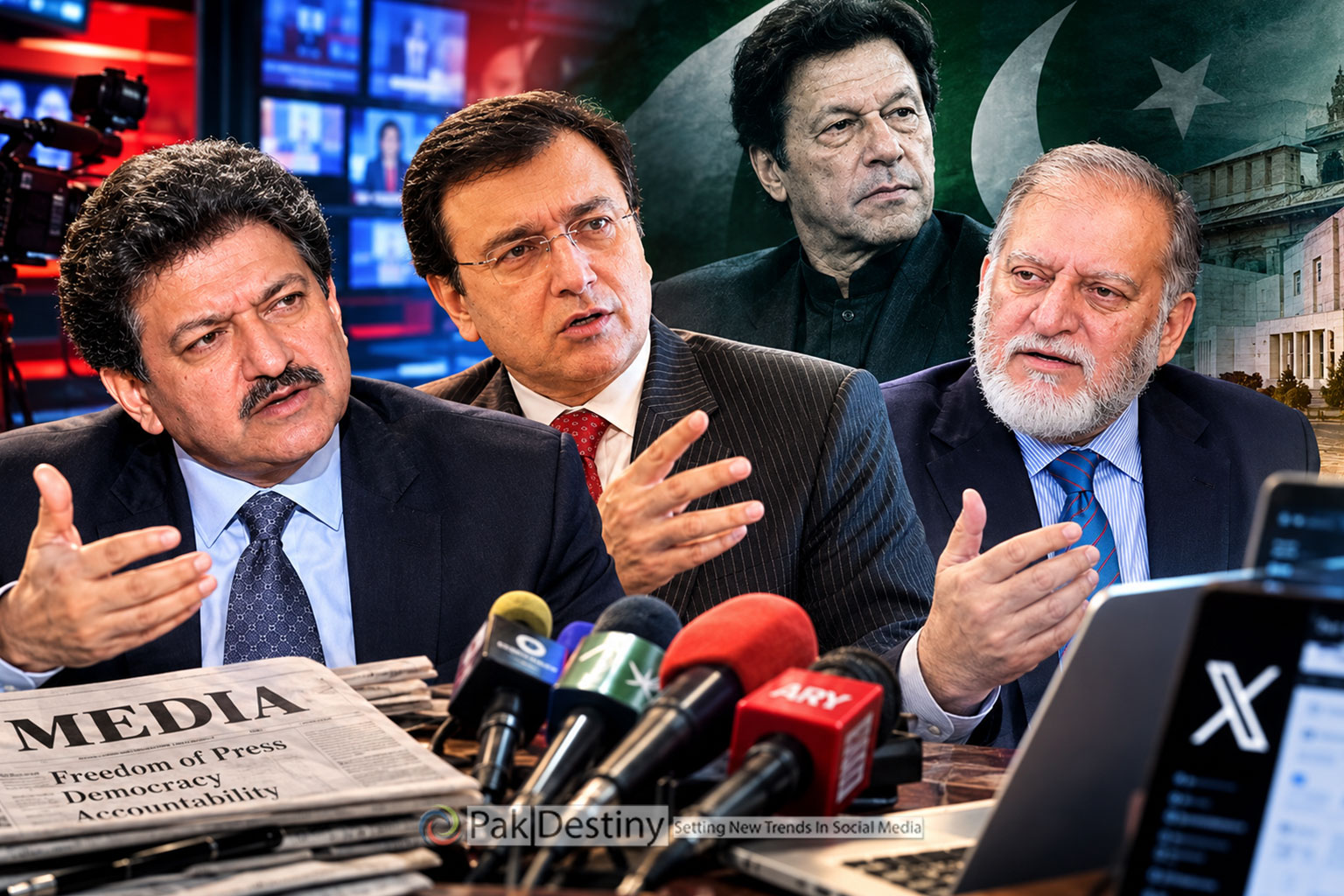
A bitter exchange between senior journalist Hamid Mir and commentator Moeed Pirzada, with YouTuber Orya Maqbool Jan joining the fray, has reignited a debate over journalistic independence, political loyalties and the media’s relationship with Pakistan’s powerful military establishment.
The row centres on a disputed meeting with former prime minister Imran Khan during his 2018-22 tenure, Mir’s allegations that Pirzada supported efforts to keep him off television, and competing accusations of selective criticism of those in power.
Mir alleged that Pirzada had approached the then director general of Inter-Services Public Relations (ISPR) after Mir opposed any move towards recognising Israel, urging that the journalist should never return to television. Pirzada categorically denied the allegation, saying he had never discussed Mir’s programme with any DG ISPR.
According to Pirzada, he had merely asked Khan whether Pakistan was closely watching the Abraham Accords, under which several Arab countries were normalising relations with Israel. He said Mir had strongly opposed any move to recognise Israel before Khan responded to the question.
The exchange quickly moved beyond the disputed meeting, with Pirzada challenging Mir to explain whether he had maintained the same level of criticism of the military establishment and the present government that he had directed at Khan’s administration.
He questioned Mir’s response to the killing of journalist Arshad Sharif, the November 2024 violence in Islamabad and subsequent political developments, accusing him of failing to sustain his earlier outspokenness.
Mir, in turn, defended his record, saying he had remained in Pakistan despite three assassination attempts and several cases he described as false. He accused Pirzada of benefiting from intelligence agencies and rejected the suggestion that his journalism was dictated by personal compulsions.
Pirzada also questioned whether Mir’s television programme had been shut down by the military or Khan’s government, while maintaining that taking programmes hosted by Mir, Talat Hussain and Rauf Klasra off air had been wrong.
Orya questions Mir’s defence
Jan entered the controversy by attacking Mir’s defence of interviewing Senator Faisal Vawda individually. Mir had reportedly compared the practice with interviewing Khan when he was a lone member of parliament.
Jan said the comparison undermined Khan’s political stature, arguing that Khan had been a national figure long before his party came to power. He cited several other political leaders who had headed parties with limited or no parliamentary representation but were nevertheless considered important enough to receive individual interviews.
Accusing Mir of failing to offer a convincing justification for interviewing Vawda, Jan argued that journalists should not diminish Khan’s standing to defend their editorial choices.
His intervention broadened the dispute from a personal confrontation into a question about the media’s power to confer visibility and political relevance on public figures.
A credibility test for the media
The three-way clash highlights a persistent fault line in Pakistan’s journalism: whether media practitioners apply the same standards of scrutiny to successive governments and the military establishment, regardless of their political preferences.
Mir’s allegations raise serious questions about possible interference in television programming, although Pirzada has denied the central charge. Pirzada’s counterattack challenges Mir to demonstrate consistency in his criticism of those in power, while Jan questions the editorial judgement behind the choice of interviewees.
The arguments also expose the danger of reducing journalism to a contest over who was more courageous under a particular government. Interviewing a politician does not necessarily imply support, just as criticising one administration does not automatically establish independence from another.
The real test is whether journalists hold power to account consistently, substantiate their allegations and subject political allies and opponents to the same scrutiny.
In a media environment marked by accusations of censorship, political pressure and selective outrage, the exchange is a reminder that credibility cannot rest on past reputation alone. It must be earned through evidence, consistency and independence from those who wield power.