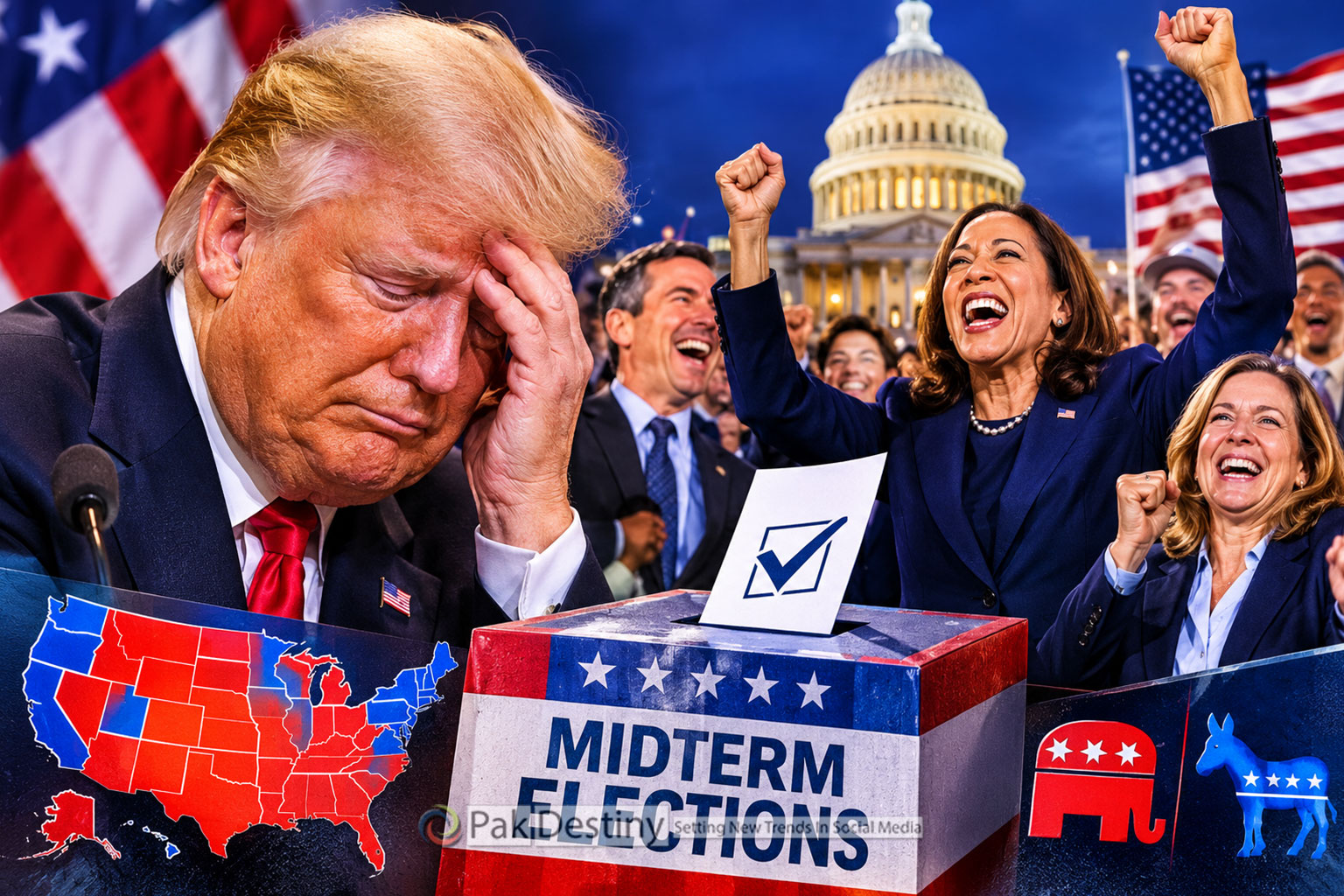
— Democrats seize control of both chambers of Congress in a stunning repudiation of Donald Trump, whose unpopular policies, economic mismanagement, controversial foreign policy and obsession with personal loyalty have alienated voters even in traditional Republican strongholds
— The drubbing exposes the political costs of turning the Republican Party into an extension of one man’s personality and ambitions.
By Zulqernain
US President Donald Trump had repeatedly urged Americans to treat the November 3 midterm elections as a referendum on his presidency. The American electorate appears to have taken him at his word — delivering a devastating verdict not only on his administration but also on the Republican Party he has spent nearly a decade reshaping in his own image.
In one of the most humiliating electoral setbacks for Republicans in modern American political history, Democrats have captured control of both the House of Representatives and the Senate, ending the Republican monopoly over Congress and handing Trump a formidable political obstacle during the remaining two years of his presidency.
The scale of the defeat is particularly damaging because it extends far beyond traditionally competitive constituencies. Democrats scored stunning victories in Republican strongholds, including Texas, South Carolina and Kansas, where their Senate victories had once appeared almost unthinkable.
Texas, long regarded as the backbone of Republican electoral strength, delivered perhaps the most symbolic blow. Democrat James Talarico defeated Trump’s preferred candidate, Ken Paxton, while Democrats also captured the governorship through Gina Hinojosa, ending decades of Republican dominance in statewide elections.
In South Carolina, another state comfortably carried by Trump in 2024, voters rejected his handpicked Senate candidate. Kansas, meanwhile, elected its first Democratic senator since 1932.
These results suggest that Trump’s political influence, once considered almost invincible within the Republican Party, has begun to encounter serious limits when tested against the broader electorate
According to the Associated Press voter poll, approximately three-quarters of voters were angry or dissatisfied with the country’s direction. Around six in 10 blamed Trump’s policies for higher prices, while voters under 30, Hispanic Americans and Black men showed significant movement towards Democrats.
The administration’s economic messaging also appeared increasingly disconnected from voters’ everyday experiences. Trump had promised to bring down prices and improve living standards, but persistent inflation, expensive fuel and the rising cost of groceries remained central concerns.
His tariff policies further unsettled businesses and consumers, while the military confrontation with Iran, which began in February, added to economic uncertainty and fuel costs.
Rather than concentrating on affordability and the concerns of ordinary Americans, Trump and Republican candidates repeatedly turned to cultural controversies and attacks on political opponents — an approach that appears to have failed to resonate with an electorate primarily concerned about its economic future.
Trump’s intervention in Republican primaries also came at a considerable cost.
In Texas, he backed Paxton over incumbent Senator John Cornyn, despite concerns within the party about Paxton’s political vulnerabilities. Democrats subsequently captured the seat.
In North Carolina, Trump’s preferred candidate, Michael Whatley, suffered defeat against Democrat Roy Cooper. His choices in South Carolina and Michigan also failed to deliver victories.
The results raise serious questions about whether Trump’s endorsement, once a powerful instrument in Republican primaries, has become a liability in general elections.
Republican critics have already pointed towards the president’s interference in candidate selection as a major reason for the losses. Some argue that established Republican candidates with stronger electoral credentials were sacrificed to accommodate Trump’s personal preferences.
For Democrats, the challenge will now be to translate their electoral success into an effective legislative agenda rather than allowing internal divisions between progressive and moderate factions to undermine their new congressional majority.
But the immediate message from American voters is unmistakable: Trump’s dominance of Republican politics does not necessarily translate into wider public support.
Having spent years demanding unquestioning loyalty from his party, the president now faces the prospect that the very political model he created has become one of its greatest electoral weaknesses.
The midterm elections have not ended Trump’s presidency, but they have delivered a serious blow to his political authority — and raised a fundamental question about whether the Republican Party can recover its independent political identity before the 2028 presidential race.