By Irum Saleem
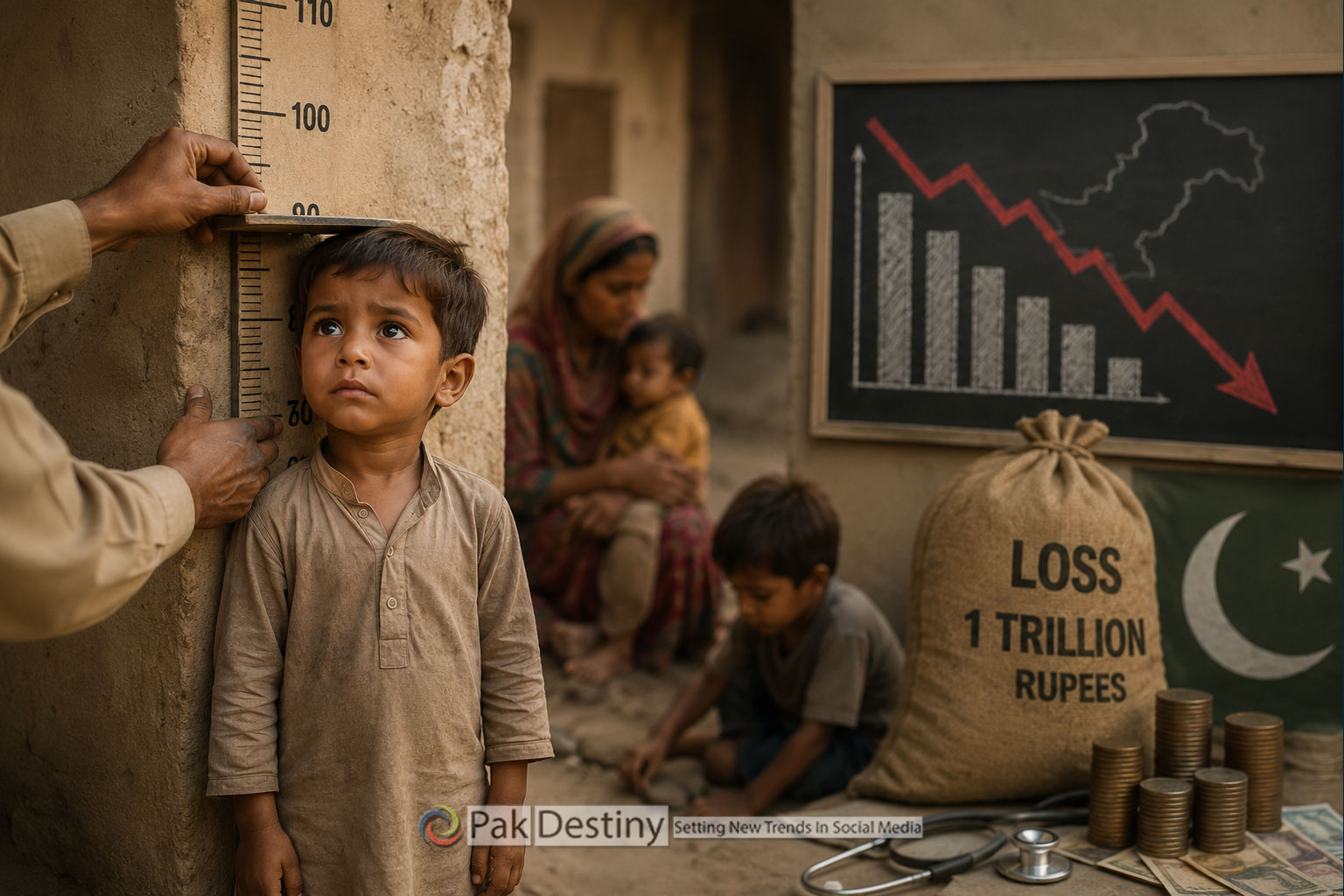
The country hopes its youthful population will power the next phase of economic growth. But with around four in 10 children under five stunted, Pakistan is compromising the productivity of its future workforce before millions of children even enter a classroom
Pakistan’s greatest economic asset is often said to be its young population.
It is a compelling argument. More than half of the country’s population is below the age of 30, creating the prospect of a large working-age population capable of driving consumption, investment and economic growth.
But there is an uncomfortable question beneath this demographic optimism: what happens when a large proportion of that future workforce reaches adulthood without achieving its full physical and cognitive potential?
For Pakistan, the warning begins in early childhood.
Around 40 per cent of children under five are stunted, placing millions of children at a disadvantage before they have even started school. Stunting is generally the result of chronic undernutrition and repeated infections, compounded by poor sanitation, unsafe water, inadequate healthcare and poor maternal nutrition.
It is therefore much more than a statistic in a public-health report.
It is an early warning about the quality of Pakistan’s future human capital.
The economic crisis begins before the economic life
The most striking feature of stunting is that its economic consequences emerge years after the causes.
A child who does not receive adequate nutrition during pregnancy and the first years of life may experience impaired physical and cognitive development. That child may subsequently struggle to learn, perform poorly at school, acquire fewer skills and eventually enter the labour market with lower productivity.
By the time the economic consequence becomes visible — a worker earning less or producing less — the original opportunity to prevent the loss may have disappeared decades earlier.
This makes stunting one of Pakistan’s most unusual economic problems: the bill arrives long after the spending decision.
Governments facing fiscal constraints understandably focus on immediate pressures — debt servicing, energy subsidies, infrastructure, salaries and emergency relief.
Nutrition, maternal health and early-childhood development can appear less urgent because their benefits are not immediately visible.
But that logic comes at a price.
The money saved today can translate into lost earnings, lower productivity and higher social expenditure tomorrow.
The first 1,000 days
The battle against stunting is largely won or lost during the period beginning with pregnancy and extending through a child’s first two years.
Poor nutrition of the mother can affect the unborn child. After birth, inadequate breastfeeding and complementary feeding, repeated diarrhoea and other infections, unsafe water and poor sanitation can compound the problem.
This is why stunting cannot be treated simply as a shortage of food.
A child may live in a household where enough calories are available but still suffer from deficiencies, infections or an unhealthy environment that prevent normal growth and development.
The issue therefore reaches deep into Pakistan’s health, education, water, sanitation and poverty policies.
A worker’s productivity can be shaped in the womb
This is where the stunting crisis becomes particularly relevant to Pakistan’s economic ambitions.
The country wants to move towards higher-value exports, technology, modern agriculture, manufacturing and a knowledge-based economy.
All of these require a workforce that is healthy, educated and skilled.
But human capital is cumulative.
A child who enters school developmentally disadvantaged is starting the race behind other children. If that disadvantage translates into weaker learning, it can affect educational attainment. Poor education can then mean fewer skills and lower earnings.
The result is a chain stretching across decades:
poor maternal and child nutrition → impaired development → weaker learning → lower skills → reduced productivity → lower income.
That chain is not inevitable for every stunted child, but at population scale it represents a formidable drag on economic potential.
The World Bank has estimated that Pakistan’s human-capital weaknesses leave a child born today able to achieve only around 41pc of the productivity potential they could attain with complete education and full health.
That should be viewed not simply as a development statistic but as an economic warning.
The cost compounds across generations
Perhaps the most damaging feature of the crisis is its ability to reproduce itself.
A poorly nourished girl can grow into a mother whose own nutritional and health disadvantages may increase the risks faced by her children.
Lower education and income can further constrain a family’s ability to provide adequate nutrition, healthcare and learning opportunities.
Thus, poverty and malnutrition can reinforce one another across generations.
The cycle can look deceptively simple:
a disadvantaged child becomes a disadvantaged adult, who then raises another disadvantaged child.
Breaking that cycle requires intervention before it becomes entrenched.
Pakistan cannot educate its way out of a nutrition crisis
Pakistan has rightly placed considerable emphasis on education, skills and youth employment.
But education cannot fully compensate for developmental damage accumulated during the earliest years of life.
Building universities while underinvesting in maternal nutrition, primary healthcare, sanitation and early childhood development is akin to strengthening the upper floors of a building while neglecting its foundation.
The same applies to vocational training.
A country cannot expect technical education alone to transform its demographic profile if millions of young people arrive at adulthood with years of accumulated disadvantages.
The demographic dividend must be built, not merely inherited.
The spending paradox
Pakistan’s public spending reveals another contradiction.
The country repeatedly speaks about human capital and the demographic dividend, yet expenditure on the basic foundations of human capital remains extremely constrained.
Education spending has fallen to exceptionally low levels, while health spending also remains below what is required to address the scale of the country’s needs.
The result is a policy paradox: Pakistan wants a more productive workforce while investing insufficiently in the years when productivity potential is being formed.
There is also a political paradox.
A new motorway can be inaugurated and photographed. A new building can carry a plaque. A nutrition intervention that prevents a child from becoming stunted may produce no visible political dividend for years.
Yet economically, the latter may be just as important — and potentially more valuable.
What should Pakistan do?
The answer does not lie in one mega-project or one ministry.
Pakistan needs a coordinated early-childhood strategy that treats nutrition as part of economic policy.
That means improving maternal nutrition and antenatal care; promoting breastfeeding and appropriate complementary feeding; expanding access to clean drinking water and sanitation; controlling childhood infections; strengthening primary healthcare; improving girls’ education and delaying early marriage; and ensuring that poor families have adequate social protection.
Most importantly, programmes need to reach children before the damage becomes irreversible or difficult to reverse.
The first years of life should be treated as an economic investment rather than a welfare expense.
A demographic dividend — or demographic debt?
Pakistan stands at an important demographic crossroads.
Its youthful population could become an enormous economic advantage. Millions of young people entering productive employment could expand the tax base, increase savings, stimulate entrepreneurship and drive growth.
But a demographic dividend does not arrive automatically simply because a country has many young people.
Young people must be healthy enough to work, educated enough to compete and skilled enough to produce.
Otherwise, today’s demographic opportunity can become tomorrow’s fiscal and social burden.
That is why Pakistan’s stunting crisis deserves to be discussed alongside GDP growth, exports, debt and investment.
The country is not merely losing height in childhood.
It risks losing productivity, earnings and economic potential over an entire lifetime.
And unlike an economic downturn, this loss cannot simply be reversed with a stimulus package.
The real question
Pakistan’s debate about economic growth is usually framed around what the government should do to create jobs for today’s young people.
It should also ask a more fundamental question:
What must Pakistan do today to ensure that the children who will become tomorrow’s workers are capable of doing those jobs?
Because the country’s economic future is being determined long before those children receive their first salary.
It is being shaped in the womb, in the first 1,000 days of life, in the quality of their nutrition, in the water they drink, in the healthcare they receive and in the environment in which they grow.
Pakistan’s youth may indeed be its greatest economic asset.
But unless the country invests in the child before it invests in the worker, that asset could remain permanently undervalued.