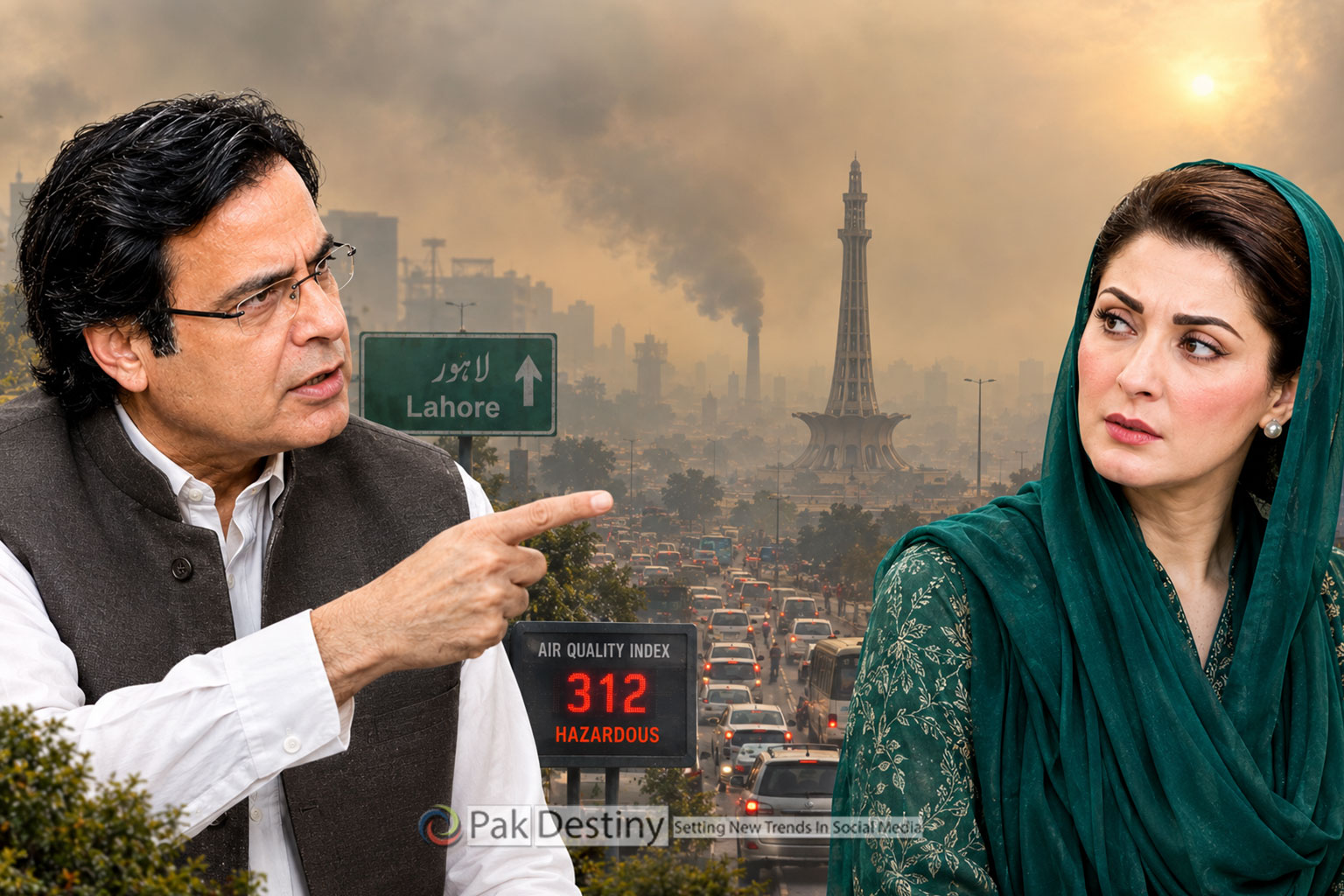
— PTI leader Moonis Elahi lambasts Maryam Nawaz government over its anti-smog campaign, alleging billions were spent on water cannons, smog towers, drones and an Environment Force while hazardous air pollution continues to haunt Lahore
By Irum Saleem
Lahore’s worsening air quality has given fresh ammunition to the opposition, with PTI senior leader and former federal minister Moonis Elahi launching a sharp attack on the Punjab government’s much-publicised campaign to make the province “smog-free”.
In a post on X, Mr Elahi criticised the Maryam Nawaz administration for what he described as a failure to tackle the province’s persistent air-pollution crisis, saying Lahore had once again emerged as the world’s most polluted city.
“Lahore is once again the world’s most polluted city,” he said, linking the situation to the government’s “Smog-Free Punjab” claims.
He accused the provincial administration of spending billions of rupees on highly publicised measures, including water cannons, smog towers, drones and the Environment Force, but claimed that these interventions had failed to produce a meaningful improvement in air quality.
“Showy water cannons, failed smog towers, drones, and a useless Environment Force—billions squandered—result: zero,” Mr Elahi said, adding that people were still being forced to breathe polluted air.
His criticism comes as the Punjab government has placed considerable emphasis on combating smog through enforcement drives, surveillance, anti-pollution measures and the use of technology.
The administration has also projected its anti-smog campaign as a major environmental initiative aimed at protecting citizens from hazardous air.
However, the recurring deterioration in Lahore’s air quality has raised questions about whether short-term enforcement operations and highly visible interventions are sufficient to address a problem rooted in multiple sources of emissions.
The city’s pollution crisis is driven by a combination of factors, including vehicle emissions, industrial activity, construction dust, waste burning and seasonal weather conditions that can trap pollutants close to the ground.
Pollution from crop-residue burning in adjoining agricultural areas has also historically contributed to winter smog episodes.
The opposition has increasingly used the issue to challenge the Punjab government’s environmental governance, arguing that public announcements and expensive equipment cannot substitute for sustained action against major sources of pollution.
Moonis Elahi’s remarks also put the government’s “Smog-Free Punjab” narrative under political pressure. His central argument was that the visible deployment of anti-smog equipment has not translated into cleaner air for ordinary citizens.
The Punjab government, however, has maintained that it is taking unprecedented measures to control pollution and has expanded monitoring and enforcement mechanisms.
Officials have also linked improved air quality to action against polluting industries, vehicles and other emission sources.
The debate highlights a broader challenge facing Lahore: whether the province can move from seasonal anti-smog campaigns to a long-term strategy capable of reducing pollution at its source.
For residents, the measure of success is ultimately not the number of drones deployed, towers installed or enforcement teams established, but whether the air they breathe becomes measurably cleaner.
As Lahore again struggles with polluted air, the political battle over Punjab’s environmental record is likely to intensify, with the government’s promise of a “smog-free” province facing increasing scrutiny from the opposition and the public.