By Irum Saleem
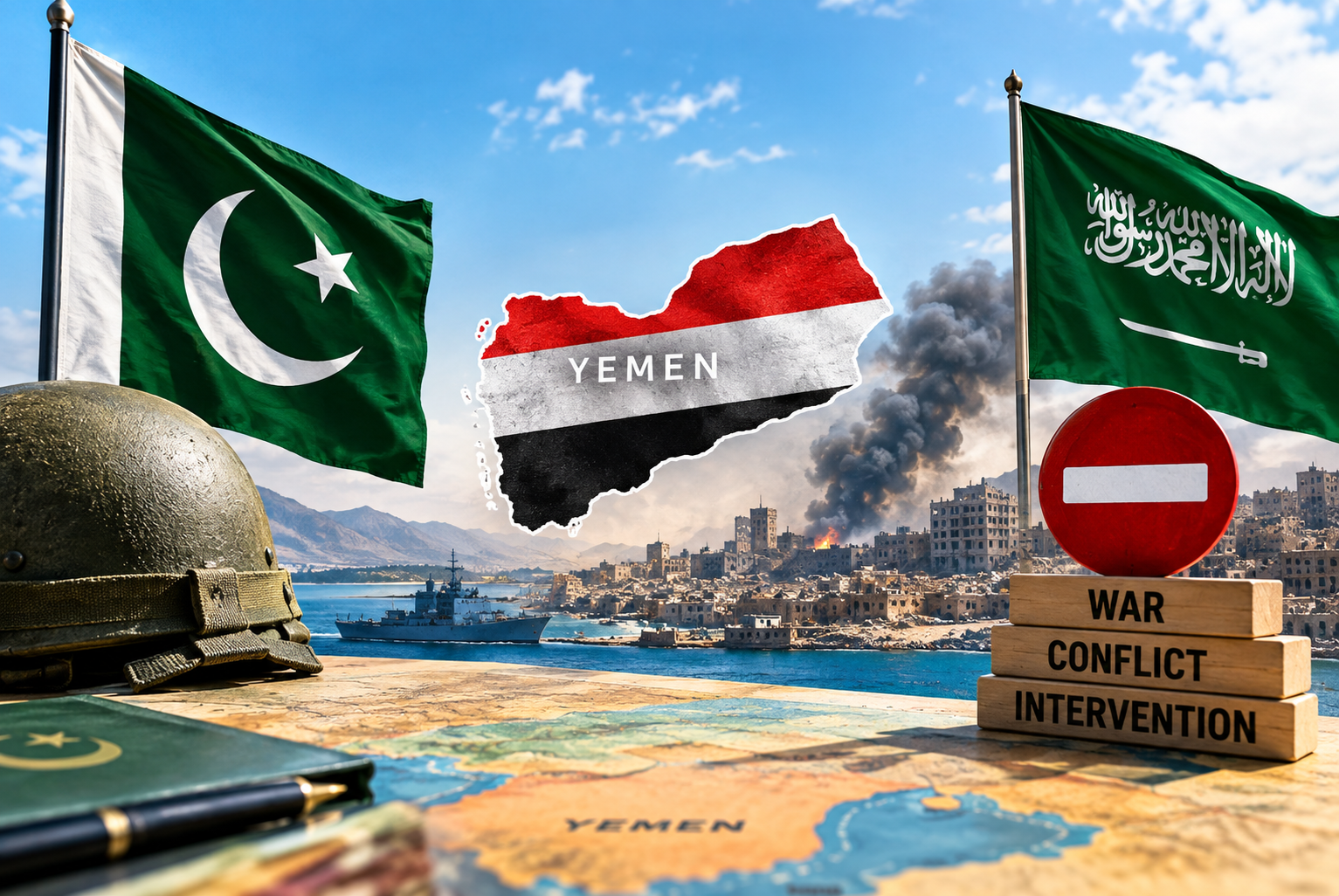
INTENSE fighting between Yemen’s Saudi-backed government and the Iran-aligned Houthi Ansarallah movement threatens to reopen one of the region’s most devastating conflicts, with potentially serious consequences not only for Yemen but also for the wider Gulf and the strategically vital Red Sea corridor.
The escalation is particularly alarming because the Yemeni front had remained relatively quiet since the Saudi-Houthi ceasefire of 2022. The latest hostilities suggest that the fragile calm that followed years of devastating warfare may be coming apart.
The Houthis, who control the capital Sanaa and large parts of northern and western Yemen, remain the most powerful military force in the country. Their control of territory along the Red Sea coast, as well as key islands and strategic positions, gives them considerable leverage over maritime traffic through the Bab al-Mandeb strait — one of the world’s most important maritime chokepoints.
The group maintains that commercial maritime traffic is allowed to pass, while excluding Saudi vessels. Any sustained escalation in the area, however, could put shipping and regional energy supplies at risk and further internationalise the Yemeni conflict.
The renewed fighting also cannot be viewed in isolation from the wider confrontation between the United States and Iran. The Houthis have long been regarded as part of Tehran’s regional network of allied armed groups, although the nature and extent of Iranian support for the movement has been the subject of considerable debate.
For Saudi Arabia, the renewed conflict presents a particularly difficult challenge.
Riyadh has spent years trying to extricate itself from the costly Yemen war. The intervention led by Saudi Arabia in 2015 was intended to push back the Houthi takeover and restore the internationally recognised government, but the conflict instead developed into a prolonged and destructive war that inflicted enormous suffering on Yemen’s civilian population.
The 2022 truce reduced the intensity of the conflict and opened the way for diplomatic efforts. A return to large-scale hostilities would therefore represent a major setback to those efforts.
More importantly for Pakistan, the escalation comes at a sensitive moment in its relations with Saudi Arabia.
Islamabad and Riyadh have recently upgraded their defence relationship, increasing speculation about whether Pakistan could eventually face pressure to provide military assistance if the confrontation between Saudi Arabia and the Houthis intensifies.
Pakistan’s response so far deserves recognition for its restraint.
The Foreign Office has reiterated Pakistan’s “unwavering support” for Saudi Arabia while making clear that Islamabad has no plans to participate in Saudi military strikes against the Houthis. It has also stressed Pakistan’s desire for peace and stability in Yemen.
This is the right approach.
Pakistan’s security relationship with Saudi Arabia does not automatically require Islamabad to participate in offensive military operations in another country.
The distinction is crucial.
Pakistan can stand by Saudi Arabia’s territorial security and sovereignty without becoming a combatant in Yemen’s internal conflict. In fact, entering the war would carry considerable strategic, diplomatic and security risks for Islamabad.
The country has bitter experience of the consequences of becoming entangled in conflicts elsewhere in the Muslim world. Pakistan must therefore be extremely cautious about allowing bilateral defence commitments to evolve into an obligation to participate in offensive operations outside Saudi territory.
The Makkah Joint Defence Agreement with Saudi Arabia and Turkiye further underscores the importance of carefully defining the scope of Pakistan’s defence commitments. Any agreement designed to strengthen collective security should not be interpreted as a blank cheque for participation in every military confrontation involving one of the signatories.
For Pakistan, there are also obvious domestic considerations.
The country has longstanding relations with both Saudi Arabia and other Gulf states, while maintaining a complex relationship with Iran, with which it shares a border. Islamabad cannot afford to be pulled into a Saudi-Iranian confrontation that could have repercussions far beyond Yemen.
A military role in Yemen could also expose Pakistani personnel to Houthi retaliation, potentially including attacks on Saudi targets where Pakistani forces or assets might be deployed.
It could complicate Pakistan’s already delicate relations with Tehran and create additional security concerns along the Pakistan-Iran border.
There is also the wider regional dimension.
The Bab al-Mandeb is a critical gateway between the Red Sea and the Gulf of Aden. Any prolonged disruption could affect global shipping, insurance costs, energy prices and supply chains. A widening conflict involving Saudi Arabia, the Houthis, Iran and potentially other regional actors could rapidly transform the Yemeni battlefield into another theatre of a much broader Middle Eastern confrontation.
Such an outcome would serve neither Pakistan nor the Yemeni people.
The humanitarian consequences must not be forgotten amid the geopolitical calculations.
Yemen has already endured years of war, displacement, economic collapse and humanitarian suffering. Millions of Yemenis have paid the price for a conflict driven by competing domestic, regional and international interests. Renewed warfare risks reversing whatever limited humanitarian and economic gains were achieved during the period of relative calm.
The international community should therefore focus on preventing Yemen from becoming another battlefield in the expanding US-Iran confrontation.
Saudi Arabia, for its part, has a strong interest in preventing a return to the kind of prolonged war that followed its 2015 intervention. Military escalation may offer short-term tactical gains but is unlikely to provide a durable political settlement to Yemen’s underlying crisis.
The Houthis, too, must recognise that military control over large parts of Yemen cannot provide a sustainable solution to the country’s political crisis.
Ultimately, Yemen needs a political settlement that accommodates the country’s competing political and regional interests rather than another cycle of retaliation.
Pakistan can play a constructive role here.
Instead of joining offensive operations, Islamabad should use its close ties with Riyadh and its geographical and diplomatic relationship with Iran to advocate restraint and dialogue. It should push for an immediate ceasefire, protection of civilians and the reopening of a credible political process aimed at resolving Yemen’s conflict.
Pakistan’s measured response is therefore not a sign of weakness or indifference towards Saudi Arabia. On the contrary, it reflects an understanding of its own strategic interests.
Islamabad should continue to support Saudi Arabia’s right to defend its territory while making clear that support for Saudi security does not mean participation in an offensive war in Yemen.
At a time when the Middle East is already dangerously close to a wider regional conflagration, Pakistan should resist pressure to become another party to the conflict.
The wisest course is clear: stand with Saudi Arabia diplomatically, stay out of offensive operations, and use Pakistan’s diplomatic space to push the parties towards an immediate ceasefire and a negotiated settlement in Yemen.