— Gold’s global power: Top 10 bullion-holding nations weather price swings
— As global gold prices fluctuate amid geopolitical tensions and shifting economic policies, countries with the world’s largest bullion reserves are reinforcing their financial security, highlighting gold’s enduring role as a strategic asset in uncertain times
By Irum Saleem
Sharp fluctuations in global gold prices over the past few months have once again drawn attention to the strategic importance of gold reserves held by central banks, with the world’s largest economies continuing to rely on the precious metal as a safeguard against financial and geopolitical uncertainty.
Gold has remained one of the safest investment assets during periods of inflation, currency volatility and international conflict. Although prices have witnessed periodic declines due to easing geopolitical tensions, a stronger US dollar and changing expectations over US interest rates, analysts say the long-term outlook remains favourable as central banks continue to accumulate bullion.
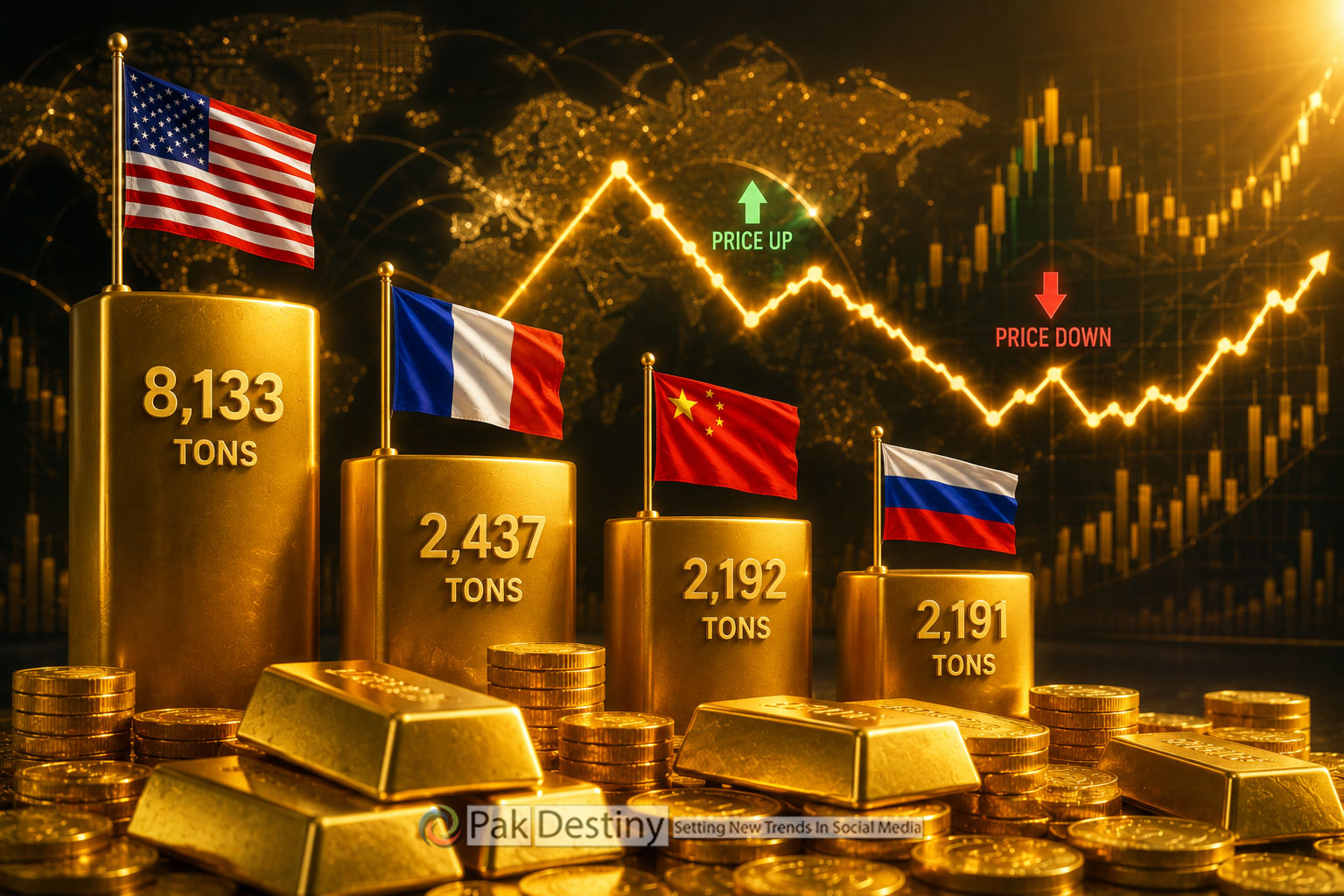
According to the latest available international data, the United States remains the world’s largest holder of gold reserves with about 8,133 tonnes, accounting for nearly three-quarters of its foreign reserves.
It is followed by Germany with around 3,352 tonnes, while Italy ranks third with approximately 2,452 tonnes. France holds about 2,437 tonnes, narrowly behind Italy.
Russia, which has steadily expanded its reserves over the past decade to reduce dependence on the US dollar, possesses around 2,336 tonnes of gold. China, despite being the world’s largest gold producer, officially reports reserves of roughly 2,290 tonnes, although analysts believe Beijing continues to increase its holdings.
Among other leading holders, Switzerland has about 1,040 tonnes, India approximately 880 tonnes, Japan around 846 tonnes, and Turkey nearly 630 tonnes, completing the list of the world’s top 10 official gold reserve holders.
The renewed interest in gold comes as the metal has experienced significant price volatility this year. Gold surged to record highs above $3,500 per ounce earlier amid heightened tensions in the Middle East, persistent global inflation concerns and heavy buying by central banks.
However, prices later retreated as diplomatic efforts reduced immediate geopolitical risks, the US dollar strengthened and investors reassessed the likelihood of interest rate cuts by the US Federal Reserve. Despite these corrections, gold has remained substantially higher than its levels a year ago.
Market analysts say gold prices are primarily influenced by several factors, including geopolitical conflicts, inflation expectations, central bank purchases, movements in the US dollar, interest rate decisions by the Federal Reserve and investor demand through exchange-traded funds.
Central banks worldwide have continued to diversify their foreign exchange reserves by increasing gold holdings, reflecting concerns over global economic uncertainty and financial market risks. The trend has reinforced gold’s role as a strategic reserve asset rather than merely a commodity.
Economists believe that while short-term price corrections are likely to continue in response to changing market sentiment, gold will remain an important hedge against inflation and geopolitical instability, ensuring that countries with substantial bullion reserves retain an additional layer of financial security.