By Zulqernain
For months, the question of Imran Khan’s health has been woven into Pakistan’s larger political confrontation — with his family demanding access, his party alleging restrictions and the authorities insisting that his treatment can be managed while he remains behind bars.
On Tuesday, the Supreme Court shifted the debate into a new phase.
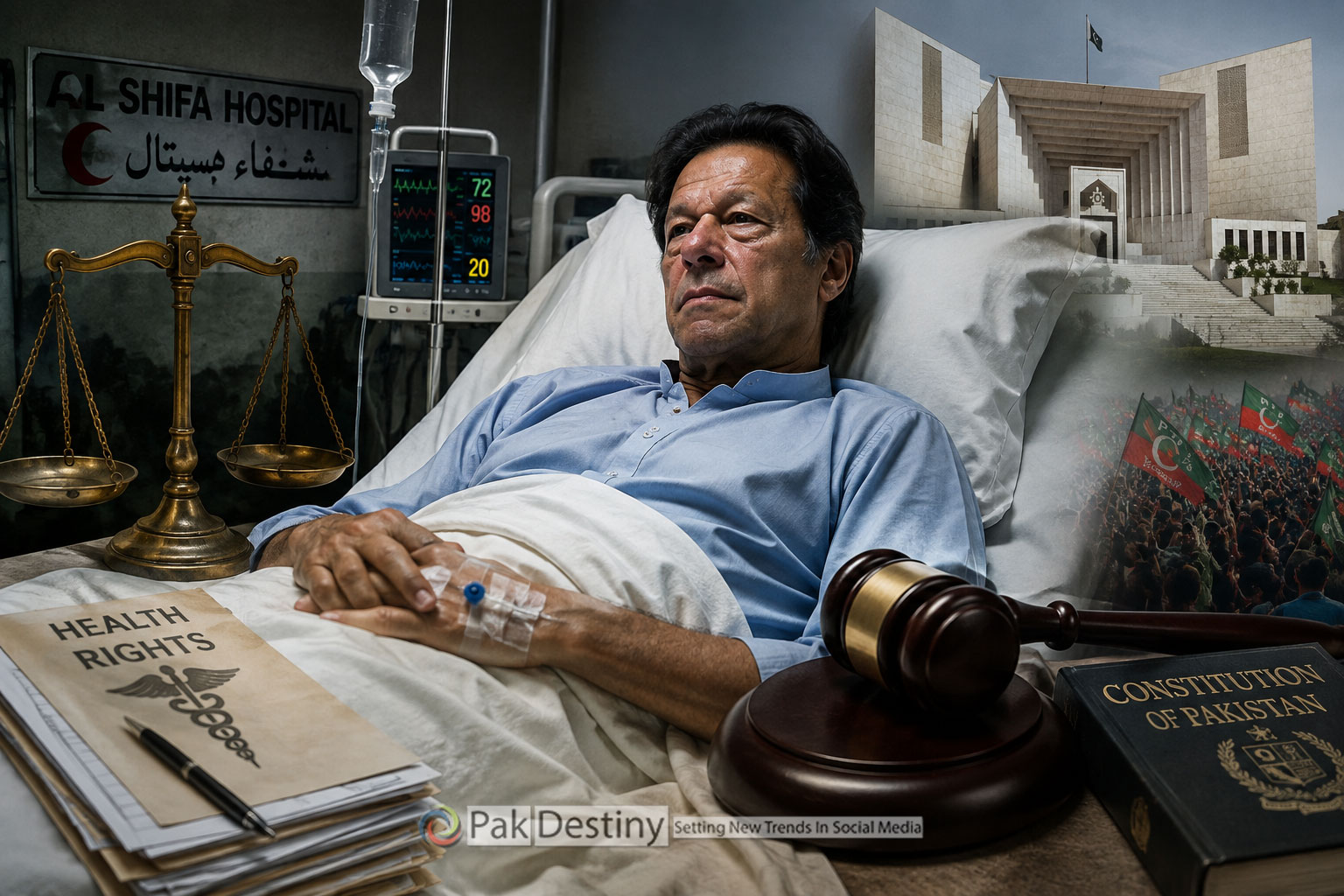
In a packed courtroom, the three-member bench headed by Justice Shahid Waheed ordered that the incarcerated former prime minister be moved to Shifa International Hospital in Islamabad within two days, turning what had largely been a political dispute over his health into a matter subject to direct judicial oversight.
The order was welcomed by the Pakistan Tehreek-i-Insaf, which has long argued that its founder should be examined and treated by doctors outside the prison system.
But the significance of the ruling goes beyond the hospital gate.
From jail cell to hospital ward
Mr Khan’s sisters — Aleema Khan, Noreen Niazi and Dr Uzma Khan — were in the courtroom as the case was heard. Khyber Pakhtunkhwa Chief Minister Sohail Afridi was also present, underlining the political weight attached to the proceedings.
The petitions before the Supreme Court sought more than a hospital transfer. Mr Khan, his sister Dr Uzma, Mashal Azam and PTI Secretary General Salman Akram Raja had asked the court to ensure access to his personal physicians, family members and lawyers, besides providing his family with his medical information.
The Supreme Court’s answer was to create a medical mechanism around him.
It directed the government, in coordination with Shifa International Hospital, to constitute a board comprising a physician, a general surgeon, an internal medicine specialist and an eye specialist.
That arrangement could allow the court to move the discussion away from competing political claims and towards an independent assessment of Mr Khan’s condition.
For the PTI, the hospital transfer represents an important breakthrough after repeated attempts to secure medical access for its founder. For the government and prison authorities, however, the order means that the handling of a high-profile prisoner’s health will now face closer scrutiny.
The case behind the case
There was another, less visible dimension to Tuesday’s proceedings.
The Supreme Court questioned an October 24, 2025 order of the Islamabad High Court concerning contempt proceedings against jail authorities. The apex court noted that the IHC had not recorded reasons for dropping the proceedings.
The Supreme Court said the failure to provide reasons appeared prima facie inconsistent with fair-trial requirements and principles of natural justice.
This observation could prove significant because the dispute is no longer confined to whether Mr Khan should be hospitalised. The conduct of the authorities responsible for his custody and their compliance with judicial directions has also entered the judicial spotlight.
The respondents have been ordered to submit written explanations and appear personally before the Supreme Court at the next hearing.
A family waiting outside the prison system
For Mr Khan’s family, Tuesday’s order represents a rare moment of judicial intervention after months of seeking greater access to him.
Yet Aleema Khan, who has frequently spoken publicly about her brother’s imprisonment, chose silence outside the courtroom.
She told reporters that she could not comment because of assurances given to the court that the petitioners would not speak to the media.
Her restraint was striking against the backdrop of the highly charged politics surrounding Mr Khan’s imprisonment.
PTI calls for calm
The PTI, meanwhile, celebrated the ruling but issued an unusual appeal to its own supporters: stay away from the hospital.
In a statement posted on X, the party urged workers not to gather outside Shifa International Hospital and asked them to respect the Supreme Court’s order.
The appeal reflects the sensitivity of the next few days. Any large gathering outside the hospital could transform a medical transfer into another political confrontation.
For now, the PTI appears keen to ensure that the court-ordered transfer proceeds without disruption.
More than a medical examination
Mr Khan’s imprisonment has remained one of the most contentious issues in Pakistan’s politics. Even from jail, he continues to shape the PTI’s political narrative, while successive legal proceedings concerning his conviction, custody, meetings and medical treatment have kept his case before the courts.
Tuesday’s ruling adds another layer.
The Supreme Court has not finally decided all the questions raised by the petitions. It has specifically left the question of their maintainability, as well as other objections from the respondents, for consideration at the next hearing.
The immediate instruction, however, is clear: Mr Khan is to be transferred to Shifa International Hospital and examined by a specialist medical board.
The coming days will therefore test not only the state’s willingness to implement the order but also the ability of all sides to keep a politically explosive issue within the boundaries of the judicial process.
For a former prime minister who has spent years at the centre of Pakistan’s fiercest political confrontation, the next chapter may begin not in a courtroom or at a political rally — but in a hospital room in Islamabad.
And this time, his health is being placed directly under the Supreme Court’s watch.
Thank you Supreme Court for ordering shifting of PM Imran Khan to hospital. Hopefully it will be implemented now.
— Moonis Elahi (@MoonisElahi) August 18, 2026
Supreme Court decision to allow @ImranKhanPTI to be transferred to hospital for proper medical treatment is a very good development. Govt should use this opportunity to reach out to PTI & bring political temperature down. This also means PTI long march may also come under review https://t.co/b6swnr7xyb
— Fahd Husain (@Fahdhusain) August 18, 2026
shameful how a former PM is being denied medical treatment even after a court has ordered it. Even more shameful, that leaders of both parties PMLN and PPP have spent the better part of their convictions in private hospitals, domestic and foreign.
— Meher Bokhari (@meherbokhari) August 18, 2026
Yet most shameful has been Law…
سپریم کورٹ کی طرف سے عمران خان کو اسپتال منتقل کرنے کا فیصلہ صرف اور صرف میڈیکل رپورٹس کی بنیاد پر کیا گیا ہے اس فیصلے کا سیاست یا کسی سازش سے کوئی تعلق نہیں عمران خان کے دور حکومت میں ایسے ہی عدالتی فیصلوں سے نواز شریف اور شہباز شریف کو بھی ریلیف ملا تھا pic.twitter.com/QV4ODPPXtC
— Hamid Mir حامد میر (@HamidMirPAK) August 18, 2026
آواز دروں —•—
— Khawaja Saad Rafique (@KhSaad_Rafique) August 18, 2026
پی ٹی آئ کے قائد عمران خان کی الشفا ھسپتال منتقلی اور انکی
ھمشیرہ و ڈاکٹر کی ان سے ملاقات کا عدالتی فیصلہ خوش آئند ھے
اس فیصلے سے عدلیہ کا کھویا ھوا وقار بحال ھو گا ،
سچ یہ ھے کہ اس فیصلے سے میرے دل کا بوجھ کچھ کم ھوا ھے ۔۔ برسات کی حبس زدہ رُت میں یہ فیصلہ…