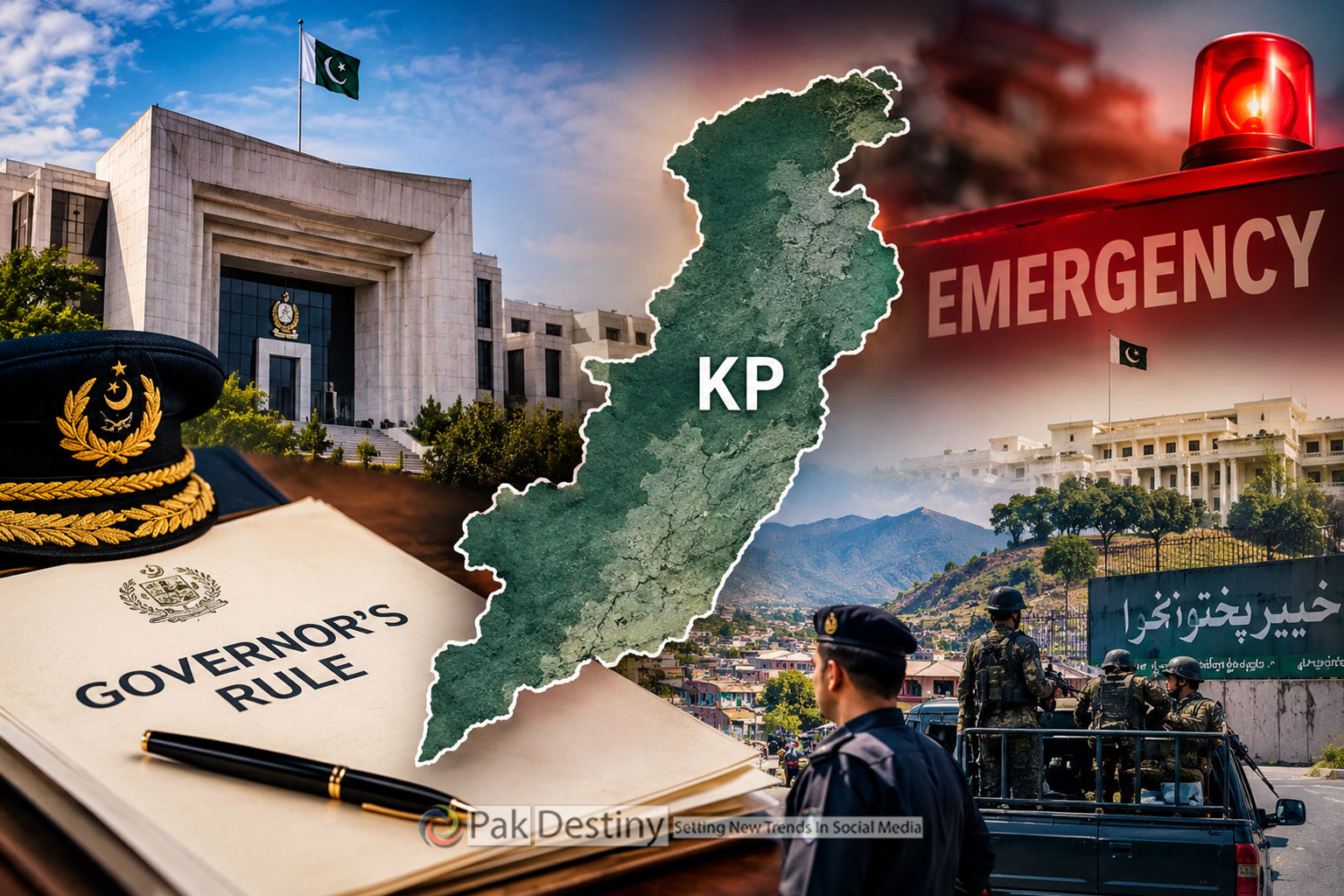
— Article 234 allows the centre to take over provincial executive functions, while Article 232 expands federal powers during an emergency without automatically dislodging the elected government
–Both measures carry constitutional limits, parliamentary checks and time restrictions.
By Irum Saleem
As tensions mount between the federal government and the PTI-led administration in Khyber Pakhtunkhwa over counterterrorism policy and worsening security, two constitutional provisions — Articles 232 and 234 — have come into focus, raising a fundamental question — how far can the centre go in asserting control over a province?
Though often discussed together, a state of emergency and governor’s rule are distinct constitutional measures with markedly different consequences for provincial governance.
One strengthens federal authority during an extraordinary situation; the other allows the provincial executive’s functions to be assumed by the centre or the governor.
Neither, however, gives the federal government an unrestricted mandate to override the provincial government.
Governor’s rule: Who runs the province?
Article 234 empowers the president to act when satisfied that a provincial government cannot be carried on in accordance with the Constitution. The president may assume the functions of the provincial government or direct the governor to exercise them.
The proclamation may also provide for the provincial assembly’s powers to be exercised by or under the authority of Parliament.
In effect, the chief minister and cabinet would no longer exercise the provincial executive powers assumed under the proclamation. The administration would function under the authority established by the constitutional arrangement.
But does governor’s rule automatically mean the provincial government is dissolved?
Lawyers cited by Dawn say the distinction is important.
Lawyer Mirza Moiz Baig questioned whether governor’s rule, by itself, brought the provincial government to an end, arguing that the government would resume its functions when the emergency arrangement expired.
حالات اس نہج پر پہنچ گئے ہیں کہ گجرات میں میرے والد اور میری تصاویر تک جعل سازی سے استعمال کی جا رہی ہیں۔ ہم کل بھی خان صاحب کے ساتھ تھے، آج بھی ہیں۔ اگر آپ کی سیاسی بے بسی اس حد تک پہنچ چکی ہے تو جعل سازی کے بجائے خان صاحب سے صلح کر لیں۔ https://t.co/1jlYUKRK5U
— Moonis Elahi (@MoonisElahi) October 11, 2026
“Once the proclamation expires, the Chief Minister and his Cabinet are restored,” lawyer Rida Hosain told Dawn.
Article 234 allows governor’s rule to remain in force initially for two months. Any extension requires approval through a resolution of a joint sitting of Parliament, with the total duration capped at six months.
The provision also places an explicit limit on the exercise of extraordinary powers: neither the president nor the governor can assume the powers vested in a high court or suspend its constitutional functioning.
Emergency: More federal power, elected government remains
Article 232 provides for the proclamation of an emergency in circumstances including war, external aggression or internal disturbance beyond the power of a provincial government to control.
Unlike governor’s rule, a state of emergency does not automatically remove the chief minister or suspend the provincial assembly. The provincial government continues to function, but its autonomy may be constrained by the additional powers available to the federation.
Lawyer Basil Nabi Malik told Dawn that the chief minister would remain in office during an emergency, although the federal government could assume certain functions under the constitutional framework.
The emergency provisions enable Parliament to legislate on matters that would ordinarily fall within provincial jurisdiction. Where a provincial law conflicts with a federal law validly enacted under these provisions, the federal law prevails to the extent of the inconsistency.
The president may also issue directions to a province regarding the exercise of its executive authority, while Parliament can confer powers and impose duties on federal authorities operating there.
These powers are not permanent. Laws enacted by Parliament that it would otherwise lack the constitutional authority to make cease to have effect six months after the emergency ends, subject to the Constitution’s provisions protecting actions already taken.
An emergency proclamation also lapses after two months unless approved by resolutions of both houses of Parliament in accordance with the prescribed constitutional procedure.
The constitutional test
For KP, the distinction is consequential.
Under Article 232, the elected provincial government remains in place, albeit under an expanded federal framework. Under Article 234, the centre can assume provincial executive functions, while Parliament may exercise the powers of the provincial assembly as provided by the proclamation.
The critical issue is not simply whether relations between Islamabad and Peshawar have deteriorated, but whether the constitutional conditions for invoking either provision have been met.
Security concerns and disagreements over counterterrorism policy may intensify pressure for federal intervention, but the choice of constitutional mechanism would determine the extent of that intervention, the position of the provincial government and the role of Parliament.
Both provisions are extraordinary constitutional instruments, not blank cheques for federal control.
Their invocation would have to be justified within the Constitution’s prescribed framework, with the duration and scope of the measures subject to the relevant constitutional safeguards.