— As Nawaz Sharif and Bilawal Bhutto-Zardari lead high-profile campaigns across Gilgit-Baltistan, PTI alleges systematic restrictions on its electioneering, raising questions about the credibility and competitiveness of the June 7 vote
By Zulqernain
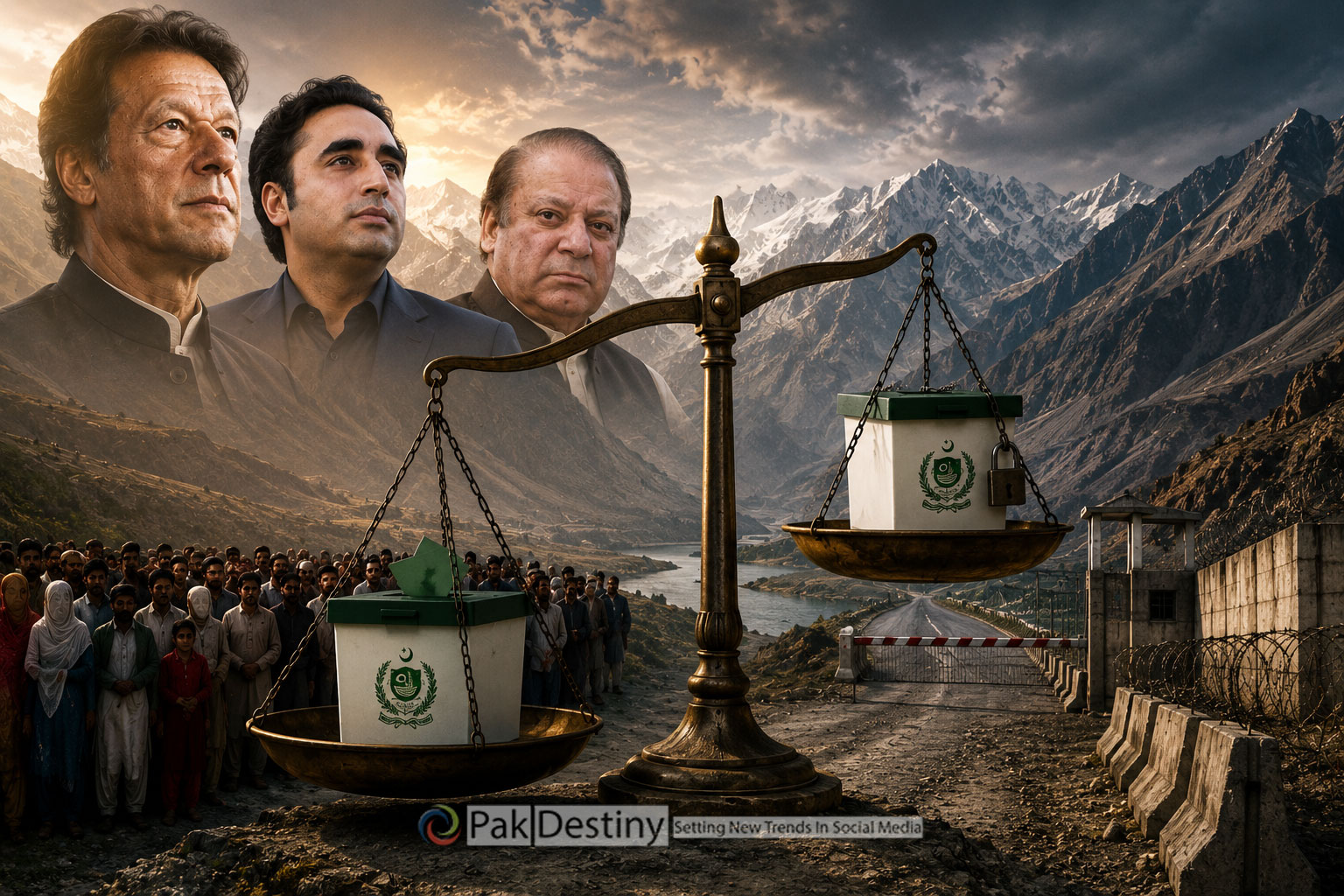
As Gilgit-Baltistan heads towards general elections on June 7, the political landscape appears increasingly shaped by an uneven contest, with the country’s two major ruling parties conducting extensive campaigns while Pakistan Tehreek-e-Insaf (PTI) claims it is being systematically prevented from reaching voters.
The latest controversy erupted on Tuesday when PTI Secretary General Salman Akram Raja and senior party leaders Shaukat Basra, Naeem Panjutha and Zaheer Babar alleged that they were stopped by police in Diamer district and escorted out of the region while attempting to campaign for party candidates.
The incident has intensified a debate that has been simmering throughout the election season: whether Gilgit-Baltistan’s voters are being presented with a genuinely competitive political choice or a contest in which one major stakeholder is operating under severe restrictions.
آج مجھے شوکت بسرا، نعیم پنجوتھہ اور ظہیر بابر کو گلگت بلتستان داخل ہوتے ہی جل تھانہ کی حدود میں آگے جانے سے روک دیا گیا۔ میرا نام ڈی آیس پی کے پاس درج تھا۔ ہمیں اور آئی ایس ایف کے آئے دوستوں کو پولیس کی گاڑیوں کے نرغے میں صوبہ بدر کر دیا گیا ہے۔ عمران خان اور آزادی _ قوم کا فیصلہ pic.twitter.com/CDSXrcr1Gd
— salman akram raja (@salmanAraja) June 2, 2026
The allegations come against the backdrop of a highly visible campaign by Pakistan Muslim League-Nawaz (PML-N) President Nawaz Sharif and Pakistan Peoples Party (PPP) Chairman Bilawal Bhutto-Zardari, both of whom travelled to Gilgit this week to address public gatherings and rally support for their respective parties.
Their participation has transformed the election into a significant national political contest despite Gilgit-Baltistan’s unique constitutional status.
At a rally in Gilgit, Nawaz Sharif sought to reconnect with voters after a prolonged absence from the mountainous region. Highlighting what he described as decades of underdevelopment, he promised to engage Prime Minister Shehbaz Sharif on infrastructure expansion, including upgrading Gilgit Airport to accommodate larger commercial aircraft.
Bilawal Bhutto-Zardari, meanwhile, framed his campaign around constitutional rights and governance reforms, reiterating the PPP’s longstanding position that Gilgit-Baltistan residents should enjoy protections comparable to those available under the 18th Constitutional Amendment in Pakistan’s provinces.
For both parties, the elections carry significance beyond the region’s 24-member assembly. Gilgit-Baltistan has historically mirrored political trends in Islamabad, with local governments often emerging in alignment with the party ruling at the centre. Political observers note that both the PML-N and PPP view the polls as an opportunity to consolidate influence in a strategically important region bordering China, India and Afghanistan.
PTI, however, argues that the contest is unfolding under circumstances that undermine democratic competition.
The party points to a series of incidents involving senior leaders who were either denied access to the region or removed from it during the campaign period. Former National Assembly speaker Asad Qaiser reportedly faced travel restrictions, while PTI leader Junaid Akbar was earlier expelled from the territory over alleged violations of the election code of conduct.
According to PTI officials, the latest expulsion of Salman Akram Raja and his colleagues demonstrates a pattern of administrative actions aimed at limiting the party’s electoral outreach.
The party has also alleged that local workers and members of the Insaf Student Federation who gathered to welcome visiting leaders were detained by authorities.
Government officials and election authorities have largely justified restrictions by citing security concerns and election regulations.
However, the absence of detailed public explanations has allowed opposition parties to portray the measures as politically motivated.
The dispute inevitably revives memories of the February 8, 2024 general elections, when PTI repeatedly complained of administrative hurdles, restrictions on campaigning and limitations on political activity. The party now argues that similar methods are being replicated in Gilgit-Baltistan.
Political analysts warn that perceptions can be as important as realities in determining electoral legitimacy.
Even if polling day proceeds smoothly, allegations that one major party was denied the same freedom to campaign as its rivals could cast a shadow over the outcome. In a region where voter participation has traditionally been viewed as an expression of democratic engagement despite constitutional ambiguities, concerns over fairness carry particular significance.
The issue is further complicated by PTI’s continued popularity among sections of Gilgit-Baltistan’s electorate.
The party secured a sweeping victory in the 2020 elections when it was in power at the federal level. Whether that support remains intact after nearly two years of political turmoil is one of the central questions of the current campaign.
For the PML-N and PPP, a strong showing would strengthen their argument that voters are prioritising governance, development and constitutional reforms over national political narratives centred around PTI founder Imran Khan.
For PTI, however, the challenge extends beyond winning seats. The party is attempting to convince voters that it remains a viable political force despite organisational constraints and administrative pressures.
As election day approaches, the focus is shifting from campaign promises to the integrity of the process itself. The presence of top leaders from the ruling coalition has injected energy into the race, but allegations of selective restrictions have also raised concerns about whether all contestants are operating on equal footing.
The June 7 polls will therefore serve as more than a test of political popularity. They will also be viewed as a measure of how competitive and inclusive the democratic process remains in a region whose constitutional future and political identity continue to evolve.
An Uneven Contest?
As Nawaz and Bilawal campaign freely across Gilgit-Baltistan, PTI alleges systematic barriers to electioneering
The Battle for Gilgit-Baltistan
High-profile rallies, constitutional promises and PTI’s exclusion claims dominate the final stretch of campaigning
Questions over political freedoms emerge as Gilgit-Baltistan heads towards a crucial electoral test on June 7.