By Rana Farooq Ashraf
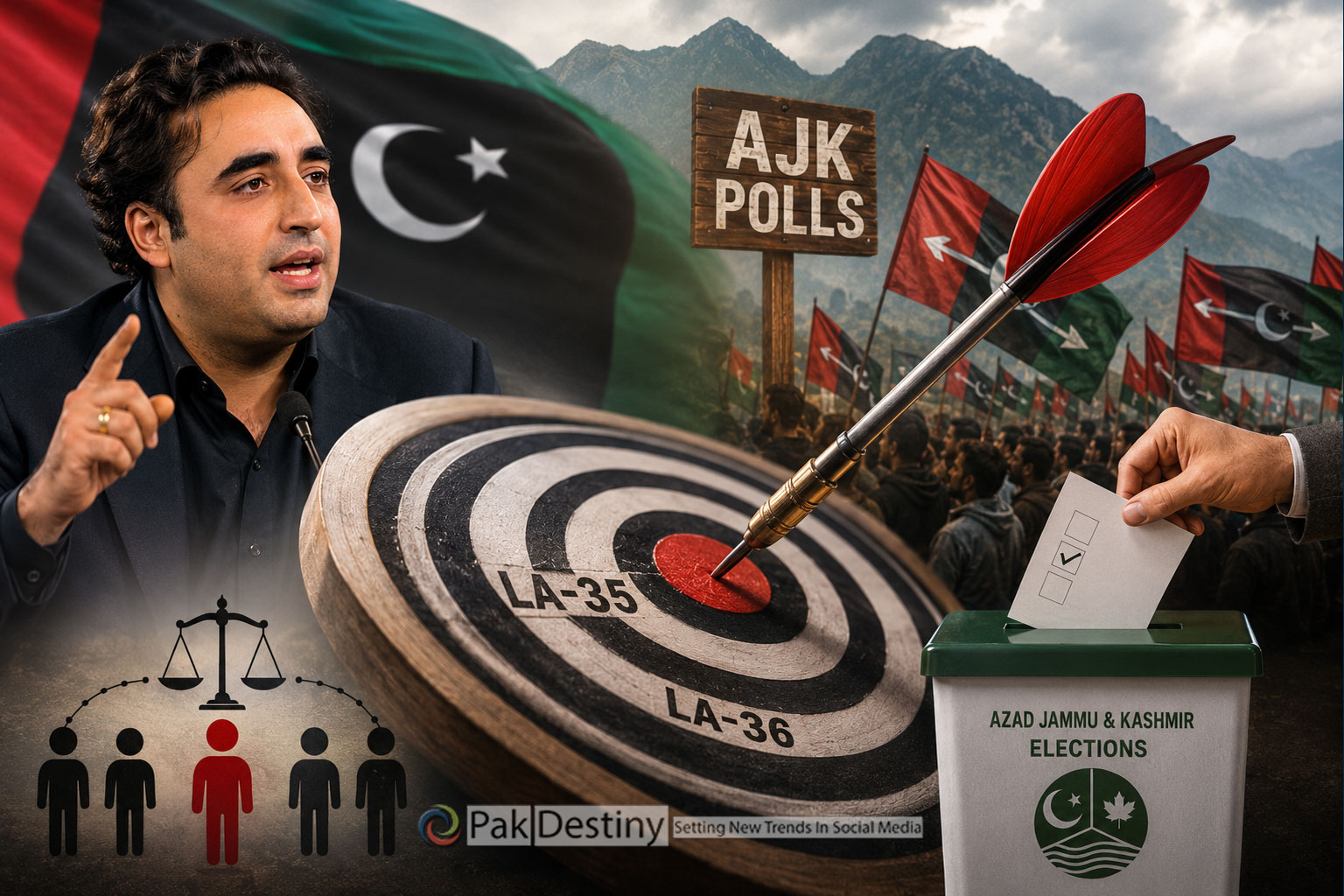
The upcoming Azad Jammu and Kashmir elections have brought two Pakistan Peoples Party candidates from Sialkot district into the electoral arena. Ahsan Ismail Gujjar is contesting from LA-36, while Asif Gujjar is contesting from LA-35 on the PPP ticket. For LA-35, the party leadership, under the guidance of Ms Faryal Talpur, awarded the ticket to Asif Gujjar after consultation with the Kashmir Election Committee, making him the party’s officially nominated candidate.
Both candidates carry the same electoral symbol. Both contest under the flag of the same political party. Both are candidates of the Pakistan Peoples Party and both ultimately represent the political leadership of Chairman Bilawal Bhutto Zardari.
Yet the campaign on the ground has raised a fundamental question:
If the arrow belongs to both candidates, why does the organisational strength appear to be concentrated around only one?
This is not merely a question being asked by workers in LA-35. It is a question that deserves the attention of everyone who believes that a political party must treat its candidates fairly and mobilise its organisational structure without discrimination.
Once a political party awards a ticket to a candidate, that candidate becomes the party’s official representative in the constituency. The party’s organisational machinery, therefore, has a responsibility to support that candidate. If the party’s organisational resources, office-bearers and political leadership are visibly more active in one constituency than another, questions about organisational impartiality are bound to arise.
LA-35 is neither a small nor a politically insignificant constituency. Geographically, it covers a wide area, including Daska tehsil and Daska city, Sambrial tehsil and Sambrial city, as well as Pasrur tehsil and Pasrur city in Sialkot district. It also includes areas linked to Gujranwala district, including Nowshera Virkan, Gujranwala, Kamoke and Gujranwala city, besides parts of Hafizabad and Pindi Bhattian.
According to local political estimates, the constituency includes approximately 20,000 refugee votes in Pasrur, around 6,500 in Daska and nearly 7,500 in Sambrial, while the Gujranwala component is also estimated to account for around 30,000 votes. These figures underline the geographical and electoral importance of LA-35 and the need for a comprehensive organisational campaign.
The central question, therefore, is simple: Is the PPP candidate in LA-35 receiving the organisational support that a formally nominated party candidate deserves?
The political picture on the ground, however, appears to suggest otherwise.
The LA-36 campaign is widely perceived to have the support of the party’s organisational structure at multiple levels, including the Punjab leadership, divisional leadership, the Sialkot district organisation, local tehsil organisations, the PLF president, and other office-bearers.
There is nothing objectionable about the party working actively for LA-36. The real question is: Why is the same level of organisational commitment not equally visible in LA-35?
Is a party ticket merely a formal document, or does it also carry with it the right to receive organisational support?
Is Asif Gujjar not a PPP candidate?
Is LA-35 not a PPP constituency?
Is the electoral symbol there any different?
Or has an informal political preference emerged within the organisation, whereby one candidate is being actively supported while the other is being left to fight largely on his own?
These are serious questions, and the party leadership should address them before the election results provide their own answer.
The role of the PLF president is particularly noteworthy. His own electoral constituency falls within LA-35, where Asif Gujjar is contesting on the PPP ticket. Yet his visible involvement in Asif Gujjar’s campaign or meetings has reportedly been limited, while his activities in LA-36 appear considerably more prominent. This raises a legitimate question: why is a senior party office-bearer’s political focus more visible in LA-36 than in LA-35, and should not both party candidates receive equal organisational attention?
Similarly, the role of PPP Sialkot District President Azhar Diyal raises questions about organisational balance. A district president is expected to maintain impartiality across the district and ensure that the party’s organisational machinery works for all officially nominated candidates. If the district organisation is fully visible in one constituency while its presence is barely felt in another, the party’s workers are entitled to ask whether the district structure is functioning with equal commitment across the board.
The same concern applies to the Pasrur and Sambrial organisations. If these areas fall within LA-35, their primary responsibility should be to mobilise workers and voters for the party’s candidate in that constituency. If significant organisational manpower is instead being deployed elsewhere, then the workers of LA-35 have every right to ask: Who is their organisation working for?
The situation in Daska is also significant. If the Daska tehsil and city organisations are actively supporting Asif Gujjar, then any attempt to pressure them, divert their workers towards another constituency or undermine their campaign would be deeply counterproductive. Political organisations are meant to unite workers around the party’s candidates, not create divisions among them.
If reports that LA-35 workers are being encouraged to engage in LA-36, or that their activities are being questioned or undermined, are accurate, then this is not simply an internal disagreement. Such a situation could directly affect the party’s own electoral interests.
The fundamental question, therefore, remains:
Has the party effectively created a situation in which one candidate is being positioned to win while the other is merely being asked to contest?
If that is not the case, then why is organisational support not equally visible in both constituencies?
If both candidates are officially representing the PPP, why are the doors of the party leadership not equally open to both?
And if both candidates carry the same arrow symbol, why does the organisational bow appear to be aimed in only one direction?
This is not merely Asif Gujjar’s question. It is the question of every party worker who has invested time, energy and political commitment in the PPP.
The role of Punjab President Raja Pervez Ashraf and Governor Punjab Sardar Saleem Haider Khan is also relevant in this context. For a party candidate, the public appearance of senior leadership is not merely a ceremonial event. It sends a powerful message of confidence to workers and voters.
I, Rana Farooq Ashraf, made repeated efforts to invite Governor Punjab Sardar Saleem Haider Khan to LA-35 and preparations were made for a major political programme. The local leadership assured that a programme befitting the Governor would be organised, with strong participation by party workers and the potential to provide significant political mileage to the party candidate. However, despite the programme being scheduled twice, it was cancelled on both occasions. There was also an apparent lack of interest in the Governor’s participation in LA-35, while, according to local political circles, organisational pressure was a factor in the cancellation. If the visit of the Governor of Punjab to a constituency represented by an official PPP candidate is repeatedly prevented because of organisational pressure, then this is not merely the cancellation of an event; it raises a much larger question about organisational priorities and political fairness within the party.
Had the Governor visited LA-35 even once, addressed the workers and publicly stood alongside Asif Gujjar, it would have sent a clear message that the Pakistan Peoples Party stands behind all of its officially nominated candidates.
If senior leadership is willing to appear in one constituency but repeatedly fails to appear in another, workers will naturally ask questions.
The proposed programme was also to be organised through the efforts and personal resources of PPP PP-50 ticket-holder Rana Farooq Ashraf. Its cancellation, therefore, represented not merely a setback for one candidate but a missed opportunity for the party’s wider electoral campaign.
Rana Farooq Ashraf’s efforts to mobilise resources, political contacts and his team for Asif Gujjar were intended to strengthen the party candidate. Yet when a party ticket-holder is working to build support for an officially nominated candidate and the party’s senior leadership remains absent from that constituency, the situation deserves serious reflection.
Ultimately, the real verdict will come on August 2.
On that day, there will be no organisational speeches.
There will be no press statements.
There will be no political explanations.
There will only be the vote.
And the results will show how many votes were secured by the candidate who enjoyed the full weight of the organisational machinery, and how many were secured by the candidate who, despite limited organisational support, fought on the strength of his own efforts, local workers and his political team.
The most important questions may then be:
Who actually pulled the arrow?
For whom was the arrow pulled?
Who strengthened the arrow?
And ultimately:
Whose arrow was it?
If Asif Gujjar manages to secure a strong vote despite limited organisational support, the credit will inevitably go to his personal political struggle, the local workers and the team that stood by him. Conversely, if the candidate who received extensive organisational support fails to achieve the expected result, the party leadership will have to examine whether organisational titles, prominent names and reports prepared at the local level are enough to win elections.
They are not.
Elections are won through sustained grassroots work, direct engagement with voters, the confidence of workers and genuine political acceptance among the people.
The Pakistan Peoples Party leadership must decide whether it wishes to rely on reports from within the organisation or on the realities visible on the ground.
Because the workers are watching.
The voters are watching.
And eventually, the ballot box will record everything.
The contest between LA-35 and LA-36 is therefore not simply an electoral battle between two constituencies. It is also a test of organisational fairness, political impartiality and the ability of the party leadership to distinguish between internal reports and ground realities.
And when the votes are counted on August 2, the most revealing question may not simply be who won and who lost.
The real question may be:
The arrow that everyone claimed as their own—who actually pulled it?
And when the result came, whose arrow was it?