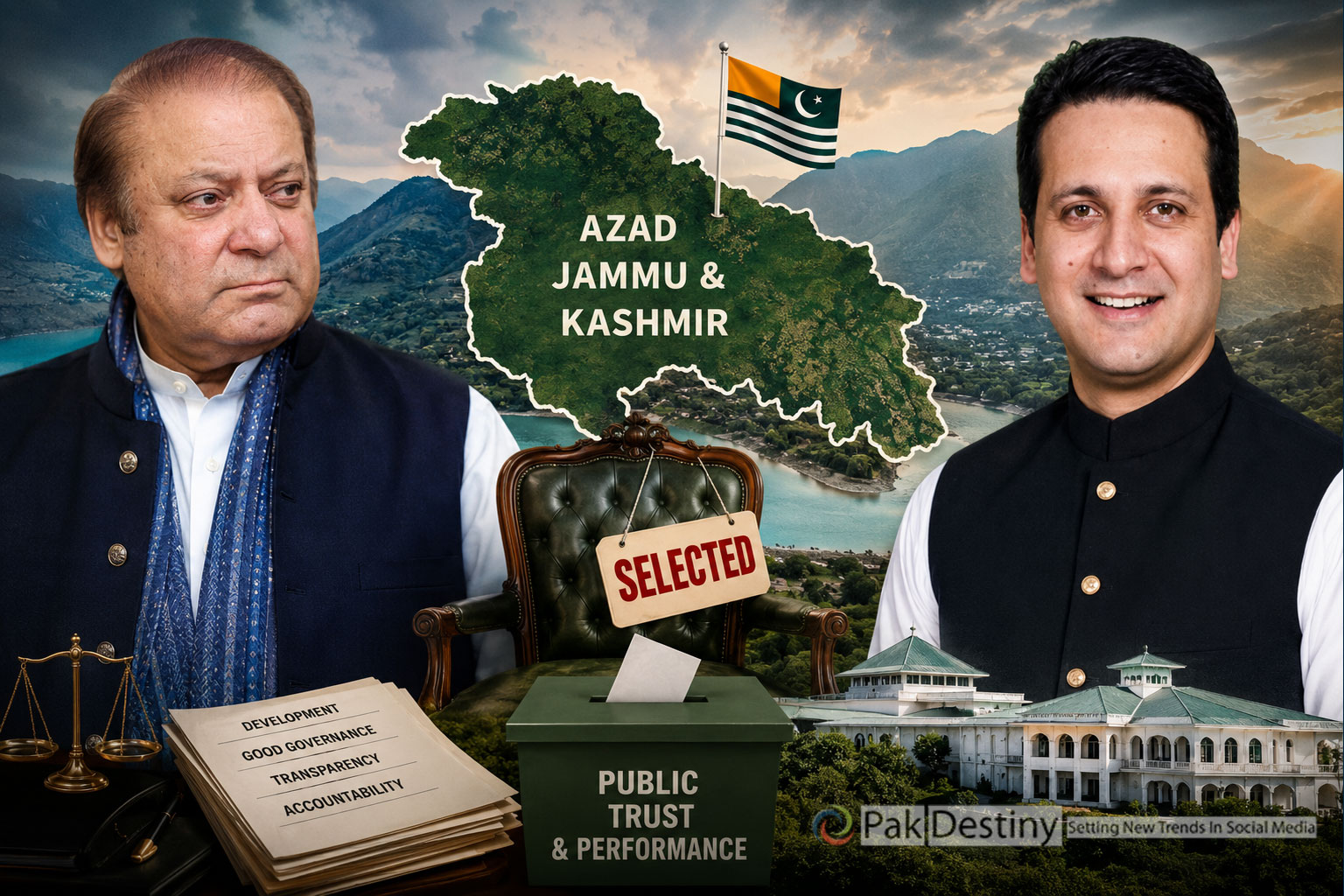
— PMLN AJK chides Nawaz Sharif for his selected decision
By Nazim Malik
The elevation of PML-N’s AJK leader to the office of prime minister marks a potentially significant generational shift in the politics of Azad Jammu and Kashmir, but the new premier inherits an administration burdened by an election whose credibility remains contested, internal divisions within his own party and a region badly in need of political stability.
The beginning of the new government may have been positive, but there is little doubt that the assignment ahead will be challenging. The new prime minister will remain under intense scrutiny — not only from opposition parties and a politically watchful public, but also from within his own party.
The recent AJK general election was conducted against a backdrop of controversy.
Allegations of electoral impropriety were raised repeatedly during and after the polling process, including by one of the PML-N’s important political allies at the federal level. Such allegations have inevitably cast a shadow over the legitimacy of the new political setup.
The AJK Election Commission’s decision to announce results after each phase of the electoral process also generated considerable debate.
Critics questioned the transparency of the arrangement and raised concerns about whether the process was sufficiently insulated from political influence.
The controversy did not end with the polling. Large-scale protests, some of them violent, disrupted the electoral process in several places.
The unrest exposed deep political and social tensions that the new government cannot afford to ignore. Unless these grievances are addressed through a credible political process, the protests could remain a source of instability for the new administration.
A divided house
Perhaps more difficult for the new prime minister is the fact that his own nomination was not universally welcomed within the PML-N’s AJK chapter.
Senior party figures, including AJK PML-N president Shah Ghulam Qadir and former prime minister Raja Farooq Haider, publicly resisted the decision.
Mr Qadir had been widely regarded as a leading contender for the top office, making the central leadership’s choice of a younger candidate particularly significant.
The episode revealed a fault line between the party’s established leadership in AJK and its central command. The decision ultimately appears to have been driven by a desire in the PML-N’s central leadership to introduce a younger face into the region’s politics rather than continue relying exclusively on the traditional party hierarchy.
That decision may eventually prove politically rewarding, but it also carries considerable risk.
A prime minister who begins his tenure with sections of his own party unhappy with his elevation will need considerable political skill to build consensus.
He will have to balance the expectations of the party leadership in Islamabad with the interests of its senior figures in AJK.
The question of the vote
The new premier also faces an awkward political contradiction highlighted by his critics.
He lost the Muzaffarabad-III constituency that he contested in the general election and subsequently entered the AJK Legislative Assembly through a reserved technocrat seat. His opponents have seized upon this fact to question the political mandate behind his elevation.
The criticism is particularly potent because the PML-N has itself repeatedly invoked the principle of respecting the vote in national politics.
Yet parliamentary politics does not necessarily require a prime minister to have won a general seat, and the constitutional mechanism allowing representation through reserved seats provides a legitimate route into the assembly. The political question, therefore, is less about legality and more about public perception.
For the new premier, the challenge will be to demonstrate that his government possesses a political mandate beyond the arithmetic that produced his election as leader of the house.
That will require performance.
Beyond party politics
The most important challenge, however, may lie outside the PML-N.
The new government must find a way to engage those political and social groups that resisted, protested or boycotted the electoral process. Their grievances cannot simply be dismissed as opposition politics.
AJK has historically been politically sensitive because of its constitutional position, its relationship with Pakistan and the wider Kashmir dispute. Political instability in the region therefore carries consequences beyond routine provincial or parliamentary politics.
The new administration will need to restore confidence in representative institutions while ensuring that dissent does not become synonymous with confrontation.
This could prove to be the defining test of the new premier.
A government that responds to criticism merely through administrative measures risks deepening alienation. Conversely, an effort to bring dissatisfied groups into a political dialogue could help create the stability necessary for the government to focus on governance.
Experience versus expectations
The new premier is not a newcomer to AJK politics. He has been involved in the region’s political affairs since at least 2010 and has previously served in the AJK cabinet.
That experience should give him an understanding of the region’s complicated political landscape. But serving in a cabinet and leading a government are fundamentally different responsibilities.
As prime minister, he will be required to manage competing political interests, maintain relations with the federal government, deal with an assertive opposition and address public expectations about development, employment, infrastructure and governance.
The public mood will also be an important factor. Political controversies can quickly overshadow the government’s performance, particularly in an environment where questions about the electoral process remain unresolved.
A generational gamble
The central PML-N leadership has effectively placed a political bet on youth and renewal over the old guard.
That may prove to be one of the more consequential decisions in AJK politics in recent years.
If the new premier succeeds in consolidating his party, opening channels with political opponents and delivering visible improvements in governance, his appointment could come to be viewed as the beginning of a new phase in AJK politics.
But if internal divisions deepen and electoral grievances remain unresolved, the decision could instead reinforce the argument that the change was primarily an exercise in political management from the centre.
For now, the new government has an opportunity to turn a controversial political transition into a period of stability.
The road ahead, however, will demand more than parliamentary numbers. It will require political reconciliation, institutional credibility and the ability to convince a sceptical public that the new administration represents more than a change of faces.
Mr Gillani’s experience in AJK politics may have prepared him for the complexities of the region. His performance as prime minister will determine whether that experience was sufficient.
The real test begins now.