— Govt-opposition talks stretch late into night as Oct 4 march remains key sticking point
By Irum Saleem
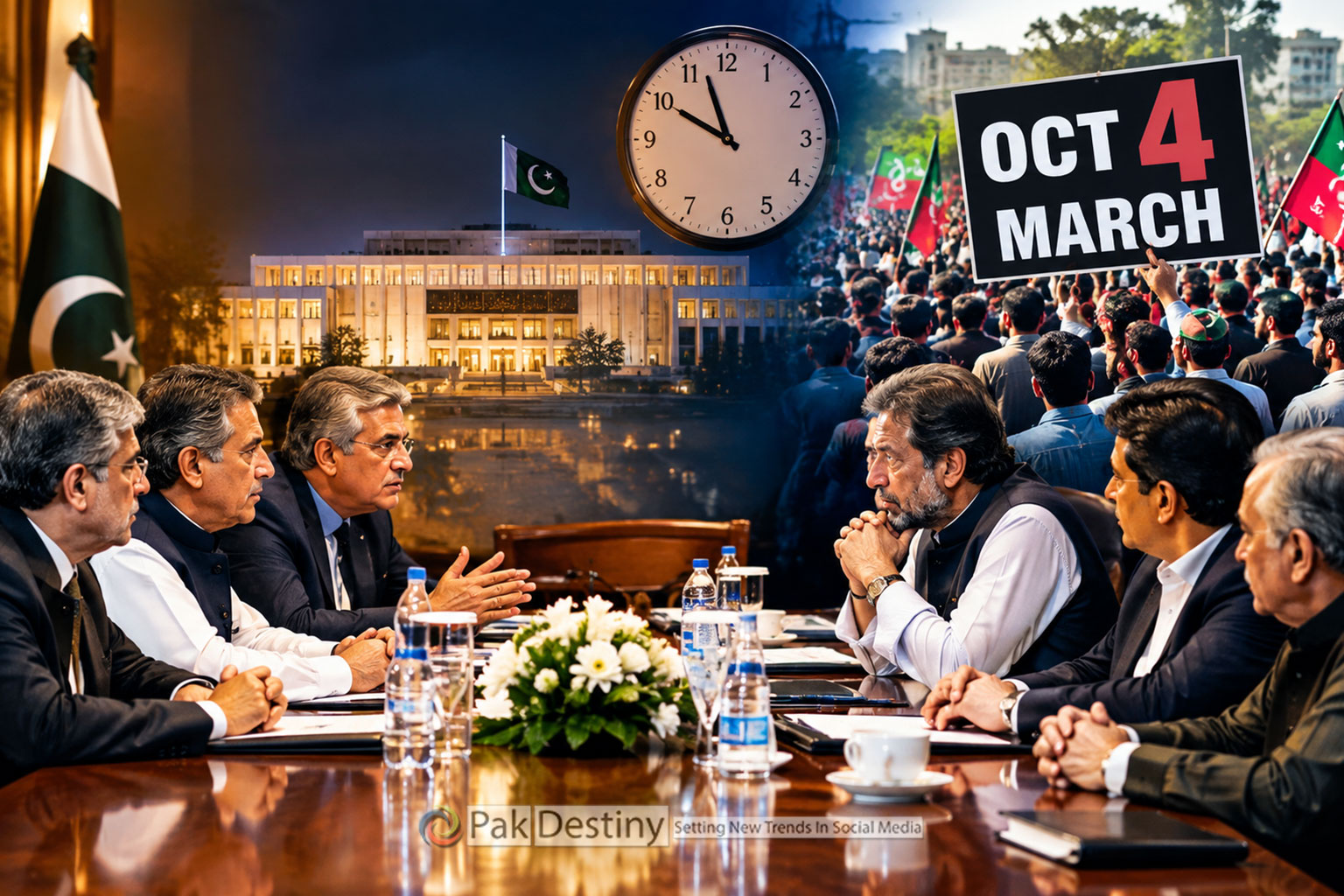
A second round of talks between the government and opposition stretched for more than four hours at Parliament House on Saturday night, with the PTI’s planned Oct 4 march on Islamabad remaining at the centre of discussions as both sides appeared reluctant to disclose details of the negotiations.
The meeting, chaired by National Assembly Speaker Ayaz Sadiq, began shortly before 5pm and continued late into the evening amid heightened political tensions over the PTI’s proposed march and the government’s concerns about law and order in the federal capital.
No formal announcement was made immediately after the meeting. Both sides appeared to have agreed to maintain confidentiality until the negotiations reached a conclusion.
Footage broadcast by DawnNewsTV after 9:30pm showed Interior Minister Mohsin Naqvi, who was part of the government delegation, leaving Parliament House carrying a document. Media reports suggested that he might consult President Asif Ali Zardari before returning to the talks.
More than an hour later, Mr Naqvi was seen returning to Parliament House. He did not respond to reporters’ questions as journalists surrounded him seeking information about the progress of the negotiations.
The prolonged meeting came a day after the government and PTI held their first formal round of talks in almost three years. The Friday meeting ended with both sides agreeing to continue the dialogue, although no breakthrough was announced.
According to sources cited in Dawn’s earlier report, the PTI has sought the shifting of its incarcerated founder Imran Khan to a hospital for medical treatment, while the government has pressed the opposition to call off its Oct 4 protest march towards Islamabad.
The government delegation included Interior Minister Naqvi, Minister for Kashmir Affairs Amir Muqam, Parliamentary Affairs Minister Tariq Fazal Chaudhry, Prime Minister’s Adviser on Political Affairs Rana Sanaullah and Minister of State for Interior Tallal Chaudhry.
The PPP was represented by Senator Sherry Rehman and MNAs Syed Naveed Qamar and Ejaz Hussain Jakhrani.
The opposition delegation comprised Senate Opposition Leader Allama Raja Nasir Abbas, PTI Chairman Barrister Gohar Ali Khan, Opposition Chief Whip Amir Dogar, Asad Qaiser, PTI Secretary General Salman Akram Raja and PTI Sindh President Haleem Adil Sheikh.
At the beginning of Saturday’s session, Speaker Sadiq expressed the hope that the talks would proceed in the same “cordial atmosphere” as Friday’s meeting.
The dialogue is being held against the backdrop of a rapidly approaching PTI protest deadline. The party had originally announced its march for Sept 27 but subsequently postponed it until Oct 4. PTI leaders have said the protest is aimed at securing the release of Imran Khan and seeking what they describe as constitutional and judicial reforms.
Afridi insists on Oct 4 march
While negotiations were under way in Islamabad, Khyber Pakhtunkhwa Chief Minister Sohail Afridi reiterated his determination to lead the PTI’s long march on Oct 4.
In a statement on Saturday, Mr Afridi said the march would begin from Gandi Chowk in Lakki Marwat at 1pm and described the proposed demonstration as a constitutional right to peaceful protest.
He said the PTI would continue its struggle until the supremacy of the Constitution and law was ensured and an independent judiciary restored.
The chief minister also said the party would neither allow a repeat of the events of May 9, 2023, nor allow anyone else to repeat them.
His comments, however, drew a response from Parliamentary Affairs Minister Tariq Fazal Chaudhry, who warned that statements of this nature could affect the ongoing negotiation process and urged PTI leaders to avoid rhetoric that might undermine the dialogue.
The PTI’s stated position is that its demands are constitutional and that the march will remain a political activity. PTI Chairman Gohar Ali Khan had earlier urged the federal government to respond through political engagement rather than constitutional measures against the Khyber Pakhtunkhwa government.
Security preparations
Meanwhile, preparations by the federal authorities for the possibility of a protest have continued.
According to reports, the deployment of Rangers in Islamabad and parts of Punjab has been extended until Oct 15, with the extension sought by the Islamabad chief commissioner and Punjab Home Department.
The government has also rejected reports that Islamabad’s roads had been completely closed, saying containers had been placed at certain points as a precautionary measure and in accordance with court directions.
The security preparations have added to the pressure on negotiators to find a political understanding before the march begins.
What happens if talks fail?
The immediate issue confronting the negotiators is whether they can find a formula that allows the PTI to modify, postpone or suspend its planned march while giving the party something tangible in return.
Several possible scenarios now appear to be on the table:
First, a negotiated pause in the march.
The two sides could reach an interim understanding under which the PTI postpones or modifies the Oct 4 mobilisation in return for progress on some of its immediate demands, potentially including arrangements concerning Imran Khan’s medical treatment and further political dialogue.
Second, continuation of the march alongside dialogue.
The PTI could decide to proceed with a political mobilisation while keeping the negotiating channel open. This would leave the government facing the challenge of managing the protest without allowing the confrontation to derail the talks.
Third, a late-night or last-minute compromise.
Given the extended duration of Saturday’s meeting and the apparent movement of senior government officials for consultations, the negotiators could continue discussions beyond the formal session in an effort to settle the outstanding points before Sunday.
Fourth, a breakdown in negotiations.
If the government maintains its demand for cancellation of the march and the PTI refuses to withdraw it, the disagreement could shift from the negotiating table to the streets, with security arrangements and possible restrictions becoming the immediate focus.
The political implications would extend beyond the march itself. The confrontation is already linked to tensions between the federal government and the PTI-led Khyber Pakhtunkhwa administration, including discussion of possible constitutional measures in the province.
PPP Chairman Bilawal Bhutto Zardari on Saturday called for political efforts to precede any such constitutional step, saying dialogue with the PTI should be pursued before measures such as governor’s rule or an emergency are considered.
For now, however, the immediate test is whether the government and opposition can bridge the gap over the Oct 4 march.
With the two sides having returned to the negotiating table for a second consecutive day after years of political confrontation, the extended meeting has kept open the possibility of a political understanding. But until an agreement is formally announced, the PTI’s march remains on its stated schedule and the government continues to prepare for the possibility of a major mobilisation in the capital.